Showing posts with label Katherine R Vasquez Tarazona. Show all posts

Saturday, 3 March 2012

Gayle Tzemach Lemmon: Women entrepreneurs, example not exception

Women aren’t micro--so why do they only get micro-loans? At TEDxWomen reporter Gayle Tzemach Lemmon argues that women running all types of firms-- from home businesses to major factories-- are the overlooked key to economic development. Reporter Gayle Tzemach Lemmon writes about women entrepreneurs around the world.


Contributed by Katherine R Vasquez Tarazona

Monday, 2 January 2012

The role of religion

Katherine R. Vasquez Tarazona

“(No matter what) never discuss politics, religion or any other upsetting matter on the table.” This is quite a popular saying in many cultures and it has its grounding. Politics and religion are topics that may bring the best and worse from us. Whatever argumentation, no one is ready to give an inch on their belief system. Yet, I have disappointed good manners many times. My huge craving for understanding and further knowledge has led the path to very impolite meals, which fortunately never ended on fights (of any kind). I guess, respect was the main ingredient served during those gatherings.

I have to warn you about the content of this post. I am aware I might raise controversy by discussing one of those forbidden topics. Nevertheless, just like in Economics and Law we discuss the role of the State in society; I believe that in society we must discuss the role of religion on their communities.

2011 left us with a bittersweet flavor on the mouth. True, I have been inspired, moved, and proud. Nonetheless, I have also been disgusted, sadden, and ashamed. One of the reasons for me to react with such strong and dark feelings has been originated in churches or under their names (do please note, I am not addressing one’s religion as such).

Back in November, I heard a lot about Aliaa Elmahdy (20). She’s Egyptian and a blogger. If the name does not tell you much, maybe you will remembered her better when I tell you she was the girl who decided to publish some nude self-portrait photos as a protest to her country’s regime. She calls herself an atheist and claims that the pictures she showed are her revolutionary way to change sexism in her country. Because of them, she has to face the Egyptian justice, yet to decide under which charges. I spent some time on one of her blogs. She is without any doubt very strong on her opinions and helps others, with similar struggles, to expose their voice. Whether you agree or not with her modus operandi, I am sure you concur with freedom of speech and respect. I read most of the menaces that she got and they are quite disturbing. I was even more surprised when I found out that she has been somehow rejected in Tahir square by the protesters, calling her and her boyfriend names and asking them to leave or separate because of their improper manners  (such as having her arm on his shoulder or sharing the same tent).

Shortly after the blogger’s photos went viral, a friend of mine wrote about her and proposed an interesting question: if Aliaa is an atheist why does she have to be judged under the sharia law? Being an attorney myself, I gave her my “legal” opinion about it but, as a community member, I would lie to you if I tell you I felt comfortable with it.

In early December, a report was given to the high-level advisory group in Saudi Arabia stating that allowing women to drive will encourage premarital sex and, therefore, threaten the country’s tradition of virgin brides. (Yes, there is a correlation there and yes, it is also escaping me). Manal al-Sharif (32) was arrested in May, after she posted on youtube a video of herself driving. She spent nine days in jail and was only freed when she agreed to quit the “Women2Drive” campaign (of which, she was a key organizer). On her pledge she said she voluntarily had decided to leave the cause and that she was in deep gratitude to the King for ordering her release. The campaign’s facebook page has not had any activity since June, 1st.

In even more unsettling news, I read that women with attractive eyes may now have to cover them up, if the resolution is passed in Saudi Arabia. The measure is due to prevent women to provoke men through their beautiful regards. Apparently, men lack of self control and it is the women obligation to prevent them from any improper thought. Saudi Arabia’s “committee for the promotion of virtue and the prevention of vice” deals with cases like this. At this point, I was certain I had heard it all but oh, I was wrong! Thanks to one of my dearest friend I came across the news of an Islamic cleric based in Europe “banning” women from touching vegetables or fruits that could have any sexual resemblance to male genitalia.

At last but not least, let me add to this list this statement: “Gay pride parades resemble KKK marches” –said by Cardinal Francis George, Archbishop of Chicago, USA. I might be losing my comparison’s skills. For those unfamiliar with the Ku Klux Clan, is enough to say that this was a radical movement born in the States in the 60’s and tried to defend white supremacy, “white-nationalism” and eradicate immigration through terror mechanisms. How does this resemble the gay pride parade? According to the Cardinal, the analogy was perfect because they both hate Catholic Church. I am not familiar with stats on the subject, if anyone has run them, but I am pretty sure that most of my homosexual friends are far from hating religion. In fact, their desire to get married is found on their catholic believes. I am sorry Cardinal; the resemblance is quite blurry to me.

Religion should not promote anger statements or reactions against those who do not share their views or believes. This is fundamental to me, may it be call tolerance or just common sense. In Israel, a little girl, Namaa (8), was called a prostitute and spit on by ultra-Orthodox men on her way to school just because her dress did not adhere exactly to their rigorous dress-code. Take a second to realize that a child was bullied, embarrassed and frighten by adult men on her way to school. How is it possible to defend such acts on the name of any religion?

Extremists usually say that women are treated poorly because of their transformation into sexual objects. I agree with that. It is both sad and frustrating to see how some women are portrayed as mere objects but I also found unbearable to observe how some [women] are emptied from all their rights and put under the obligation of taking care on men’s mind, preventing them from sin. In most common ultra conservative societies, women are exposed to harassment and dishonor in a greater proportion than in other.  When one of my friends moved to Cairo, she said she had to be very careful because men will grab her behind (without consent) anytime. When I went to Morocco, a bunch of guys were walking next to me asking me about the origins of my “pretty face”. Back at home, I cannot wear short pants and pretend not to hear men expressions about it. All of these are examples of sexism and have no correlation with religion, none. However, when religion leaders find their way through words to create those fictional links, people tend to defend them as their own and commit unspeakable acts, such as the ones that Namma went through.

Religion is very strong in some communities. They gather people with similar views of life and they defend those from others. I get that, and I respect it. I do not mind seeing someone with a veil (when it’s by their own choice) or with a cross on their hand[i]. It bothers me to see them attempt against human rights, in a passive-aggressive mode or just in a very aggressive way. How is anyone who asks for someone’s death any different from a terrorist or a murderer? Let me step back for a second here. I do not mean that anyone with a spiritual belief is on danger of becoming a hater nor to be brainwashed. I denote that a person, who is filled with anger and cannot respect a human being for what she/he is worth (life), should not use religion as a mean for rage transference. 

What is the role of religion in their communities? To my modest understanding, promote love and respect for life, in spite of one’s beliefs and ways of conduct. Easier said than done, yes; but trying is significant. Religion should not become a channel or a pillar to hinder humanity. If anything, it should be a bridge that brings together, equally, men and women. And maybe, with some luck religion will inspire understanding and serve as an open channel for communication. I have might gotten all it wrong, since I am not a very spiritual person myself; however, I think it is worth the debate.


[i]      I do not want to start the debate on some European legislation on the subject but I have it in mind while writing this sentence.

Monday, 19 December 2011

The Egyptian Protester

The protester’s life: frustration, despair, and human rights violations

2011 Time’s person of the year is the protester. From its birth in Tunisia, revolution has set the pace for change in the Arab world, in the United States (where the occupy movement gains strength), in Russia (where locals complain about fraudulent elections), and now it is back in Egypt.
Since November 18th, Egyptians are back to the streets chanting for more than hope. They crave for structural change. Their frustration and despair has originated a moving association where people get to speak up and condemn the abuse of those in dominance. The citizens accused the SCAF of suffering from power poisoning. Despite its continuous denial, the junta is finally showing its truth face, in the form of human rights violations.
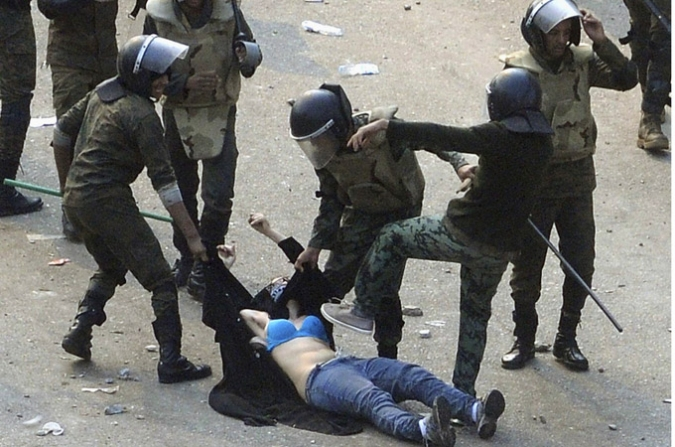
The following image has gone viral on internet for the past hours:


On this picture, a woman (protester) is been stripped and beaten up by the military forces. Probably, your reaction to it is similar to mine; you may find yourself torn, sad, ashamed, disgusted, and helpless. Not to judge, humanity is showing a terrifying facade. According to the tweets and comments I get from friends living in Cairo, this is the first time that the army is reacting this violently. (Let’s keep in mind that the SCAF was the people’s ally on the end of the Mubarak’s era.)  
2011 is a year filled up on adversity and crossroads; yet, it allows revolution and with it, possibility, and inspiration. Early this month I wrote that I was unclear about Egypt’s road after the elections, although I found it would be fascinating, passionate, and hopeful. I could have not foreseen it would also be this sad and horrifying. Yesterday, Aljazera posted a video showing soldiers shooting directly to protesters in order to “clean up” the streets. Also, we can observe them tearing apart tents and setting them on fire. Already, when the turmoil started a month ago, I was considering how unsettling was to observe the abuse of tear gas as a form of “pacifier”. After this weekend proceedings, I fear for Egyptian’s path. Libya and Syria have held the worst images on human rights violations on this revolution. I hope this do not occur in Egypt. 


The protester’s life is without any doubt inspiring, and it has been taken as a role model around the globe. Let’s do something, anything, in our capacity to end demonstrations of oppression that take harm mentally or physically the life of another human being. In my case, I spread my words of unrest and sadness.  

By Katherine R Vasquez Tarazona

Friday, 16 December 2011

Breaking a myth

Solar energy is expensive and impossible to sustain in a large scale. Considering the many global initiatives that have been put into place and their come backs, this statement seems to be rather accurate. Nonetheless, I am open to hear otherwise. Arguments on my side are based on less oil-dependency and the better use of natural resources, and to make it affordable for the most. The latter, however, is the greatest criticism that solar energy has to overcome. Not long ago, journalists from the BBC did a special report on the subject showing the skepticism in the sector within the UK. If solar projects are not working in the developed world, what can we expect to happen in those most vulnerable areas?

Barefoot College happens to disagree with my initial sentence. Solar energy is feasible and is been implemented by many in rural areas since 1989.  Established in India in 1972, the College has trained more than 15 000 women in diverse jobs; solar engineering, been one of them. “Traditionally, women in Indian villages do more than 70% of the domestic and agricultural work. They are responsible for sowing and reaping, fetching water, taking care of children and livestock, cooking, washing and cleaning the house etc. However, their inputs are not regarded as ‘proper’ work. Women are still considered to be the weaker sex, incapable of doing hard physical labor. Barefoot College has endeavored to break such stereotypical notions by training rural women in ‘technically challenging’ jobs that have traditionally been considered for men. Unlike the chauvinistic and patriarchal society, the College recognizes and harnesses the tensile strength, determination and graceful dexterity that rural women already posses (…)”-says the College’s site.
A solar engineer at work (Credit: Barefoot website)

Challenged by such declaration, I decided to do some research and find out more about their initiative.

Women are being empowered

“I am not literate but I am still earning around 100US$ a month by constructing these panels and I can send my kids to school”, says one of the local students in an Aljazera’s report. Several studies have shown that women’s increasing economic power affects positively not only their families but their communities. From what I have read, the College makes a strong case on this. The approach is to encourage communities to grant this opportunity to middle-aged women, such as those who are widows and single mothers with families, bringing a unique prospect for those who never held a job before or probably never foresaw one in their future. Also, I found quite inspiring the formation that they are providing. By agreement, between the particular village leaders and the College, the students who graduate from the program are meant to work with their community for at least five-year period, giving access to the units produced, installation and maintenance. One of the usual concerns with development projects is about their aftermaths. We know that is not enough to implement something, there has to be engagement and follow up. This is why this program is so attractive to me, it just works for the whole cycle.

Light after dark

"Snakes, rodents, reptiles and biting insects crept and crawled into our homes with the dark at 7pm. Children couldn't study, and we couldn't relax, socialize or plan our lives after a long day's work," says Fatmata Koroma from Mambioma village, Sierra Leone. This program really made a difference to them. According the College website, only villages that are inaccessible, remote, or non-electrified are considered for solar electrification. Thus, this initiative would not replace other types of energy supplies, if there are any.

One of the difficulties of traditional electricity supply anywhere in the globe is the infrastructure (click to access the map). It is on the agenda of developing countries but it is complicated to setup and do regular maintenance. Instead of waiting for solutions that may take too long to come, villagers immerse in this program take charge of the situation by selecting members from their communities who would follow the program, subscribe to the agreement and build the units and eco-buildings. Also, it must be said that the program is run by the community and its costs are managed by them. This is not charity but a sustainable and dignifying project.

In Jordan, the senior advisor to the Ministry of Environment, Mr. Dabbas says: “Providing this green technology to the rural community, whilst it will not have a major impact on reducing climate change, it will have a profound impact on the socio-economic position of the Bedouins and it will help improve their standard of living.”

Off, we go!

The United Nations Development Program (UNDP) supports a similar program in Mali which, according to their estimations, affects about 30 000 people. Though, I do not have access to the details of the program, I understand that the leaders of the sub-projects are women. They are earning money for their families, learning new skills and re-investing in their villages. This shows us the relevance of the project and the important role that women play in this industry. While the energy sector has been predominately a male domain, this new bridge might flip the pendulum towards women. 

After reading this post, do you still consider that solar energy is impossible or unpractical in the developing world? I have been proven wrong and I am looking forward to see it expand even more. 

Katherine R. Vasquez Tarazona

Friday, 25 November 2011

Women and Food Security


Katherine R. Vasquez Tarazona

I often hear that the world is just beginning to grasp the real role that women play in the [local and global] economy. The fact that we contribute both as consumers and providers seems obvious to me, yet not everyone has acknowledged their part in the market. Nowadays, more and more women are entering the labor force, increasing production numbers but also affecting households’ living standards. Nonetheless, we still see that wage disparities persist around the globe. 

When reading about development programs, we frequently find an ongoing discussion on gender advance. Some may question the relevance of spending resources on women’s economic power. To others, this is very clear. Research is showing that by enhancing it a positive affectation on the collective is more likely to occur, and international actors are shifting to focus more on designing efforts based on evidence of impact. 

Recently, there has been great debate on the American and European crises and their capacity on foreign aid. USAID has suffered an extreme reduction on its budget (even, current candidates are suggesting a zero aid campaign for the future of the country). A similar situation has appeared at some European countries, and the argument of effective aid has risen once again. Among all that literature, I came across the interesting subject of food security and the part that women take on it. 

One of the many faces of foreign assistance is humanitarian aid which includes natural disaster and man-made disaster alleviation. Food security has generated concern in the international community, especially in Sub-Saharan Africa (Somalia, being one of the most affected). According to the Food and Agriculture Organization (FAO), “women produce between 60 and 80% of the food in most developing countries and are responsible for half of the world’s food production.” However, they have more difficulties than men accessing resources, such as land or credit. 

More than two decades ago, Muhammad Yunus started his micro lending program in India. For those who are not familiar with his initiative, the Grameen Bank’s objective is to promote financial independence among the most vulnerable, offering credit to people that usually have been neglected by the financial system. Thus, Grameen has reached illiterate and unemployed people, among many others; creating access to credit on reasonable terms and enabling them to build on their skills to earn a better income in each cycle of loans. 

One of Grameen’s more significant features is that the majority of borrowers are women (97+ %). Yunus recognized that women acted differently from men regarding money, in the context described earlier. According to him, “Women are very cautious with the use of the money, but the men were impatient; they wanted to enjoy right away. (…) But women didn't look at it personally. Women looked at it for the children, for the family and the so on, and for future.”

According to the International Center for Research on Women (ICRW), “studies show that (…) when women farmers have the opportunity to earn and control income, they are more likely to focus their spending on their children’s nutrition, education and health. Women also are integral to alleviating hunger and malnutrition because they are primarily responsible for ensuring that food for their families is reliably available, accessible and nutritionally balanced.”

Great efforts are been met world-wide in order to attack the problem of land accessibility and property. In many countries, women struggle with the lack of resources existing for them and the discrimination of their work. Women have confirmed to be as successful as men working the land and finances; many have proved their way in the entrepreneurial world; most of them secure their family health and own improvement. Still, they find themselves somehow trapped by inequality and restrictions. 

In addition to these efforts and recognitions, I wonder if we could do more. In 2010, the United Nations implemented the “women-only food coupons” in order to assure that supplies really reached families in need, as a consequence of the earthquake in Haiti. Women are main players in the economy, not just as consumers and providers. They have a strong impact on families and communities development. They have been acknowledged as key actors for ensuring progress. Then, why are we falling so behind –in facto- from achieving structural changes on gender equality, respect and non-discrimination policies?