Showing posts with label Malala Yousufzai. Show all posts

Tuesday, 11 February 2014

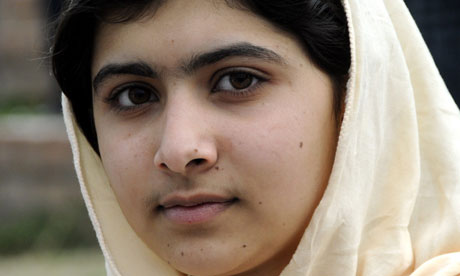
Malala! The girl that changed the world into a better place...


“When the whole world is silent, even one voice becomes powerful.” ― Malala Yousafzai, I Am Malala: The Girl Who Stood Up for Education and Was Shot by the Taliban
A significant portion of females worldwide are lacking decent educational programs: almost two thirds of the world’s 792 million illiterate adults are women. In 47 out of 54 African countries, girls have less than a 50% chance of completing primary school. In sub-Saharan Africa, the gender gap widens significantly at the secondary level of education, where around six girls are enrolled for every ten boys. In Nigeria, out-of-school female children of primary school age are estimated to be 5,753,795 and the net enrolment rate for primary education has fallen from 67.1% from 2006 to 56.2% in 2010.
The intense studies aiming at assessing the state of education of women are the motives of formulating future policies for providing educational services for women. The whole society will reap much benefit by investing in educating women: every 1 percent increase in the proportion of women with secondary education boosted a country's annual per capita income growth rate by about 0.3 percentage points. Educated women are more likely to participate actively in political roles and also more capable of resisting violence and poor traditions like female genital mutilation. Educated women are also more competent in terms of maintaining proper health of their children.

A girl who emerged in Pakistan, where only 40% of Pakistani women over the age of 15 can read and write, understood the previous facts and tried to overcome the oppression and enlighten her society. Malala Yousafzai lived in Mingora, Swat in Pakistan, where Taliban used to prohibit girls from attending schools. Malala refused to succumb to the restrictions of Taliban and used to write articles for a BBC blog under a pseudonym, Gul Makai, at the age of 11. Malala described thoroughly the destructive practices of Taliban and how they intentionally targeted girls’ schools, the thing that hampered Malala’s education. Malala’s international fame is attributed to a documentary produced by New York Times starring Malala and her father Ziauddin describing the suffering of the Pakistani people of Swat, and how Malala aspired to be a politician to help her society to overcome its crises especially education. Malala was identified later to be the author of the articles published on the BBC blog.


Malala acted relentlessly to promote the case of education of girls both nationally and internationally. She was nominated for the International Children’s Peace Prize and she managed to be the first winner of the National Youth Peace Prize in Pakistan. Despite her young age, she intended to set up the “Malala Education Foundation” whose mission is to aid the poor people of Pakistan to pursue their education. Malala was sinfully shot by Taliban assassin in her school bus, but luckily she received all sorts of care in Pakistan and was sent to Queen Elizabeth Hospital Birmingham where she continued her therapy and recovered without any brain insults.

The incident of Malala’s assault was met by worldwide rage and was condemned in Pakistan. Malala gained support from different politicians and was allowed to give her speech at the United Nations in 12 July 2013 - dubbed as Malala’s day - as a support of the United Nations Secretary-General’s Global Education First Initiative, where she reiterated the importance of education for everyone “One child, one teacher, one pen and one book can change the world. Education is the only solution. Education first.”

Malala’s activism contributed to improving the state of female education in Pakistan. In December 2013, UNESCO and Pakistan launched the Malala Fund for Girl’s Education which would provide support for new educational projects for the Pakistani girls. In February 2014, UNESCO commenced Malala Funds-In-Trust for Girls’ Education in Pakistan to support better access, improved quality and safe learning environments for girls in the hard-to-reach areas of Pakistan.
The whole world shall learn from Malala. She offered her people commitment and dedication and she courageously faced death in her endeavor for achieving the education for herself and her peers. Malala has made what leaders and politicians failed to in many decades with her patience and vigilance. Thanks to Malala, the world would be a better place!
By Ahmed Magdi Youssef.
References
UNESCO Institute for Statistics in EdStats, 2011
Key Messages and Data on Girls’ and Women’s Education and Literacy. UNESCO April 2012.
Women Deliver, Facts & Figures. Girls Education.
Global Education First Initiative. Malala Day.
The Office of the UN Special Envoy for Global Education. Malala Day.
Adam B. Ellick, Irfan Ashraf. Class Dismissed - The Death of Female Education. New York Times Documentary.
UNESCO launches Malala fund for girls’ education. Daily Times February 08, 2014.

Sunday, 27 October 2013

Why didn't we prevent it?

Malala Yousufzai was shot at for daring to want an education.

We stood by her side. We roared in anger at the atrocity. We said she was our hero. We said she was a strong fighter.

Then her father said that Malala will not cower, and will fight back.

We applauded his bravery, and his daughter’s bravery. And then we dedicated a day for Malala. The UN applied her example to the world crisis that gender based violence has come to be. Popular demands have risen to a feverish pitch, that Malala be nominated for the Nobel Peace Prize.

And yet, the situation closer home to Malala is bleak.

Malala’s achievements in the face of the Taliban despotism have not been received the way they should have. On the one hand, some religious parties call the whole thing a drama, a fiasco, and some other religious parties call the attack a product of the drone attacks, hinting at a weaker responsibility of the Taliban. On the other hand, political parties and the army have supported the cause of the education of women. And then there is the third side that deems the whole event a conspiracy by the Afghan Intelligence and the US Military – a grim reminder of the difficult relations between Pakistan and Afghanistan.

A time can come when the world will move on, and Malala’s shooting will be but a distant memory. But, we, as a people must fight every propensity for such a time: for Malala stood for a cause, fought for a cause, and bravely stayed put when there were threats aplenty hounding her. Malala may have made the cause for women today, for the deprivation that many of her global sisters face. But Malala has left behind a legacy, an epoch making one at that. She showed the world that defiance in the face of tyranny is bleeding courage. She showed the world that one cannot be too young or too old to demand her rights. She showed the world that no one can deprive her of her courage or her will, try as they might to strike her down.

Just imagine - One young girl taking on a terror outfit that dented a superpower and wiped out two buildings in its Skyline. Awe-inspiring, to say the least.

Malala is the symbol of courage that the rest of us need to learn to have. We write, we talk, we applaud, we curse, we shout, we scream. But how many of us question? How many of us demand where we are denied, ask where it hits, fight where they dictate, and stand strong when adversity slaps us in the face and deprives us?

Eleanor Roosevelt tells you to do one thing a day that scares you the most. Malala showed you not to let that fear exist, at all.

There is a Malala in every one of us. The least we can do to truly respect what she did, and the path she carved for us in these dense woods is to fight, and keep that path sustained.


Sunday, 13 October 2013

Malala Yousafzai’s victory


It was with great happiness that I heard about Malala Yousafzai winning the Sakharov Prize for human rights. Malala has had a very unfortunate attack recently (it has been one year since she was shot), but she gives hope to many that are in the same situation as she is, and to the many others who wish they could do more in order to defend and fight for education.
Recently, Malala was also awarded with the Amnesty International Ambassador of Consciousness award, the Pride of Britain award and the Anna Politkovskaya award. By being an advocate of such an incredible and especial cause, Malala brings the eyes of the world to its inequality and to the suffering of vulnerable individuals. She is seen as a symbol of innocence and virtue.
Malala had her innocence violated by terrorists, but she still represents lightening in places where education is not accepted, especially for girls. She brings hope; she is like a flower that blossoms in the desert. Her eyes are deep and serene, demonstrating her faith in changes, faith that is transmitted to all of us.
Unfortunately, nearly 57 million primary school age children are out of school and more than half are girls; data also indicates that 116 million young women have been denied the opportunity to complete primary school. These people will never be able to get a real chance to improve their lives without schools and books. It makes no sense that a world capable to offer these prizes to Malala is incapable to provide education for children, especially for girls.
As Malala said in her recent speech for the UN Assembly, the Taliban and other terrorist groups are afraid of books because they know their power. Knowledge transforms lives; books are a scape to those who cannot bare their existences due to the conditions they live in.
Even though books and education have infinite power, many changes still need to be made in society regarding dignity and respect to the female gender and the access to books by girls; Malala is a living proof of that.
In honor to the International Day of the Girl Child (October 11th), it is important to raise awareness about the daily difficulties of being a female and the absurd that it is to prevent girls from going to the schools. Malala’s prize is a great start in order to provide more visibility to the cause of education as a basic human right.
We all have the hope that one day common rights will be assured to both genders, causing, thus a fairer world to everyone. Freedom of opportunities will not be only in paper, but will become a fact assured by the own structure of society.
We, from Delta, expect that in the future the world becomes more like what Malala wishes, with more education, books and equality to both genders. Malala, you give hope to us all!!!

By Gabriela Campos

Sunday, 23 December 2012

Why did we let it happen?


Malala Yousufzai was shot at for daring to want an education.
We stood by her side. We roared in anger at the atrocity. We said she was our hero. We said she was a strong fighter.
Then her father said that Malala will not cower, and will fight back.
We applauded his bravery, and his daughter’s bravery. And then we dedicated a day for Malala. The UN applied her example to the world crisis that gender based violence has come to be. Popular demands have risen to a feverish pitch, that Malala be nominated for the Nobel Peace Prize.
And yet, the situation closer home to Malala is bleak.
Malala’s achievements in the face of the Taliban despotism have not been received the way they should have. On the one hand, some religious parties call the whole thing a drama, a fiasco, and some other religious parties call the attack a product of the drone attacks, hinting at a weaker responsibility of the Taliban. On the other hand, political parties and the army have supported the cause of the education of women. And then there is the third side that deems the whole event a conspiracy by the Afghan Intelligence and the US Military – a grim reminder of the difficult relations between Pakistan and Afghanistan.
A time can come when the world will move on, and Malala’s shooting will be but a distant memory. But, we, as a people must fight every propensity for such a time: for Malala stood for a cause, fought for a cause, and bravely stayed put when there were threats aplenty hounding her. Malala may have made the cause for women today, for the deprivation that many of her global sisters face. But Malala has left behind a legacy, an epoch making one at that. She showed the world that defiance in the face of tyranny is bleeding courage. She showed the world that one cannot be too young or too old to demand her rights. She showed the world that no one can deprive her of her courage or her will, try as they might to strike her down.
Just imagine - One young girl taking on a terror outfit that dented a superpower and wiped out two buildings in its Skyline. Awe-inspiring, to say the least.
Malala is the symbol of courage that the rest of us need to learn to have. We write, we talk, we applaud, we curse, we shout, we scream. But how many of us question? How many of us demand where we are denied, ask where it hits, fight where they dictate, and stand strong when adversity slaps us in the face and deprives us?
Eleanor Roosevelt tells you to do one thing a day that scares you the most. Malala showed you not to let that fear exist, at all.
There is a Malala in every one of us. The least we can do to truly respect what she did, and the path she carved for us in these dense woods is to fight, and keep that path sustained.

By Kirthi Jayakumar