Source
The male tormentor of the young women of the Madiyav slum did
not spot the danger until it was too late. One moment he was taunting
them with sexual suggestions and provocations; the next they had hold of
his arms and legs and had hoisted him into the air.
Then the
beating began. Some of the young women lightly used their fists, others
took off their shoes and hit him with those. When it was over, they let
him limp away to nurse his wounds, certain that he had learned an
important lesson: don't push your luck with the Red Brigade.
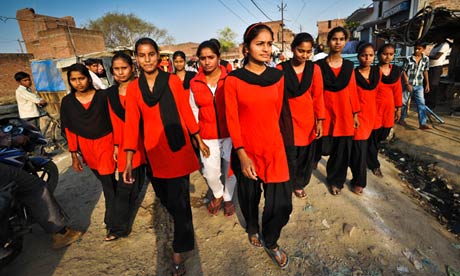
Named
for their bright red outfits, the Red Brigade was formed in November
2011 as a self-defence group for young women suffering sexual abuse in
the northern Indian city of Lucknow, 300 miles south-east of Delhi.
Galvanised by the gang
rape
and murder of a 23-year-old medical student in Delhi last December and
the nationwide protests that followed against a rising tide of rapes,
they are now gaining in confidence.
From a core membership of 15,
ranging in age from 11 to 25, they now have more than 100 members,
intelligent and sassy and with a simple message for the men who have
made their lives a misery: they will no longer tolerate being groped,
gawped at and worse. Their activities are a lesson in empowerment.
Men
who fall foul of the Red Brigade can first expect a visit and a
warning. Sometimes the Red Brigade will ask the police to get involved,
but if all else fails they take matters into their own hands. Their
leader, 25-year-old teacher Usha Vishwakarma, has her own experience of
the daily danger faced by many young women in the country. She was just
18 when a fellow teacher tried to rape her. "He grabbed me and put his
hands round me and tried to open my belt and trousers," says Usha,
sitting in the bare-brick front room of her small house. "But I was
saved by my jeans because they were too tight for him to open, and that
gave me a chance to fight, so I kicked him in the sensitive place and
pushed him down and ran out of the door."
No one at the school
took her accusations seriously, telling her to forget it and stop
causing trouble. The experience left her traumatised and for two years
she did nothing. But little by little her confidence came back. In 2009
she set up her own small school for local girls in an outbuilding next
to her family home. Yet all around her, she says, she saw more and more
young women suffering the same abuse she had faced. And it was
threatening to wreck the chances of her young female students.
"Parents
were telling girls to stay in their homes so there would be no
incidents. They said, 'if you go to school, boys will be troubling you,
so stay home and there will be no sexual violence'," says Vishwakarma.
"But we said no, and we decided to form a group to fight for ourselves.
We decided we would not just complain; we would take a lead and fight
for ourselves." They bought red
kameez (shirts) and black
salwar (trousers) and began to plan the fightback. "We chose red because it means danger and black for protest," says Vishwakarma.
There
is much to fight back against. "It is in the minds of men that girls
are objects and it has been like that always," says Vishwakarma.
"Religion shows women as very powerless and that whoever is strong can
do anything."
Other members of the group drift in and join her,
sitting on the bed along one wall of the front room. At the other end of
the room is a table laden with the placards they carry with them when
they go out to protest on the 29th day of every month. The
demonstrations mark the date of the Delhi bus rape and murder on 29
December. Their slogans read: "Stop rape now" and "We want safety".
"In
the electronic era there are pictures everywhere of women and girls
being treated like objects. It is now very simple to see pornography and
it is feeding the hunger for sex. The men think that if you are looking
sexy, then you want sex," says Vishwakarma.
They have started
martial arts training so that the men do not have a physical advantage
over them. Pooja, Vishwakarma's 18-year-old sister, laughs as she
recalls the reaction of the boy they grabbed in the street when his
taunts became too much. "We all stopped and turned round and we
surrounded him and grabbed his arms and legs and he thought it was a
joke, but we were not kidding and four of us lifted him in the air and
the others started to hit him with their shoes and fists," she says.
The
rough justice the Red Brigade metes out might seem extreme to western
sensibilities, but many Indian women are making it clear that they are
no longer prepared to put up with endemic abuse. That much is clear from
the crime figures: reports of molestation in Delhi are up 590% year on
year and rape reports by 147%. The rape cases have hit tourist numbers,
which were down 25% in the first three months of the year – 35% fewer
women are travelling to
India.
The
Red Brigade say sexual abuse is a part of daily life for young women
like them. They all have stories of abuse, attempted rapes and daily
harassment. "This is what happens in India," says 16-year-old Laxmi, one
of Vishwakarma's lieutenants. "These things happen all the time. All of
us know this, so don't let anyone say otherwise. This is why we have
formed the Red Brigade."
Seventeen-year-old Preeti Verma nods in
agreement. Her family are too poor to have a toilet in the house, so she
has to go out into the fields, she says. Every time she went out, the
man in the neighbouring house threw stones at her to try to scare her
into jumping up. "He wanted to see my body," she says. "I told him:
'What are you doing? You are shameless, don't you have a mother and
sister in your house?' But he replied that his mother is for his father,
his sister is for her husband and that I was for him." She told
Vishwakarma, and the man received a visit from the Red Brigade and
another from the police. She has had no trouble from him since.
"We've
caught a lot of men recently," says 17-year-old Sufia Hashmi. "I joined
up because men always used to pass comments on me and touch my body,
but now we beat them the men cannot do anything and they run away. You
feel powerful and you feel good."
The next day, they gather on the
roof of a gym across the city to run through their moves, a mixture of
kicks, punches and throws. An instructor shows Pooja how to use a wooden
stick to keep a boy at bay. She holds it against his assistant's throat
and the boy looks terrified. The others gasp and giggle.
Yet it
is not just the young men of the neighbourhood that the Red Brigade must
overcome. Many of the members are very young and, although some of
their parents are supportive, others are convinced they are wasting
their lives. "The attitude of my parents is very demoralising," says
16-year-old Simpi Diwari, a tiny young woman who a few moments ago was
kicking away the legs of one of her colleagues. "I want to be like Usha,
fighting against the cruel things, I want to be a teacher and a
motivator too, but I am fighting with my parents just to be allowed out
of the house."
On the way back to the slum, the rickshaws pass a
public park and for a moment these tough young women show themselves for
what they really are – children forced to grow up fast. They beg and
plead to stop. "Please, please," they say, their eyes gleaming in
excitement. Shrieking gleefully, they race off towards the swings,
slides and roundabouts. Later they stroll back through the market,
eating ice-creams, heading for their homes. The sun is low in the sky,
the shadows long. The men watch sullenly as they pass, like wolves who
have just discovered the sheep are armed. No one risks a word.