Showing posts with label Rebeca Alvarez. Show all posts

Monday, 26 August 2013

Dealing with grief


I lost my father a month ago, and I’m still trying to get conscious of this fact. He suffered chronic kidney disease (CKD), and this illness damaged his heart, causing him a heart attack. During this month, I have realized death and mourning are forbidden topics that at least in Latin America we never talk about, until we lose a significant other. There’s no moment for being prepared for facing the news about a relative or someone we care passes away, but not discussing it, and being afraid or in denial of the inevitable experience, will only cause a stronger impact.

We are not only going to deal with the grief for relatives or friends, but also we will deal with our personal grief, at the moment we realize we can become seriously sick or we are getting older, and we are losing our health and strengths.

Death, getting old, unexpected accidents are part of life, they are so closed to us that we cannot see them, until they suddenly come to our lives.

This experience is personal and unique, there are no proper ways of recipes to resolve pain and sorrow easily, in fact, we have the right to demand respect to our own mourning process, no one else can live it on our behalf, and nobody knows how we are actually feeling, and the meaning that the person who passed away has to us.

Because even if this person is no longer physically among us, we still love this person and that remains till the end of our days, along with the experiences and memories we shared with him or her.

I dislike when someone tries to teach me what to do or not to during mourning, or which is going to be worst moment of the process, like if there’s an expertise for it. The best thing we can do is just listen to the other person, and provide care and companion during this process, without judging.

However, I can share from my experience what has been useful for me, hoping it can help someone who can be currently facing the same process:

-          Live actively your mourning process, I don’t avoid crying or talking about my lose if I want to, I try to choose the appropriate time and person, but it’s not a totally rational process, so if one day you’re driving and you need to stop by the cemetery and visit the tomb and cry, or if you need to yield, just go ahead and do it, it’s a completely normal reaction.

-          Face the pain, deal with it, suffer, it’s the best moment to do it, express it freely.
-          Support from friends and relatives becomes really important as part of healing process
-          Don’t lose yourself in the grief process, try to eat, do exercises or activities that will help you to get back to your life. I’m doing it little by little, not pushing too hard, but with daily effort.

-          Loss will remain, no matter how much time passes, however memories and good experiences will survive too. Hold in them, they will keep this person alive in your hearth for a lifetime.


Life won’t be the same again, I know. But yesterday I was a different person of who I am today, that means change is part of life, even we need strong experience to get conscious of that. I don’t have the whole picture of a mourning process yet, but I can tell that never in my 30 years old, I have felt so human, so sensitive, so addressed into human reality, and I have never valued my life in the way I’m doing it now. 

By Rebeca Alvarez

Friday, 26 October 2012

How to depend less on people´s opinion


We can´t deny that there are important people in our life who we trust, and look for some advice when tuff decisions come into our life, or when we need to receive some feedback about how we´re dealing with certain duties. In spite of their help, we´re the ones in charge of the decisions we make and their consequences, and the ones who should support them, and believe on our conscious and our inner voice who says what is right or wrong.


However, not all of us are ready to deal with comments or criticism of the rest of people about how we live and behave. This is a real shame, since no one else can handle the same purpose in life, and no one else has knowledge enough to judge strongly our decisions and behavior. We have to be proud of who we really are, and improve all the time, based on our own wellness, not in what other people are going to say about me.
In order to get this attitude, here are some ideas that can help:


  • Freedom of someone else´s opinion:  We need to trust in our inner voice, this can avoid people of being slaves of people´s opinions, or being tied to prejudices and repeat them in our lifes,  just because that was the way we were raised, without analyzing if it works for us or not. This situation causes unhappiness, and reduces our capacity of choosing and building our own story.
  • Happiness depends upon us: We just can share it with people, but we can´t expect people to make us happy.  Happiness is an attitude, not an emotion that depends on people´s approval.
  • Nobody can make us feel less, without our consent: We can dedicate time, an hour daily if possible, to build our self- esteem, to visualize who we really are, what we want in life, heal our heart, and recover our force to reach our goals.
  • Being yourself is a gift: If we only hope the praise and worship to feel valuable, we can be so easily destroyed by criticism of others, by malice, by discredit. It can address out lifes to depression and affects our immunologic system.
  • Our own opinion is more important that the opinion of anyone: Other´s opinions are exactly this, other´s opinion. We know what we have faced in life, our efforts, our personal battles, all valuable things we have given to people, our weak areas, and our strengths. There´s nobody else with the capacity to build a really deep opinion about us, but ourselves.

So, before trying to look for approval or recognition, build it inside, where you know who you really are, and how strong you can be to reach what you want in life.


By Rebeca Alvarez Montoya

Tuesday, 20 March 2012

The Death Penalty


Death penalty is a sentence that allows causing death to an individual. It would be applied due to the execution of several crimes, such as: treason, murder, espionage, rape, terrorism, .etc. It has been used in every country, but nowadays only 29% of them are still applying it.
Humanity started to question the benefit of this penalty to the society by XVII century, and it has been a controversial topic since that moment. Historically, death penalty has been always part of our culture, being part of justice system in primitive tribes, when arbitration was out of context, and family issues need to be solved.
Then, tribes develop a system called vendetta, to handle these situations, especially for disputes that need to be resolved under an honor code.
When modern society becomes part of the scenario, governments started to use it more frequently, and in a crueler way, and it caused two opposite positions that still defend their opinion, some groups were pro death penalty, some others were against it.
There are some arguments from both parties which can illustrate their perspectives. Groups which promote to ban this kind of punishment, justify their position due to:

  • It is cheaper to have someone for a lifetime in prison, rather than applying a capital punishment.
  • Endless appeals cause obstacles in the court system.
  • Law is not perfect, and there is always a chance that an innocent person could be killed.
  • Killing people who kill people, it is making the same mistake twice.
  • It can cause compassion to the perpetrators.
  • It is barbaric
  • It has racism influence. Two-thirds of any case involving a black or Hispanic killing a white result in the death penalty.  Overall, a black person is 5 times more likely to get the death penalty.
  • In the countries which have applied it, crimes continue without decreasing, since people don’t think in capital sentence consequences at the time to execute a crime.
The pro position is based on the following arguments:
  • Death penalty contributes to a closure for the victim’s family.
  • It can decrease crime execution rate
  • It will promote more sympathy for the victim’s family than for criminal.
  • Crime Scene Investigation currently counts with the best technology which can precisely determine who was the perpetrator.
  • It can help with the overpopulation in jail system.
Both positions inspire different ways of taking care of the common interests, and how to deal with irreparable damages. But they don’t go deeper to the cause and reality of people who execute crime, their reasons, their context, and eventually how to prevent them.
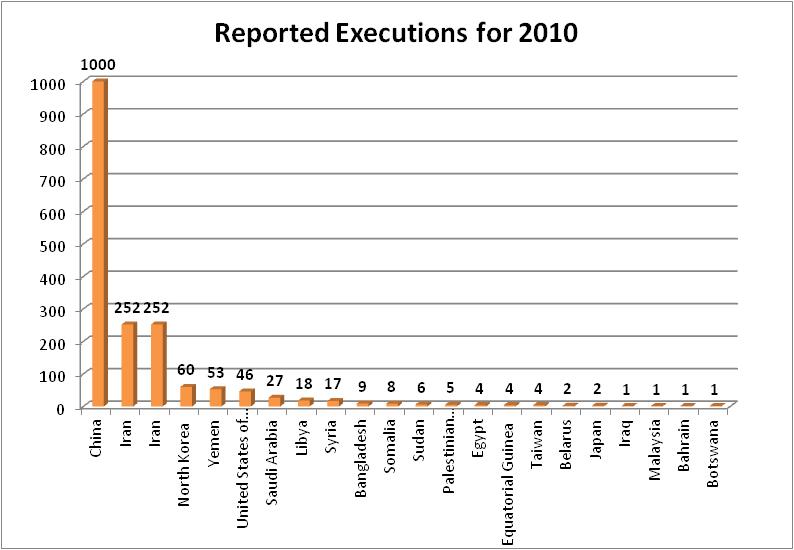
The situation is currently as follows:

Based on Amnesty International web page

China leads the scenario, with more executions for 2010. The “tradition” of applying this punishment is pretty ancient. The range of crimes which deserve capital punishment in China comes from tax evasion to murder and drug traffic. Recently, in 2011, Chinese authorities approved an amendment to their death penalty law, reducing the amount of crimes under this penalty from 68 to 55, however there are no intentions to eliminate this penalty from their system.
In general, capital penalty is an ancient intent to control people’s behavior, according to agreed codes by the empowered groups in a society, but it hasn’t been able to eliminate criminality. That should make us reflect about the causes of criminality, and how to propose new alternatives which can impact needs and conditions that cause criminality to exist.


By Rebeca Alvarez