Showing posts with label society. Show all posts

Monday, 20 August 2012

Stand up


The government has come up with new laws, constitutions have been changed, society has stood up and is willing to lend a helping hand. We have now been given the courage that we lacked all this time to stand up for ourselves. We now have people behind us, willing to take a stand with us, but the verdict to this case is society cannot help us if we are not willing to help ourselves. 

It is us who should stand up. It is I who should stand up, put my foot down and say I will not be abused, I who should stand up start dusting myself of this poverty, I who should decide I want to get my education. It is time to realize the importance of the self. It is agreed that the women are the trees that bear nations, we are the life of the family and if that life does not acknowledge the importance of themselves how then will the branches that stem out of her know of this tree‘s importance. 

Women need to realize the influence they have on the world, that we not only give birth to its population but that the way we look at the world influences the way a our families and societies will look at it. A hopeful, hard working woman gives hope to her family, she sheds on them a light that will lead them through life and its trials on the other hand as well a gloomy woman will lead the people around her into darkness. 

We need to understand that we have so much power within us to change the world, and that power is can only be awakened by the realization of the self. We need to know who we are, know our worth. Child bearing and housework is just a mere fraction of our capabilities, we have proved beyond doubt that we can do that now its time to show the world the rest of our capabilities. We are born leaders, we have led families with our love with passion with strength we can do the same to the world. We are healers, it is time we heal the world. We give life, let us breath back hope into the corridors of our streets, into the lungs of the world. We are teachers, let us teach the world to love again to work their hearts and minds intertwined. There is so much we can do, let us stand up, for us, for our families, for our suns and daughters. Their all waiting on us, this worlds needs us now more than ever.  

By Tshwetso Kaan

Thursday, 7 June 2012

Slum Tourism...Ethical, Exploitative or Aid?


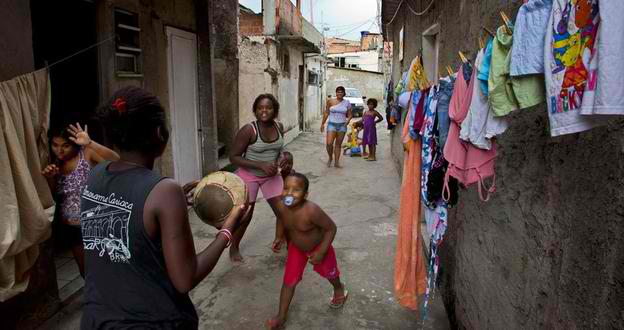
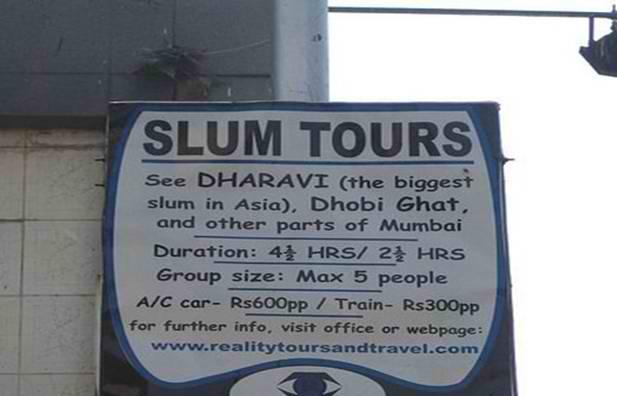
(Favela do Metro shantytown in Rio de Janeiro, Brazil (Slum Tour signage in Dharavi India)
(Victor R Caivano/Associated Press Via Passport Blog)

Slum Tourism...one Slum Tour organizer justifies it by saying “travellers come to see the differences from the way they live themselves,” and they “show some good examples of the community.” Another says that “Today poverty tourism is practiced all over the world.” Other organizers say it “raises awareness and brings aid to the destitute of the city.” So is “creating awareness” via slum tours something to be tolerated and accepted because people pay to take pictures of how the slum dwellers live? Would letting it continue eventually help take the slum dwellers away from their impoverished “habitat?” Or would the tour organizers try to “preserve” that habitat and its dwellers to keep making money?

Exploitation was the first thought that came to mind when I read about slum tourism being a phenomenon. People were clearly making profits from the slum tours at the expense of the slum dwellers whose private lives and dire situation are exposed to visitors who want to take pictures of the “realities of life.” Aren’t the media and NGOs already doing that without “collecting payment” for people to be made aware of the slum dwellers’ situation?  

The practice had long been in existence but only came to public scrutiny when the first article on slum tourism was published in the New York Times in March 2008 (NYTimes Weiner, 2009).
Slum tourism isn’t an impromptu act of touring or visiting the slum areas. These are well-organized tours run by profit-making companies or tour agencies complete with websites and tour itineraries of what tourists expect from the tour. These are organizers where most do not donate money back from proceeds into the slum communities they visit.

I wonder if these agencies even bothered to ask the slum residents’ permission to have their private lives exposed for tourism. While some may be in such dire strait as to accept anything including exposure of their private lives for a fee, others suffer the humiliation of having their lives put on display to tourists. Thus, these tours have often been branded as “exploitative, voyeuristic, and imperialistic.” For slum tour operators to justify their trade as “trying to educate tourists about the realities of poverty and are helping to dispel negative stereotypes surrounding slums” is something I personally find pathetic. Though some operators claim to have used tour revenues to build schools or community centers in the slum areas, many get a regular fee from the tours, while the slum residents who the operators benefit from can hardly say that they also regularly benefit from the intrusion on their privacy.  Some operators simply “hope” that the tourists would donate funds to help the residents after seeing the living conditions. The guaranty of getting donations is not absolute. To me, if help you must, then help without taking but give something in return to the community and not simply hope that the tourists would. The community must be involved or the motive becomes subject to criticism and scrutiny.

There are slum tours that focus on cultural or entertainment tours. Cultural tours show how slum residents live their lives and how the slum community functions. Entertainment tours focus on a “safari”-like experience vehicles takes tourists around in open-roof, army-style jeeps or motorcycle ride through the slum areas (source: http://repository.upenn.edu/cgi/viewcontent.cgi?article=1011&context=uhf_2010).  

The description being likened to an African safari trip of watching and taking pictures of wild animals from a distance is not hard to miss. It is the focus on poverty and how it is conducted in a safari-like manner as if the slum dwellers’ “habitat” were of wild animals that earned the slum tours wide criticism. The focus on the cultural education for tourists is lost and what is magnified is the profit made by organizers at the slum dwellers’ expense. The “safari experience” offered by tour organizers makes me agree with Wardah Hafidz statement, an activist with the Urban Poor Consortium: “It's not about shame. People should not be exhibited like monkeys in the zoo. What residents get from these tours, in cash or whatever form, only strips them of their dignity and self respect, turning them into mere beggars (source: 'Slum tourism' treads between aid and exploitation’ - http://www.rappler.com/world/6268-slum-tourism-treads-between-aid-and-exploitation).

Slum tour organizers and operators however, claim to be corroborating with local NGOs to help slum dwellers benefit from the tours. Many of them say they give back to the communities they visit. Some give money to children’s education centers, children’s projects, schools, in these slum communities. In India, for instance, Reality Tours and Travel in Mumbai set up its own charitable organization, which runs a community centre, kindergarten and cricket program in the slum of Dharavi, according to Chris Way, founder of Reality Tours and Travel.  According to Way’s estimate, “nearly 40 percent of this, or approximately US$23,000, will go back into Dharavi through Reality Gives’ programs -- money the community wouldn’t see otherwise.” The website is complete with an itinerary and cost depending on the type of tour ranging from Rs500 per person to Rs6,800 for five persons. It also shows off the charity organization’s various projects in Dharavi which is part of the tour itinerary.  In Indonesia, each tourist pays 500,000 rupiah ($54) "Jakarta Hidden Tours" to visit, with half of that going to the tour company, and the rest funding doctor visits, microfinance projects or community projects such as school building.


In Brazil, Marcelo Armstrong, who started Favela Tour in Rio de Janeiro in 1992, said his company gives money to a children’s education centre. To further lend credence to the claim that the slum tours are not exploitative, the companies (Reality Tours and Favela Tour) limit picture-taking and only allow tourists to take out their cameras at certain times. (source: The Passport Blog:  http://www.bbc.com/travel/blog/20120307-ethical-traveller-do-slum-tours-profit-off-the-poor).
But have these slum tours really done good for the community? In India, the number of people living in slums has more than doubled in the past two decades and now exceeds the entire population of Britain, the Indian Government has announced.  The number of people living in slums was projected to rise to 93 million in 2011 or 7.75 percent of the total population, almost double the population of Britain. Census data released in December 2011 by the IBGE (Brazilian Institute of Geography and Statistics) shows that in 2010, about 6% of the population lived in slums in Brazil. It means that 11.4 million of the 190 million people lived in the country areas of irregular occupation and lack of public services or urbanization - called by the IBGE of "subnormal agglomerations"  (http://en.wikipedia.org/wiki/slum). 


Many governments around the world have attempted and continue to try to solve the problems of slums through relocation and construction of better living conditions and sanitation. Often, this causes displacement and violence when slum areas are cleared and the residents find themselves distanced from their main source of livelihood, schools or clinics.  Despite the offer of a better housing, better sanitation and their own land, the slum residents return to where they can earn money for their day-to-day survival.  (See, for example, Abahlali baseMjondolo in Durban, South Africa. 


That slum tourism exists and is a phenomenon cannot be argued with. These are facts that have to be accepted...and there are people who make money from it. Some maybe there for the intent of also creating awareness but it cannot be discounted that others are there simply for the profit at the expense of the impoverished. What is essential is for governments, NGOs and communities to address any possibility of exploitation and profiteering and be closely involved in ensuring that the slum dwellers do not suffer from intrusion of their private lives from greedy profit-makers without conscience. The community must be involved.
Sources:

  1. A Trip into the Controversy: A Study of Slum Tourism Travel Motivations http://repository.upenn.edu/cgi/viewcontent.cgi?article=1011&context=uhf_2010
  2. Rappler: 'Slum tourism' treads between aid and exploitation’ - http://www.rappler.com/world/6268-slum-tourism-treads-between-aid-and-exploitation
  3. The Passport Blog:  http://www.bbc.com/travel/blog/20120307-ethical-traveller-do-slum-tours-profit-off-the-poor     
  4. http://en.wikipedia.org/wiki/slum    


By Lylin Aguas

Wednesday, 30 May 2012

Voluntourism


A recent report by People and Power, Al Jazeera, has revealed the dark side to the world of volunteering and tourism based on volunteering, with Cambodia as the place where it all unfolds. After facing two decades of civil War, Cambodia has had a considerable boom in its tourism industry with scores out of them working to help as volunteers in schools and orphanages, all in order to fill a gap left by the government, owing to a lack of funds for development. The report explains that instead of doing good, sadly, the onslaught of volunteers seems to have caused a steep rise in destitute children. Impoverished parents are tempted by the prevalence of western-style residential care homes, upbringing and education, and thus wind up sending them to these “orphanages”. The past decade itself, records a doubled number of children in orphanages, with nearly 70% of the estimated orphans having at least one living parent.

Among a plethora of things, the report brings to light that there is frugal awareness of the psychological damage being done to children by forcing them to form an endless series of relationship with strangers, that the donors themselves cannot see where their money actually goes, that unscrupulous practices are involved in exhorting donors to contribute more, and that volunteering ventures are in it for profits. Volunteer credentials are not taken into account, nor is there any effort to comply with minimum standards.

The report isn’t far from the truth in the global volunteering scenario. And the fault doesn’t lie in the hands of the perpetrators of wrongdoing alone, because, well, standards aren’t even existent in the first place. International Volunteering and Development has become a buzzword, a fabulous means of engaging labour in times of recession, in a hard labour market. Volunteering is easy on businesses because volunteering is not paid labour, and at the same time, having a policy encouraging volunteerism suggests the existence of a “big picture” worthy of coveting monetary assistance. The Banana Republic-like scenario welcomes unscrupulous practices in a fractured setting that functions as a thriving hotbed of malpractices. Even as there are standards to regulate corporate action and labour behaviour, there is malpractice in some form or the other. But what can be said when there is no standard to regulate volunteerism? What can be said when there is no legal instrument that governs the institution of volunteers, no organization to govern volunteers, no authority to size up any malpractices? 

Tuesday, 29 May 2012

Rebuilding a Future

This week I started a project in my Human Geography class that focuses on redesigning an international city. I chose to look at Urban Development, and more specifically at slum prevention and then viable alternatives for future growth. The language of the universe is written in mathematics, from the interaction of particles at speeds near light to stars slowly (or at least relatively) orbiting one another. A statistical model can describe most of Human interaction and behavior that we call economics, and there is where I first turned. History tells us that there has rarely been an event where frugality didn’t play the key player and economics confirms that people look for the solution that is most viable with the highest profit for the party in power.


The question on the surface is what is the best solution, but ‘best solution’ is a subjective question. Everyone has an agenda, whether they are a high school student looking for a solution that improves foreign investment, gender equality, and human capital or a city planner looking to level the highest profit for the city or a slum dweller just hoping for a better life and better access to water. Obviously, leveling all the slums, building high rises, and shooing the untouchable further from the city center would be the most profitable for the city, but there isn’t a way that they could do that. Alternatively, they can’t invest their entire budget into the slums to bring them sanitation, bathrooms, water, and transportation systems. So what is the happy medium?


Well, first what are the main problems in the average slums today? And since this is a Gender publication what are the largest gender inequality issues? Slums are large expanses of land that are developed by migrants from the rural countryside to find jobs in the city. Generally, they aren’t looking for riches but a chance to survive. They build homes out of wood and cardboard. The average home size is about the size of half an American car parking space with an average house size of six to twelve members. In some house the members sleep on their sides and they almost fit. Sanitation is a huge issue, and women especially feel this, with few bathrooms that have constant lines and a surcharge per use and non-existent hygiene stations like sinks for hand washing. Most children just use the restrooms in the makeshift slum streets that run with water from the crowded and dirty water pumps that serve about 100 to a 1000 people each. Women are hard hit in these situations and are the first to feel the effects of poor sanitation through high birth-mortality rates, higher fertility rates, and little access to proper health care to boot.


In my project I followed the model that India is champing and combining it with western tax & property policies. The city I chose was Cairo, but I found that most developing cities are facing the same problems and that the solutions are more or less universal. First, land needs to be privatized to get anywhere. After that, there are a few roads that one could go down that could lead somewhere positive, the road I took was one where the city government and foreign investors came together to create change through free market competition. India champed this model, in a way; they would sell existing slum land to investors and give current inhabitants a lease in the building. In my model the land was sold anywhere from 16th to 1/3rd free market value, which would be rather high for land with that proximity to the city center and to charge an impact fee that would bring the sale price to about 2/3rds to 4/5ths the free market value. The impact fee would be used to purchase leases for 1.5 times the amount of space that current inhabitants previously occupied. Money would still be left over after those leases were paid and could be used to cover the cost of new infrastructure like water and roads. 


One major obstacle to this kind of plan is that slum businesses and services don’t want to, or can’t, pay the higher cost of business that urbanization brings. I proposed that the tax system be bracketed so that low-income businesses that operated in former slum land be given rent subsidization and that companies that hire low income workers on the books be given a tax credit. This would also encourage more companies to hire low-income workers and disperse more income. The next policy would be to create a perpetual sharing scheme in the city where infinite maturity bonds are sold and the profits be used to create infrastructure and finance the increased social sector, which I’ll touch on soon. All the citizens in the city, which would include the previous slum dwellers, will pay the interest that would be built on those bonds as they are cashed. This would mean that those who benefited from the projects would also be helping shoulder the cost. I wanted to create low-income housing for new residents to prevent future slums. However, they would only be able to retain residence if they practiced fiscally sound policy. That’s where the expanded social sector comes in; the city would need to train a fleet of social workers, which could be previous slum dwellers, which would help keep citizens on a fiscally responsible path.


This plan probably is too idealistic and too simple to spite the time I put into it, but I think that some of the ideas from the project could really be put into place to prevent, fight, and reverse slums in developing countries and help reduce gender in-equality and raise the standard of living across the board. 


By William Lynch