Showing posts with label Farahnaz Mohammed. Show all posts

Sunday, 21 April 2013

Syria’s Second War


This is a screenshot from a crowd-sourced map of Syria. The red dots are not representative of major towns or cities. Rather, the red dots indicate where the latest reports of sexual violence have come from, and the number of attacks reported. Women Under Siege, like other organizations, has dedicated itself to tracking the casualties of the civil war. It is a particularly difficult task in Syria, where NGOs, aid groups, journalists and health workers have limited access, but it is clear that violence against citizens, especially violence against women and children, is rampant in the ongoing conflict. It would appear that there are two battles raging: the fighting between the rebel groups and the Syrian military, and the quieter, but no less devastating war being waged on the country’s most vulnerable citizens.

Rape is tragically almost inevitable in war. Yet in Syria, as in Bosnia and Darfur, the mass rape of both women and men has been particularly widespread and vicious. The armed government forces are said to be responsible for the worst of the attacks, rather than rebels or citizens, making the government’s destruction of its people psychological as well as physical. Rape is used as a tool of intimidation and humiliation. Waves and waves of horrific stories are emerging from Syria. Soldiers who are mentally tortured by having their wives, sisters or mothers raped in front of them. Women detained to be kept as sex slaves. Soldiers forced to rape as part of duty. One 23 year old who identifies himself as Mohamed, describes what caused him to defect to the rebel side:

“The officers were mostly Alawite, and they would target the houses of [opposition] activists in Homs and gather the young girls and rape them,” Mohamed said. “After they’d finished they’d tell the soldiers outside to come in and rape the girls, too. The girls would generally be shot when everyone had finished. They wanted it to be known in the neighbourhoods that the girls had been raped, but they didn’t want the girls to survive and be able to identify them later.” (source:
http://www.yalibnan.com/2012/08/13/syrian-army-accused-of-vicious-systematic-rape/)

The counts of human rights violations is Syria are mounting daily. While the rest of the world is becoming numb to the endless stream of news of carnage and causalities, it is incredibly difficult and incredibly important to remember that behind the skyrocketing figures are real women and children caught in the crossfire of Syria’s hellish civil war.

Violence map:
https://syriatracker.crowdmap.com/reports/view/2720
Women Under Siege’s map: https://womenundersiegesyria.crowdmap.com/


Thursday, 11 April 2013

Facing every challenge possible


Women have always had a more challenging role in the workplace. From lower wages, to casual sexism to outright gender bias, a woman can expect several obstacles throughout her career, whether from her family, her bosses or even herself. In Venezuela, however, some women journalists are now facing threat from a new and significantly more disturbing source: their government.

Rayma Suprani, an award-winning cartoonist for El Universal, has been threatened for her satirical cartoons, which criticize the government’s policies and the social conditions of the country. She and other women journalists have been ridiculed on television (on media channels that are sponsored by the political party in power), sent threatening text messages and been denounced, at times violently, on social media sites such as twitter. According to reports, this is not an unusual occurrence. Suprani is among the few journalists who have been brave enough to speak out, yet there are many other organizations that succumb to the pressure of the government and self-censor, a well-documented phenomenon that is not only harmful to the political protest, but also the psyche of the journalists.

In a democracy such as Venezuela, a free press should be a cornerstone of the society; the recent tumultuous political times, however, have somewhat eroded the sanctity of the institution. The death of the much beloved president Hugo Chavez in March posed a danger to the popularity of the already-controversial socialist party. Heated rhetoric and a rushed election date of April 14th have pushed the Venezuelan government into apparent paranoia, and they have shifted from disgruntled by criticism to outright intolerant of it.


Clashes among party supporters, angry and accusatory speeches by the respective candidates and deep divisions in ideology show the unstable state of the nation. Tempers are flaring, and the murder rate at an alarming high. With the government not only encouraging vitriol against writers who dare speak against them, but dragging their feet in prosecuting those who translate their anger to action, Venezuela’s journalists are not unjustified in fearing for their safety. Suprani herself states, “...any Venezuelan that leaves his or her house in the morning runs the risk of not coming back because crime levels are so high…the government doesn’t murder openly, but it has a political reach that protects those responsible from facing justice.”

Whatever one’s political beliefs, it should offend one’s moral conscience that any government feels it has a right not only to control the opinions and words of its population, but to be so blatantly an agent in anything that poses a threat to the well being of its citizens, male or female. Not only is this a political issue, but also a human rights issue. Having an opinion should never be a crime, and threatening a citizen should never go unpunished.

To show your support for Rayma and other journalists in the region, you can follow @raymacaricatura or find her on facebook at http://www.facebook.com/pages/Rayma-Suprani.

Monday, 18 March 2013

Survey Post 2


On the 16th of December, 2012, a brutal rape would take place on a Delhi bus that would shock India and the international community. The attack and gruesome death of an anonymous, yet now internationally famous 22 year old woman caused violent uprisings in the nation, provoked a reaction from the Secretary General of the United Nations and sparked protests in Paris, Bangladesh, Nepal, Pakistan and Sri Lanka. The incident led many women to closely examine the roles they played in their own societies, and re-examine a question we often take for granted: how far have we come, as women, in terms of respect and safety in our countries? To answer this question, a survey was sent to 7 different young women living and working in some of the world’s most gender-progressive countries – Canada, the United States, the U.K, Bermuda and Argentina - to examine their views on the status of women in their countries. This is the second in a series of posts discussing their responses. 

The United States has a reputation for being one of the world’s most progressive countries in terms of gender equality, where a woman’s liberty is becoming as much a cornerstone of the society as freedom of speech. Similarly, the tiny island of Bermuda has not shied away from tapping into the potential of the gentler sex. Aside from having a large and active working female population in positions of power, in the early 2000’s, a black and openly lesbian woman was Prime Minister of the country. Emily Ross is a PhD student at Oxford University from Bermuda, and Vivian Chow is a young American who is currently acting as a research assistant at the Children’s Hospital of Philadelphia. Both are high-achieving young women who have been born into two very female-friendly nations. Yet both paint a similar picture of the struggles inherent in a society that tries to find a balance between traditional womanhood and militant feminism.

Both young women are grappling with a similar pressure on women to somehow ‘do it all’. Emily states, “I do think there is a general social consensus that women can and should be able to ‘rise to the top.’ However, there is also a general condemnation of women who hire nannies and let ‘strangers raise their babies.’ Women are expected to be CEO and head of the PTA. They’re criticised if they choose to be stay-at-home moms, they’re criticised if they focus too much on their careers. Men don’t have that pressure.” Similarly, Vivian states, “My own parents acknowledge and encourage my desire to have a fulfilling career and to be financially independent, but they also constantly mention that I need to find an outstanding guy, forge a happy healthy marriage, and eventually have good family. In many ways, I think women today have more to tackle. More duties and responsibilities to juggle.  It seems society advocates the ability to stand alone and be independent and have careers, but still expects the same level and quality of motherhood.  As someone whose medical career path will be a very long and hard road, I know I feel that partly societal and partly self-imposed pressure.” This is just one manifestation of a problem that is often discussed: one of Princeton’s leading female figures, Anne-Marie Slaughter, published a controversial article in the Atlantic entitled ‘Why Women Still Can’t Have It All’. In it, she discusses the toll the new expectations set for women have on them; she argues that the older expectations of women haven’t faded, they’ve just been added to. This leaves women in the uncomfortable position of feeling like they must be successful in all facets of their life, a herculean task.

The other side of the coin is that while the idea that women can somehow be everything is, in its own ways, stressful, it is also heartening. It seems it is a problem both girls feel weighing on them, but that they feel they are lucky to have. Vivian says of the States:

“The US is more progressive in terms of defining the role of the modern woman, and
I agree that a young woman should have the opportunity to be financially able to support herself, and to build a career for herself in addition to the traditional option of becoming a mother and loving wife. Although the world is changing their definition of what a woman should and should not do, this creation of a new role for women as strong and independent, still lags in many parts of the developing world.  I feel in some parts of rural China for example a woman still belongs as though property to her husband. She has no say in matters of the house or running the farm and does not speak til spoken too.  This may be a generalization but I can see similar situations happening in other rural areas or areas where tradition is a pillar of everyday life and beliefs.  I see this in the former Taliban rule of Afghanistan where girls were denied the same education as boys.  I see this in Somalia where there are some cultural attitudes that men are not considered ‘men’ until they have raped a woman.  I see this in those raped victims who sometime feel that it is their lot in life, almost their duty to merely bear this. “

While different societies are struggling to adequately address the issue of gender equality, and the shifts in power and responsibility that come with that, the United States and Bermuda serve as two exemplary cases where the problem is not that women aren’t allowed to be too little; it is that they are expected to be too much. It is the author’s opinion that if two nations can reach a point where its young women are equally enthralled and exhausted by the number of possibilities available to them, it is shameful to accept less in the rest of the world.

Farahnaz Mohammed


Saturday, 2 March 2013

Responses to VAW incidents: Part 1


On the 16th of December, 2012, a brutal rape would take place on a Delhi bus that would shock India and the international community. The attack and gruesome death of an anonymous, yet now internationally famous 21 year old woman caused violent uprisings in the nation, provoked a reaction from the Secretary General of the United Nations and sparked protests in Paris, Bangladesh, Nepal, Pakistan and Sri Lanka. The incident led many women to closely examine the roles they played in their own societies, and re-examine a question we often take for granted: how far have we come, as women, in terms of respect and safety in our countries? To answer this question, a survey was sent to 7 different young women living and working in some of the world’s most gender-progressive countries – Canada, the United States, the U.K, Bermuda and Argentina - to examine their views on the status of women in their countries. This is the first in a series of posts discussing their responses.       

Buenos Aires is a bustling, metropolis city known for its flavour, its passion and also for its women. Argentine women are famous for their beauty, their temperament and their strength. Headed by Cristina Kircher, and the home of the female icon Evita Peron, Argentina has never shied from embracing the power in its female population. Yet somehow, simultaneously, Argentina is known to have a culture of machismo that pervades throughout the city’s social sphere. Twenty-five year old Romina Insausti has lived in countries such as Brazil, Jamaica and Africa and is currently studying in Argentina. Her global experience combined with her in depth knowledge of the Argentinean culture placed her in an ideal position to shed light on the role women play in her home country.     

Professionally, she feels women in Argentina are unhindered by their gender. “Some [women] are expected to become presidents; some are expected to become housewives. But all women have the same possibilities of educational enhancement given that education up to university level in this country is free.” Yet she also notes that women’s equality in the workplace does not always translate to gender equality across the board. Women in Southern American nations still face the dangers of sexual and physical abuse that mar developing countries. Continues Insausti: “In the working class, although they have the same possibilities, women are usually the ones that stay at home while the men work. These women are usually taken advantage of.  It’s common for these men to physically abuse them and cheat on them (i.e. have sexual relations with prostitutes and other women that aren’t their wives). But the real problem that women are facing right now in this country is human trafficking and physical and sexual abuse. Women from the lower and working classes are mostly talked about when it comes to human trafficking, but there are countless women in the middle and upper-middle classes that are kidnapped on their way to work or school and never heard of again. Some are included in human trafficking; some are simply raped and murdered. It is known that police, judges and other people that are supposed to protect people’s rights are involved in human trafficking. Many of the loved ones of the women that go missing try to investigate their cases by themselves because the authorities won’t do their job.           

In addition, it is very common to see cases of women that lose their lives or getting very hurt being beaten and burned by their (ex)boyfriends/(ex)lovers/(ex)husbands/ (throwing some kind of alcohol at them and setting them on fire is very common now). There are high levels of insecurity in this society and women are mostly the main target.”            

Conversely, in the U.K., Caitlin Field, a charming and intelligent tomboy from the University of Edinburgh, relates her feelings about the status of women in her country, across the world, the United Kingdom. While Insausti states she feels relatively unsafe in her country, suffering verbal abuse on an almost daily basis, Field notes that though she feels physically safe. Yet the psychological bias against women in the U.K. is an unseen but powerful prejudice that affects women in the workplace and at home.

“In my society,”, states Field, “both as a UK resident and a citizen of the western world, I do feel that
there are huge social expectations that put undue pressure on women. Often, this pressure is the kind of insidious pressure that creeps in to people’s daily lives, like the pressure to “lose those last few pounds”, courtesy of every women’s publication on the newsstands, or the pressure to decide between career and family satisfaction, as is still depressingly common during job interviews.”       

Field describes her personal situation during university, when she felt pressured to conform to certain set roles, in spite of her own personal preference: “...it often depends on what “kind” of woman I was presenting myself to be. For instance, if I wore eyeliner and tighter-fitting clothes, I was treated by my peers as having more of a voice, compared with if I turned up to a class in baggy jeans and a hoodie, with no makeup, I was often not paid much attention to at all. That’s not to say that I was sexually objectified when wearing tighter-fitting clothes, just that I feel like people were better able to “code” me appropriately – something like “tight clothes, woman, fulfilling womanly duties to be feminine, yep, I can deal with that” – compared with when I wasn’t making any real effort to appear feminine, which seemed to make people uncomfortable and confused. In that situation, I become kind of neither fish nor fowl – too feminine to be “one of the guys”, and too masculine to be “one of the girls” – meaning that often the only way I was able to really feel like I was communicating with people was to “femme up”.

The contrast between Insausti and Field are enlightening. In two very developed countries, both which offer university level education to women and enforce gender-equality laws, there is a significant difference in the breed of challenge faced by women. Discrimination comes in many forms; both physical and psychological, and the absence of one does not necessarily mean the absence of the other. This, however, is not to state that either woman does not recognize the progress that has been made in their own countries in comparison to others - both Insausti and Field accede to their being a difference in the severity of problems faced by different countries, with Field stating: “..it seems that there are a great many other societies in which women are forced into vastly different roles, with much more of a focus on motherhood and marital duties than freedom of self. The shooting of Malala Yousafzai for speaking out in favour of a woman’s right to education is a clear example of the vast difference between the oppression that I feel women face in the UK, and the oppression that women face in other societies...”     

Simultaneously, however, it is important to take to heart the lessons of the rape in India. A nation’s culture deeply affects the biases and prejudices of its citizens. India, for example, has a long history of gender discrimination with which it must grapple, and the rising prevalence of women in the workplace or in professions does not indicate that this underlying cultural bias has been adequately dealt with. At the same time, an absence of sexual objectification or verbal assault does not mean that a society considers its women equal, as pointed out by Field. To ignore discrimination or gender inequality, in any form, as harmless, or to accept the progress made to the modern day as ‘good enough’ is a passive acceptance of misogyny.  


Farahnaz Mohammed


Wednesday, 30 January 2013

On Beauty.


Cameron Russell is a striking brunette, blessed an Amazonian stature and the face of a Grecian goddess. She has spent the last 10 years gracing the runways for Victoria’s Secret and Chanel. In October of 2012, she took the stage for a different kind of show: a TED talk, where she denounced the fallacy behind modelling, and examined the pervasive effect that distorted representations of beauty can and do have on modern day women.

It is a discussion that is often brushed upon, but not adequately dissected or criticized. While, every so often, there is an outcry in the media of the unrealistic representations of women, there is too little research done on the deep-seated psychological effects of the modern-day images of beauty, and what that does to the average female consumer. With eating disorder rates skyrocketing, and affecting girls at younger and younger ages, and plastic surgery becoming commonplace, it is becoming apparent the media’s distortion of the female image is moving from the realm of a superficial annoyance to a social and psychological issue that has deep-seated effects.
On the unattainability of beauty

While the media is saturated with a very specific ideal of beauty, in reality, the minority of women can achieve the modern day Western ideal. Super tall and super thin, the unrealistic expectations that have been established for the modern day woman lead to poor body image and a skewed vision of what the majority of the world’s women look like.

Russell herself quotes a PhD student who discovered that out of 677 models hired for runway shows, only 27, or less than 4%, were non-white. The current media ideal of thinness is only achievable by 5% of the population. Fashion models’ weight averaged only 8% less than the average women 20 years ago. Today the average fashion model weighs 23% less than the average woman. 25% of
Playboy centerfold models meet the criteria to be considered anorexic.
Even without statistics, it is easy to see the constant onslaught women are subjected to, reinforcing a belief of inadequacy. In any given department store, there are solutions for excessive body hair (which is any body hair), for bleaching, clearing or smoothing skin, for whitening teeth, for making hair more voluminous, shinier, longer, thicker, curlier, straighter, for reducing wrinkles, for breast enhancement or for tummy reduction, not to mention makeup. One begins to wonder when and why normality became a thing to be disguised, rather than celebrated.
On individual responsibility

While there are campaigns to combat the stereotypical images of beauty that are infecting girls and women, they are insufficient in quality and quantity. It is becoming more and more apparent that the way to combat media pressure is not to attempt to change representations of women, but to embrace our own appearances.

In our individual experience, we all know friends who have flaws that would be unforgivable in a fashion magazine: crooked teeth, a few extra pounds, frizzy hair. We still, however, find normal looking women beautiful all the time. If we can find beauty in the people around us, and they can find beauty in us, no magazine and no television program should be able to tell us otherwise.

As women, we rail against the pressures others put on us. Yet, simultaneously, we do not question the standards we’ve learned to set for ourselves. What weight is low enough, what hair is shiny enough, what teeth are white enough and why? While it is reprehensible for media outlets to propagate a harmful image of women, it is far worse for us not only to condone it, but to encourage it by buying into it. 

Monday, 31 December 2012

Anti Rape Campaigns

The myth of rape being an exclusively a woman’s problem has begun to fade away, in more senses than one. Not only has it become more acceptable to admit that rape is a crime committed against both sexes, but more encouragingly, rape prevention is a responsibility that is slowly spreading to be a universal duty.

In modern culture, rape is a grey area. Each case is examined, with percentages of blame assigned to victim and perpetrator based on the circumstances. In a petty robbery, one does not ask the victim how they were holding their wallet or purse. One does not ask where they were when they were robbed, at what time, nor scold them for not having a handbag that zips and shuts or a secret compartment where they keep their valuables. We recognize that robbery is a risk and there are reasonable precautions to be taken against it, but we simultaneously acknowledge that ultimately, the only way to prevent thievery is for the thieves themselves to abstain from it. Yet when a person is raped, it is not only the details of the event that are meticulously examined, but the individual’s past sexual history, orientation and emotional stability. A degree of ‘victimhood’ is established by how much alcohol was consumed, whether the victim is promiscuous, whether or not the victim was in a relationship with the person or whether or not the victim was initially interested. None of these, however, directly impact on a specific and crucial moment when consent is given or denied.

Despite this, anti-rape campaigns have long been targeted towards potential victims. While sensible advice – don’t drink to excess, don’t dress too provocatively, never drink something you haven’t poured yourself – the fact that preventative measures were consistently presented as being entirely in the hands of the potential victims mean that, subconsciously, the responsibility for the crime shifted. The result was the idea that rapists are somewhat less culpable for their crimes. After all, if we are constantly told, for example, not to drink to the point where we cannot give adequate consent, it becomes our fault if we do, and anything that happens as a result thereof is simply an extension of our failure. It has become our responsibility to be able to withhold and give consent, through our dress, our sobriety and our location rather than the responsibility of others to ensure that our consent is freely and adequately given, regardless of circumstance.  

Recognizing this, 2012 brought in a new species of anti-rape campaign which was heartening in its approach and variety. In the now well-known ‘
Men Can Stop Rape’ and Canada’s ‘Don’t Be That Guy’ campaign, the onus is put on men to stop themselves committing rape. Through recognizing when their partner or a woman is unwilling or unable to consent to sexual activity, the campaign operates on the fundamental tenet that common decency is the bare minimum we should expect of our male population. They have released a series of posters that show couples of differing ages, races and even sexual orientation with sentences that should be the norm. For example, “I couldn’t tell if she wanted to, so I asked.” “She changed her mind, so I stopped.” Britain has also taken up the torch, launching a controversial advertisement in which a male watches himself pressure his girlfriend into sex and screams at himself to stop. While disturbing, it is an important and powerful message which reminds us of the agency of the perpetrator, something which we (somewhat disturbingly) often overlook.

Rape is a crime of power which violently robs a victim of their most fundamental of needs – that of a sense of security. To suggest that they somehow asked for or deserved their misfortune is as shameful as committing the act itself. This new brand of anti-rape campaign, while a small step, are a heartening reminder that the fight for women’s rights is becoming more globally accepted, and adopted by men as much as it is by women.


By Farahnaz Mohammed

Sunday, 16 December 2012

Obstetric Fistulae

While much attention has been paid to the socio-economic plight of women in developing countries, the media often neglects to highlight the physical ramifications of such environments, especially regarding women’s health. Poverty and low status are not only psychologically debilitating, but can have severe medical consequences. While an unsexy issue, and therefore one that is difficult to publicize, a lack of adequate medical care is a dangerous (and potentially fatal) problem for women worldwide.

One such issue, remarkably simple and yet devastating, is a birth complication known as obstetric fistula. In regions such as sub-Saharan Africa and parts of Asia, where many women do not receive pre-natal care, this easily preventable and treatable condition affects up to 50,000 women each year.

Obstetric fistula occurs during obstructed labour, when the baby’s head pushes against the pelvic bone, cutting off blood supply to the surrounding tissue.  This creates a ‘fistula’, or a hole, between the birth canal and the nearby internal organs. Among these are the bladder and bowel, which, when affected, can rob the woman the ability to hold her urine or her faeces, an embarrassing and debilitating condition. The physical pain and psychological effects are profound enough, but even worse is the stigma attached to it. Because of the physical incapacitation and foul smell, many individuals are shunned by their communities or exiled from their families. In some cultures, it is not seen as a medical problem, but divine punishment for misbehaviour and in others, women lose their worth when unable to bear children.

In pain and alone without the resources for treatment, women can suffer for years in physical and psychological agony. Relating her story, a Ugandan woman, Sifa, explains how she endured days of labour and a miscarriage after her family refused to take her to a hospital for delivery. “I started leaking urine like tap water after that. I suffered a lot during that time. My husband left me. My mother hated me. I couldn’t fit in with people.” Sifa eventually managed to find herself at a hospital, where she made a full recovery after treatment. However, not all women are as lucky as Sifa.

The treatment for fistula is surgery – estimated at a cost of USD $450 for an individual, it is a relatively low cost procedure that can make or break a life. Recognized as one of the most widespread problems in women’s health, treatment of obstetric fistula was included in the Millennium Development Goals established in 2000, and the UNFPA has begun a campaign directly geared towards ending obstetric fistula.


While the direct cause of fistula is indeed a prolonged labour, an indirect cause is the poverty in many of these countries. The condition has been practically eliminated in the developed world, because of the availability of C-sections and high level of prenatal care. In poorer countries, however, a variety of factors contribute to this growing problem. Malnourishment during growth causes many women to be ill-equipped for childbirth, as their bodies are stunted and pelvises tend to be underdeveloped. Lack of education means many women are unaware of the risks of a prolonged labour. Inability to access adequate healthcare because of cost, distance or in some cases, a woman’s lack of agency over her own body, are all obstacles in caring for high-risk individuals.

Currently, there are a variety of organizations established to educate and eradicate obstetric fitula. You can learn more or how to help at the websites below:
http://www.fistulafoundation.org
http://www.engenderhealth.org/our-work/maternal/digital-stories-uganda-fistula.php
http://www.unfpa.org/public/home/mothers/pid/4386
http://www.who.int/features/factfiles/obstetric_fistula/en/


Farahnaz Mohammed

Friday, 22 June 2012

Umoja’s Silent Rape Victims


The small Kenyan village of Umoja has a large reputation for its small size. Located some 400 km from Nairobi and comprised of less than 100 people, Umoja is remarkable not for its economic or political power, but for the resilience of spirit which built and now maintains it. Founded for women who are rejected by their families for being raped or widowed, it has become a haven for victims of violence for the last few decades. Mentioned previously in an article by Paola Brigneti, the village has come to signify hope for female populations in even the direst of circumstances.
A recent documentary has shed light on some of the victims of Umoja’s community. In a bleak tale of neo-colonialism, it came to light that hundreds of women had been raped by British soldiers, who use Kenya for training grounds. In the documentary, one woman, crying and holding a mixed race child in her lap, relates the story of her attack. Subsequently banished from her home when her partner saw that her next child was half-white, she stated, “I don’t know why God is punishing me.”
Cases had been gathered and presented to the British Army who, after a three year investigation, cleared all those charged, claiming that there was insufficient evidence to support rape accusations. Reports stated that some of the evidence given by doctors had been fabricated, and when presented with the mixed-race children born from these forced encounters, investigators surmised that the women had been prostitutes, paid for sexual favours by British soldiers. The case received little attention in the British media, and in the reports that did, some clearly agreed with the judgement passed.
The twelve-minute documentary, made by the organization Cultures of Resistance, immediately poses the obvious objections to Britain’s response, such as the irony of having the British military investigate itself, the unlikelihood that hundreds of cases were a collective fabrication and the risk of continued military operations in a consequence-free environment.  
The British government, though its lack of response, has not only done injustice to the Kenyan victims, but disregarded a fundamental tenet of human rights and created a precedent for further violation of Kenyan communities without fear of retribution. The communities are unwilling to cease pressing for action, despite discouragement by the British and Kenyan government respectively, and are now seeking international aid and attention. Stating one hopeful man from Umoja, “The UK is not the only place that has good lawyers.”

To learn more about their causes, you can follow this videolink: http://vimeo.com/20808275 or visit the website itself at www.culturesofresistance.org.


By Farahnaz Mohammed

Sunday, 17 June 2012

Women & Videogames

Gaming as an industry has not generally been perceived as threatening to women, with the term ‘gamer’ conjuring images of shy, somewhat socially awkward preteens who are intimidated by the opposite sex rather than wishing to dominate them. But recent reports have come to show that the group has a disturbingly extreme misogynistic minority.

Videogames have always pushed the envelope of the acceptable: with graphic depictions of war, murder and robbery, very few games have been lauded for their sterling moral character. There has always been a certain unspoken trade-off, therefore, when it comes to decency and virtual simulation. Boys will be boys, and we are willing to tolerate simulations of overly sexualized female characters and violent testosterone-pumped antics, as long as they are kept within the realm of the console.
The gaming community, however, has begun to take its ‘freedom of expression’ to extremes.

Recently, a player named Aris Bakhtanians drew attention to this issue when fiercely defending his right to verbally sexually harass another female player during gameplay, stating that sexual harassment was “part of the culture”. He also responded to the question of whether the casual use of the word ‘rape’ out of context was acceptable, stating, “There's nothing unacceptable about that…We're in America, man. This isn't North Korea, we can say what we want." His treatment of another player, Miranda Pakodzi, during an online broadcast of a game caused her to drop out of the competition. He later apologised for his comments, but divided the gaming world into those who believed he was out of line and those who defended a gamer’s inherent ‘right’ to debase his opponent on whatever grounds possible.

The attitude of the game creators seems alarmingly outdated as well. In Grand Theft Auto, one of the most successful videogame franchises to date, a player is able to solicit sex from a prostitute, which drains his money levels but restores energy. This in and of itself is a dubious addition, but passable in that no non-consensual activity is taking place and that there does indeed exist a section of the population that willingly sells sex for a living. Where the game goes too far, however, is that it then allows the player the option of beating up the prostitute after the transaction, killing her and stealing back his money, shouting ‘bitch’ while he does so.

This also pales in comparison to a Japanese videogame released in 2006 called RapeLay, in which the player takes the role of a man who stalks a mother and her two daughters and then molests, strips, rapes and tortures them until they ‘break’, with the additional options of gang rape for multiplayers. It was banned first in Argentina with other countries quickly following suit, and the distributor pulled it from its website over concerns of ‘impact on the industry’.

These three incidents alone are enough to beg the question of what kind of morals and what kind of attitude would foster an environment in which any of them are acceptable? The fact that RapeLay could even be conceived of, much less distributed or that Aris Bakhtanians has gone without official reprimand or that Grand Theft Auto has yet to repeal or suffer a drop in sales are all should be of concern to the female population. While the gaming industry largely consists of decent men, the completely indecent behaviour by a select few has been ignored for far too long. We have to ask ourselves, what level of disrespect are we willing to tolerate for the sake of entertainment? And what kind of message are we sending to children if we present rape, sexual harassment and misogyny as casual, consequence free fun?

Tuesday, 12 June 2012

On the educated woman.


I have often thought of it as one of the most barbarous customs in the world, considering us as a civilized and a Christian country, that we deny the advantages of learning to women. We reproach the sex every day with folly and impertinence; while I am confident, had they the advantages of education equal to us, they would be guilty of less than ourselves.


These words were written by Daniel Defoe, in 1719. While maybe ahead of his time, it is alarming to see that in some places in the world, very little advancement has been made in over three centuries.

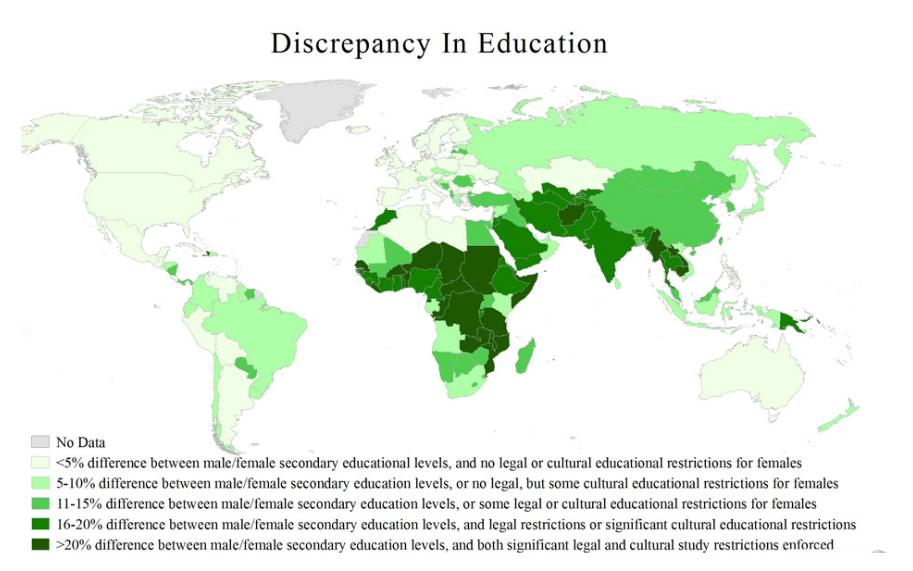
In the developed world, the education of women has become almost a non-issue, with girls overtaking boys both in achievement and number as education progresses. In fact, there are numerous articles discussing potential ways to redress the imbalance between the two. This has led to a sense of false complacency, as gender discrimination no longer really impacts a woman’s access to education.

In many parts of the world, however, the quality of a life can still be made or broken by the presence of absence of an X chromosome. According to a study done by Valerie Hudson, in the Middle East, parts of central and southern Africa and parts of southern Asia still see significant gender-based discrepancies in education and legal or cultural restrictions which propagate them:

(source: http://www.foreignpolicy.com/articles/2012/04/24/the_worst_places_to_be_a_woman#0)


The education of women is not important solely on the principle of equality (though that is ample enough reason), as it has been shown that the effect of an educated female population has a ripple effect throughout the communities in which they live. Mothers have smaller, healthier families, are able to make better economic and personal choices. Such is the effect of the simple implantation of education that closing the gender gap in education was one of the Millennium Development Goals established by the UNFPA.

In a global community which is facing health and population crisis, it seems that empowering the central figure within families – still, centrally, the women – would not only greatly improve individual qualities of life but aid in the alleviation of larger issues. One only has to realize the untapped potential of the educated woman. In terms of sexual health, enforced usage of condoms would slow the HIV/AIDS epidemic. Economically, women could learn to support themselves and their families through simple trade. Family planning, a higher-skilled workforce, a population able to make discerning political choices – it is fair to say that by changing the status of women worldwide, the state of the world itself would alter dramatically.

Defoe’s essay does not entirely fulfil his ideological potential; while starting promisingly enough, it falls short in that it nonetheless concludes by relegating women to the household sphere and as less important than men. However, it would indeed be heartening if we, as an international community, could prove to Mr. Defoe that we have taken a step further and realized not only the moral importance of educating women, but the obvious benefits. Thus we would accurately be able to claim we have advanced somewhat since the sixteenth century.


By Farahnaz Mohammed

Monday, 4 June 2012

Gender Politics


Conservative or not, any spectator of this year’s run-up to the Presidential elections in the United States would have to admit that the Republican Party has pulled some unbelievable stunts, eliciting a collective, ‘Are they joking?’ from the public. From Herman Cain’s entire campaign (highlights include sexual scandals and quoting the Pokémon movie in an address to his supporters) to Donald Trump’s potential candidacy, they seem determined to undermine their own legitimacy. Nothing they have done, however, is more ridiculous - or more terrifying - than their attitude towards women.

Indeed, the Republican Party’s consideration of the fairer sex seems astoundingly antiquated. Before the GOP announced its health care proposals, it attracted scandal and outrage through Rush Limbaugh’s comments regarding Sandra Fluke, a female university student who publically supported state-sponsored provision of contraceptives. Limbaugh, on his program, lambasted the idea that the government would provide young women with such resources, and verbally attacked Fluke herself in a long-winded tirade, stating:
“What does it say about the college co-ed Sandra Fluke, who goes before a congressional committee and essentially says that she must be paid to have sex, what does that make her? It makes her a slut, right? It makes her a prostitute. She wants to be paid to have sex. She's having so much sex she can't afford the contraception. She wants you and me and the taxpayers to pay her to have sex…. So, Ms. Fluke and the rest of you feminazis, here's the deal: If we are going to pay for your contraceptives and thus pay for you to have sex, we want something for it. And I'll tell you what it is. We want you to post the videos online so we can all watch....”

The public outcry and subsequent backlash from advertisers and former supporters has been well documented, but what has not been examined is how any party could breed or propagate such misogyny.

Though the GOP largely declared Limbaugh as an extreme example, through their actions, they ave come to prove themselves as equally misguided. Cutting funding to Planned Parenthood under the guise that they do not support abortion, though less than 3% of Planned Parenthood’s budget is used to fund the practice thereof, attempting to implement mandatory trans-vaginal ultrasounds prior to abortions (even to victims of rape or incest), and in perhaps their most outrageous move, attempting to redefine exactly what constitutes rape.

This is not to paint all Conservative party members as Stone Age anti-feminists, but it is worth questioning an ideology that would justify the clear violation of women’s rights involved in the aforementioned actions. For ultimately, any party is as free to be as radical or outrageous as it chooses. As full of sound and fury as one may be, the only position that truly matters is the one that public chooses to elect. What is most disturbing about the Republicans is the amount of power they hold in one of the most powerful countries in the world. If such ideas can garner such support in one of the most technologically advanced and gender egalitarian societies we have, we must stop and deeply consider what that says for the future of women’s rights worldwide.


By Farahnaz Mohammed

Sunday, 3 June 2012

Argentinean Aesthetics

Argentina is famous for many things: the steak, the football, the landscape and of course, the women. The country has a reputation for having of the most attractive female populations in the world, but, upon closer examination, this honour becomes a dubious one when one considers the high price at which it comes.

Notoriously preoccupied with their image, Argentinean women are unusually concerned with their weight. Argentina’s culture has adopted the obsession with appearance. It is standard practice for the stores to carry sizes significantly smaller than the international standard, causing women to believe they are bigger than they are. A 23 year old student of healthy size and weight who had been on exchange for her studies remembered shopping overseas with fondness. “I remember I went into the store and tried on the XL and they were all too big for me – I tried a medium – a
medium and it was fine! I remember calling my mother to tell her, mom, in London, I’m an M! I’m never leaving!”

The wonderment at average sized being labelled as average is a symptom of a deeply rooted psychological disease in Argentina. According to the Association Against Bulimia and Anorexia (ALUBA), 1 in 10 Argentineans is afflicted with an eating disorder ; a natural result of such aggressive cultural brainwashing. It is normal for the women to calorie count and restrict their meals and the local celebrities, more often than not, have undergone significant (and at times drastic) plastic surgery.

This is not a localized problem; globally, standards of beauty have become more unattainable, and consequently, more psychologically and physically damaging. Argentina in particular may be unusual in how visible the problem is, but the psychological manipulation of women to hate themselves – through the media, through society, through shows and magazines and advertising –is indeed a global problem.

Luckily, work is being done to combat this. Campaigns have been launched by independent organizations and major companies (such as Dove’s now-famous ‘Campaign for Real Beauty’) to expose the ridiculous nature of modern ideals. Argentina itself has advocates, working for a cultural shift. Three years ago, a law was passed enforcing stores to stock larger sizes than was then-standard practice. One of the nation’s major newspapers, Clarin, ran a feature advertising the few stores that sold larger-sized clothing and featuring healthier sized models. Said the editor Andrea Rabolini, "We have never received such a tremendous reader response as we did in that one issue..It was like a huge shout of liberation."

We can only hope the trend of embracing our bodies as they were meant to be will gather momentum. After all, it is a form of cruelty to shame any woman into denying herself the enjoyment of some of the best that is available to us; of fullness, of health, of food, of life.


By Farahnaz Mohammed