Showing posts with label gender equality. Show all posts

Thursday, 2 April 2015

WHERE ARE WE TODAY ABOUT GENDER EQUALITY?

By Ana Isabel

Investigating about gender. Searching, reading and deepening on the subject. I found the following infography. Sometimes we think, what is the current situation in relation to gender equality? Coincidence or causality of life, I found this very interesting infography:

Although we see progress in the comparative data hits see these figures today. Because there is still a significant inequality, more than we imagine or think, there is still much to do. A curious fact I commented recently that in Costa Rica only 30% of women own.

As for infography
* 45% fewer deaths than in 1990, but still 800 women die every day from causes of preventable pregnancy. 800 deaths could be avoided, is a large sum even thinking that could be avoided if the media had.

* Between 1990 and 2010, 200 million people have gained access to clean water. Although there are women who spend a total of 16 million hours a day fetching water in 25 sub-Saharan countries. This figure shocked me. But it got me thinking about the importance of analyzing and adapting. That is, we noted that a draft women walking miles to fetch water. The project was a water well and avoid km. But for them it was the meeting point for communication and exchange. Is key to any project is in line with reality and real needs. Plenty to do but you have to see what is being done, learn from the successes and mistakes

* Still find differences in wages, women earn between 10% and 30% less. What would link with access to management positions, according to this infography represents only 5% of managers and directors. Add to reflect on the comments and social thoughts there when a man agrees to a managerial position and when it does a woman.

* Although gender parity in primary education is getting even find cases as in sub-Saharan Africa in higher education 64 girls per 100 boys. Not only have we tended to look at developing countries, because sometimes they are more developed in other important aspects that "developed" countries. Everywhere there is still work to be done, there are still children who have no access to basic education. We found that 60% of women are illiterate person.

* 1 in 3 women continues to suffer physical or sexual violence by an intimate partner mainly. For me this was one of the figures that impacted me, I believe the number is high, especially if we think of all the measures and actions that have been implemented. Will failing something or really effective actions are being carried out but time is concerned? What do you think?


I leave you to analyze the data, reflect on the figures. At what point do we believe? Are we moving? Have you had enough? What else can you do? ... Reflect

Sunday, 23 March 2014

"Women's Rights are Gender Rights " - Equality for Humanity

"We need to steer clear of this poverty of ambition , where people want to 
drive fancy cars and wear nice clothes and live in nice apartments but don't 
want to work hard to accomplish these things. Every one should try to realize 
their full potential. " - Barack Obama spoke these very words one after noon 
in office. Saturday, March 1st will be women's history month in 2014.

When in 1980, President Jimmy Carter, has declared March 8th , as national women's day in 1911. In 1987, the year that I was born , the women's theme was set to be as  "Generations of Courage , Compassion , and Conviction. "

The theme for the 2014 women's month will be " Celebrating Women of Character, Courage and Commitment. "

 NGO is a None Government organization that work with victims of trafficking  and also addressed many different faces when one was to attempt reintregate. There are a few offices regarding these issues. These offices are that include, "Office of Democratic Institutions and Human Rights " , Of Anti - Trafficking Legislative Review. " and a few others that exist as of today.


United Nations released a pdf file of guide lines to prevent such thing as women trafficking.
Each state must follow this protocol, United Nations stated. The protocol as follows goes, each state must address all aspects of trafficking in person, concerns, recalling general assembly 53/111  of 9 December 1998.

 Also the first protocol for the United Nations to follow is "The Religion with the United Nations Convention against Transnational Organized Crime. " And there are over  a few articles written in the United Nations agenda rule of book.

Mary Marshall and Mary Allen on board nurses in in an aboard Commodore Stephen Decatur's ship United States in War of 1812. There are as of now at least 214, 098 women serving in the United States Army in total. And the statistics breaks down the total from military, navy and air force.

Alabama, Alaska, Arizona, California and Colorado are some of the states that hold women in congress such as, Tulsi Gabbard in Hawaii who is a congress woman. Candice Miller, woman in congress in Michigan and others follow as well. 


Jane Adams, Susan B Anthony, Mary Antoinette, Saint Jone of Arc, Aspasia of Miletus, Clara Barton and many more are all women of faces of American history. Jane Adams who was born in September 6th, 1860 of a small town of Cedarville , Illinois was one of eight children.  In 1931, Jane received a Nobel Prize for all she did which included her work with written books on prostitution, women's rights, juvenile delinquency , and militarism, who which she was very nobel for.

Susan B Anthony was very well known for her roll in creating the Women's State Temperance Society. She was also a part of Anti - Slavery Society from 1856 to 1861. Who she later wrote the Susan B. Anthony amendment in 1878. The amendment was the revision of the sixteenth amendment, which stated," The Right of citizens to vote shall not be denied or abridged by the United States or by any states on account of sex. "

The nineteenth amendment is a law that allows the state to determine the qualifications for voting,  and until the 1910 most states disenfranchised women. The Civil War hit hard on women. The thirteen, fourteen and fifteenth amendments suffrages as civil rights laws. But was hard to attain as the real amendment for the nineteenth amendment.


When congress proposed the nineteenth amendment on June 4th, 1919, the thirty six states also passed the amendment within periods of times.

Thursday, 13 March 2014

Lessons from The Parliament of Rwanda, A Genuine Model of Women Leadership.


“Gender equality in every sector is not a favor, it is your right. It is the way it should be. The right to equality is not something that can be given or taken. It begins with each of you believing in your equal ability to achieve,” Paul Kagame, the President of Rwanda.
The representation of women in the parliaments worldwide is low if compared to their portion of their respective populations. According to United Nations Entity for Gender Equality and Empowerment of Women, “Only 20.9 per cent of national parliamentarians were female as of 1 July 2013, a slow increase from 11.6 per cent in 1995”. Women are significantly lacking considerable participation in decision-making positions, an issue that takes its toll on the fulfillment of women’s ambitions and interests.
A publication by The Women & Politics Institute, Washington, D.C. entitled “Men Rule: The Continued Under-Representation of Women in U.S. Politics” highlighted the problem of the vast gap between women and men in occupying places in U.S. political institutions and addresses the possible causes of this glaring fact:

1. Women are substantially more likely than men to perceive the electoral environment as highly competitive and biased against female candidates.
2. Hillary Clinton and Sarah Palin’s candidacies aggravated women’s perceptions of gender bias in the electoral arena.
3. Women are much less likely than men to think they are qualified to run for office.
4. Female potential candidates are less competitive, less confident, and more risk averse than their male counterparts.
5. Women react more negatively than men to many aspects of modern campaigns.
6. Women are less likely than men to receive the suggestion to run for office – from anyone.
7. Women are still responsible for the majority of childcare and household tasks.
USA was shockingly ranked 80th among 188 countries in terms of percentage of women representation in National Parliaments according to the Inter-Parliamentary Union (IPU) statistical archive published by December, 2013.
The situation in Rwanda is entirely different: Rwanda is the country of highest percentage of women representation in parliament where women hold 64 percent of seats in The Parliament. Rwanda is thus by far the world’s leader in women lawmakers. How women rose in the political ranks in Rwanda raised a lot of eyebrows and such phenomenon needed elucidation in the light of what Rwanda suffered in the last decade of the bygone century. The situation in Rwanda hit a rock-bottom in the wake of the futile genocide in 1994, where the war between the extreme Hutu and Tutsu had torn the nation apart. Roughly one-fifth of the Rwandan population was massacred, an HIV epidemic has hit a big chunk of the women and their offsprings secondary to “war rape” incidents, the economy was crippled and the development was dwarfed; however, The Rwandan Patriotic Front (RPF) managed to bring peace to Rwanda and the constitution that was set in 2003 recommended that women to be granted 30 percent of posts in all “decision-making organs”. 
Elizabith Powley, in her work entitled “Case Study: Rwanda - Rwanda: Women Hold Up Half the Parliament” discussed the pivotal factors that affirmed women’s role in political practice. She attributed much of the success to the relentless work of non-governmental organizations and feminist movements, headed by Pro-Femmes Organization that influenced the inclusion of statements clarifying women’s roles in the nation’s constitution. The genocide itself impacted the demography of the Rwandan society as women who composed the majority of the population afterwards were forced to develop themselves and attain leadership characters to meet the needs of their hapless community. The RPF itself had much faith in the idea of empowerment of women and genuinely adopted an equal gender policy at all levels, even though the Kagame-led RPF regime is widely criticized as being not sufficiently ripe democratically. Connie Bwiza Sekemana, the RPF leader and the member of the Parliament said “The issue is not the sex. It is the issue of equal opportunity, of citizen’s rights, human rights, the fundamentals of any citizen. Who is who that brings what? It does not matter whether it is a woman or a man. It matters on performance and delivery”.
Challenges are yet to be overcome in the future. Women representation is still subpar at lower level of governance in Rwanda. According to the Institute of Security Studies (ISS) Africa, “93,3% of all mayors are male, while 75% of the governors are men. Just 6,7% of the district executive secretaries are female. A mere 9,1% of the sector executive secretaries are women, as are 37,7% of the cell executive secretaries”. Some analysts believe that bragging the issue of women’s predominance in the parliament is just a way to blur the real situation in Rwanda and to conceal the biased policy of the Tutsu-based RPF. The gains for Rwandan women in inheritance, land rights and anti-violence approaches intercede for the sour allegations.
Irene Ndungu debated whether the feminist rise in The Parliament of Rwanda signifies a real gain; still she stated that “the role of women in general in Rwanda’s peace-building efforts cannot be gainsaid. The extent to which they have mobilized at all levels to bring about reconciliation, healing and recovery following the genocide is remarkable. Their active role in cultivating a peace agenda is especially commendable, with their country being among only a handful of African countries that have developed an action plan for the implementation of United Nations Security Council Resolution 1325 on women, peace and security”.
The remarkable women representation in Rwanda is a lesson to all countries who still doubt the competency of women and their capabilities in holding leadership positions. The idea of male predominance is written off in Rwanda, a country whose model encourages others to promote women appreciation and empowerment.
By Ahmed Magdi Youssef
References
UN Women, Facts and Figures: Leadership and Political Participation, Women in parliaments.
Jennifer L. Lawless, Richard L. Fox. Men Rule: The Continued Under-Representation of Women in U.S. Politics. Washington, DC: Women & Politics Institute, January 2012
Women win 64% of seats in parliamentary elections, maintaining number one spot worldwide. The official Website of The Government of Rwanda.
Elizabeth Powley. Case Study: Rwanda - Rwanda: Women Hold Up Half the Parliament.
Roopa Gogineni. Rwandan Parliament's Female Majority Focuses on Equality. Voice of America (VOA), September 26, 2013.
Irene Ndungu. Does the dominance of women in Rwanda's parliament signify real change? ISS Today, 12 November 2013.
Inter-Parliamentay Union – archive of statistical data, situation as of 1st December 2013

Friday, 28 February 2014

Fair-play at work


‘Whenever I was asking questions, he was telling me to stay in my place’, confessed a very good female friend of mine some time ago. ‘I wasn’t allowed to know more than he considered adequate. He took all the decisions and all I had to do was to agree with him and follow his rules. He wasn’t interested in any of my ideas or opinions, actually he was angry if I said I had something to say. My men colleagues always had the chance to present their views on every matter. We (the women) have never done that. When I realized this, I quit the job. It wasn’t easy, but I couldn’t stand anymore this discriminatory attitude of my boss’. I was angry to hear that hostile sexism still exists in a so-called democratic environment, but felt happy to know that women realize their unfair status and seek social change.


Few days ago I was talking to the same friend, who found another job. She is working as a junior assistant, although her education, experience and competencies recommend her for a higher position. It’s not easy to find a job nowadays, especially in the area you like, so I didn’t pay too much attention to this aspect until she told me that she is really appreciated at this workplace as she gets a lot of positive feedback whenever they have the staff evaluation and she feels relaxed as she doesn’t have to solve difficult tasks. In that moment I realized something was wrong. Who would value ones’ skills and knowledge, but not give the chance to really use them? Who would hire an expert and let her waste time with average responsibilities? The things got clearer to me, when she added that one of our men acquaintances, who got hired in the same period as she did, already got promoted two times. He wasn’t a brilliant student, nor a skillful person, so how come he succeeded and she didn’t? I knew that she wasn’t the kind of person who just gives up easily. She dreamt big and worked hard to achieve her professional ambitions. I remembered she quit her job in a time of crisis because she was discriminated and she wanted to make a difference. So, what changed?


I found the answer in the “Gender & work” study from the Harvard Business School (Peter Glick, 2013), which brings into attention the fact that nowadays sexism against women in the workplace is much more subtle. While normally we think that only negative stereotypes and hostile positions towards women cause discrimination, this research shows that also attitudes that simultaneously idealize but subordinate women as men’s dependents have the same effect, although at first glance they look favourable. The concept of “benevolent sexism” (BS, Glick & Fiske, 1996, 2001) best illustrates this situations and is the answer to my friend’s case and many other women that found themselves in the same situation. It has its roots in traditional gender stereotypes and helped me understand the on-going discrimination against women in the workforce process and its evolution. While experiencing hostile sexism, my friend’s motivation to succeed and her desire to prove oneself were extremely high. She had the strengths to leave that place and start from scratch. But facing the new form of discrimination, disguised in a kind attitude and a pretty comfortable but insignificant position, she didn’t even notice that it reduced her resistance to inequality and rewarded her for conforming to old stereotypes and status. She unconsciously stays “in her place” because she accepted it to be hers. The combination of positive feedback with less challenging assignments suggests that, rather than being favoured her manager patronized her. Such subtle discrimination undermines women’s ability both to develop and to demonstrate work-relevant skills. This is how women are denied various opportunities to use and improve their competencies, and to achieve success.


Discrimination at work has a wide variety of forms, and occurs in all kinds of settings. The inequality of opportunity is the result of treating people differently because of their features and reinforces disrespect towards Human Rights. As the International Labour Organization states, the elimination of discrimination is an indispensable part of any viable strategy for poverty reduction and sustainable economic development. My friend is one of the many people discriminated at work. Of course, although this text refers to a specific category (women), it can be extrapolated to any person who is denied the right of equal opportunity in employment, because of race, age, gender, sexuality, belief or disability. If it happens to you or to someone you know, please take a clear stance in order to condemn this attitudes.

By Diana Adela

** If you are interested in the “Gender & work” study (Peter Glick, 2013), you can read it here: http://www.hbs.edu/faculty/conferences/2013-w50-research-symposium/Documents/glick.pdf


Saturday, 22 February 2014

Sochi: A Benchmark for Gender Equality


By Sabrina Willard

As we reach (roughly) the halfway point in the 2014 Olympic Winter Games, it seems timely to reflect on the significance of what is always an exhilarating and highly-anticipated event for the international community. Sochi, as it is with all Olympic Games, is a moment in time when people of various backgrounds are tossed together on the world stage and hyper-analyzed by seven billion pairs of eyeballs. It can therefore be a telling benchmark for how the world is progressing in terms of social acceptance and equality, revealing fascinating (and sometimes ugly) insights into how much further we still need to go on these fronts. Importantly for us, the limelight also magnifies the current treatment of women in the sports arena and calls into question any glaring mistreatment or oversight.

The Olympic Charter is the principle document that sets the terms and conditions by which the Olympic Games are governed. One such condition declares that the International Olympic Committee (IOC) is “to encourage and support the promotion of women in sport at all levels and in all structures, with a view to implementing the principle of equality of men and women.” But are the IOC’s efforts to uphold this particular provision falling short?

Yes, we are progressing in the world of sports. Women were first allowed to compete four years after the inaugural Olympic Games were held (despite push-back from the man credited with the revival of the modern Games, Pierre de Coubertin). During that first year, women comprised 22 out of the 997 total athletes competing in tennis, sailing, croquet, equestrian and golf. Just two of the five sports offered in 1900 included women-only events compared to the London Games in 2012, which was the first year in history that women have competed in every sport offered and accounted for more than 44 percent of the participants. In fact, the participation of women in the Olympics at all levels has steadily, if not dramatically, increased over the last 20 years. This is thanks in part to the IOC, which has set various equalizing precedents, such as the 1991 rule that all new events to be included in the Games must have complimentary women’s events, adding more women-only events to events already offered, as well as hosting an international conference every four years that strategizes on ways to promote gender equality in sports. But, as the IOC calls-out in its own “Women in the Olympic Movement” document, “the percentage of women in the governing and administrative bodies of the Olympics has remained low” (Women in the Olympic Movement, October 2013).

To address this issue, the IOC previously “set the objective of reserving at least 20% of decision-making positions for women (particularly in all executive and legislative bodies) within their structures by the end of 2005,” but this goal was not met. (Note: the document did not specify what year the objective was set.) However, it has stated that it is “aware that such an objective can be attained only in successive stages,” adding that “a first objective (having at least 10% of women in decision-making positions by December 2000) was met.”

Slate recently posted an article providing context on women at the Winter Games, and the headline “Smaller Hill, Shorter Sled: How the Olympics Infantilize Women Athletes” leaves no doubt as to the author’s particular take on the IOC’s efforts to promote gender equality thus far. She uses ski jumping as an example of how “in 2014, many women’s Olympics sports are still stuck in that protracted transitional period between basic entry and complete participation” (Slate, February 2014). Most notably, she reported that it took women 90 years (and a lawsuit five years ago during the Vancouver Games) to finally be allowed to compete in this event. Yet, even now, men are allowed the option of jumping from a higher hill and on teams of four while women aren’t. This is true for events across the board at Sochi, she notes, where “women are still skiing shorter distances, launching from more diminutive hills, and competing on teams of smaller sizes.”

So, assuming that the IOC’s programs to promote gender equality are doing what it says they are doing, why are women’s Olympic events still being “half-assed”? (As the Slate journalist put it.) One theory suggests that the continued pervasiveness of male chauvinism in the sports world has a lot to do with it. 

Gian-Franco Kasper, President of the International Ski Federation, was reported saying in 2005 that ski jumping “seems not to be appropriate for ladies from a medical point of view.” Further, Alexander Arefyev, the Russian men’s ski jumping coach at Sochi, has recently claimed that the sport requires “too much hard labor” for a woman’s body.

Why is this sort of talk acceptable, and why aren’t we hearing more uproar from the very people who are the supposed protectors of gender equality at the Games? Dr. Amy Bass, a professor of history at The College of New Rochelle who led NBC’s research team during the 2012 London Games, explained that the International Olympic Committee “is a very elitist and very male organization.” She also stated that “the abbreviation of women’s competition is a testament to the lingering belief that female bodies are physically incapable of going as long, hard, or high as male ones.”

Whether or not this is actually true of the IOC, I am becoming increasingly convinced that the only way women have a shot at clearing the hurdle of sexism in Olympic sports is to infiltrate the system at the executive level. We need to get in there and offer much-needed perspective and guidance on how future Games can be organized to better provide for the rising number of female athletes. Ironically, we need to do exactly what the IOC claims it has been trying to do for years: increase the percentage of women in the governing and administrative bodies of the Olympics.

This is our call-to-action. This top-down approach is the best chance we have of achieving gender equality at the Olympics. 

Monday, 18 November 2013

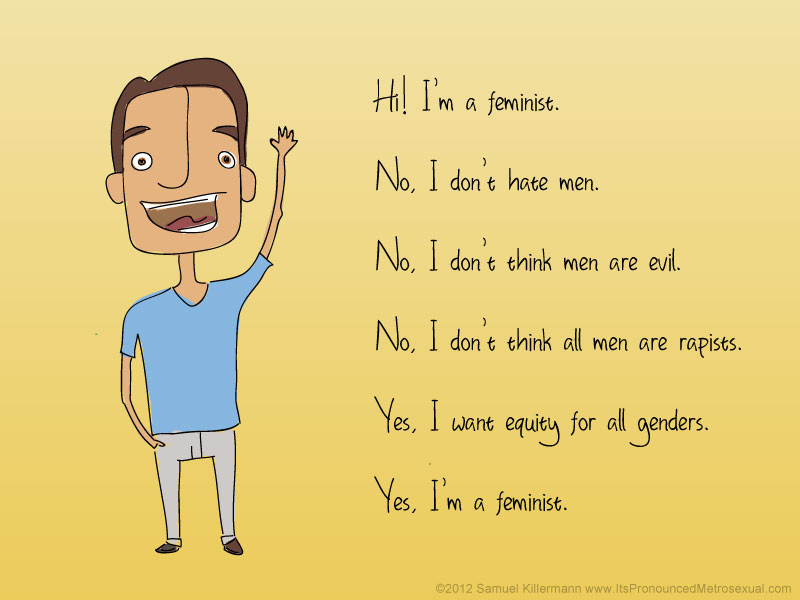
"Oh hai. I is Feminist. I can has Equality?"

This past week has been pretty interesting online: from discovering the dichotomy among feminists, to laughing my head off at Buzzfeed’s new list of funnies for internet feminists. Over the last week, I found a lot of women online insinuating that Karvachauth was anti-feminist. And that got me thinking. Are we becoming crazily antagonistic to men, ignoring the actual notion of equality that underlies true feminism?
Ayuh, dis sounds about right! 
My understanding of feminism – (this may or may not be substantiated by academic theory, and I claim no expertise on my part to assert that my idea of feminism is the absolute truth) - is that it is a promoter of equality.  Not absolute equality or the warped notion that a man = woman = man = woman. But rather, equality warts and all. Equality among equals, equality of respect and value, and equality of worth.
To my mind, feminism is about seeking the empowerment of women, and by extension, of men. To my mind, empowerment is truly attained when a human being is sovereign over their mind and body, and the attainment of the state of understanding and acceptance that every individual’s mind and body is theirs only, and not for another to pass judgment on or impose upon unreasonable restraints, encroachments and demands.
With that in place, it does not disturb me that there are women and girls who choose to veil themselves in different parts of the world of their own volition. With that in place, it does not disturb me that there are women who choose to fast for their husbands’ longevity from dawn until the moon appears in the night sky.
Why? Because each of these women makes the choices they actively believe in, and endorse. And in doing so, they are entirely free and liberated. She made the choice, and she must (and will) deal with the consequences. Why brand her a scion of all things anti-feminist, when she is simply doing something of her own volition, something no one compels her to do, something she does because she wants to?
The trouble creeps in when these things are imposed. Imposed veiling, imposed rituals, imposed obligations, imposed rules that a woman must be subservient to a man. For when there is an imposition, there is an encroachment of individuality. When there is an encroachment of individuality, there is an erosion of empowerment. When there is an erosion of empowerment, there is an absolute disregard for identity. And when identity is disregarded, as a natural corollary, dominance prevails.
Being a feminist is the one part of my identity that I am happiest about. But that does not mean I hate men, or
Oh hai. I is Feminist. 
that I do not believe in giving men the respect that is due to them. For me, feminism is not about denouncing everything by reading a sexist overtone into it when there is and should be none. For me, feminism is not about blindly parroting that “the woman is always right”. For me, feminism is not about taking down men and all things masculine.
For me, feminism is about celebrating the differences that men and women bring to the table. It is about not just recognising those differences, but complementing them with each of our own contributions. Men and women are both valuable to society: one can’t survive without the other, and the entire human race will crumble in seconds if one is wiped out while the other remains. There is something that intricately links the survival of society and the acceptance of this truth.

For me, feminism is about loving all the men as much as the women in my life for making it what it is. 

Telling you that I am a feminist feels great. It feels like a mug of steaming coffee early in the morning. Warm, fuzzy and home-like.
Yep. Totally.

Tuesday, 20 August 2013

Gender Equality Action Plan

The efforts of some countries to improve women’s quality of life and decrease gender inequality demonstrate the complex processes involved in promoting gender equality and women’s empowerment.
Despite all the difficulties in this process there are initiatives that intend to bridge the gaps that still exist in this subject.
An example of these initiatives is the UN-HABITAT's Gender Equality Action Plan.
This plan was developed through a participatory process, uniting all UN-HABITAT programmes and partners to improve gender equality and women’s empowerment. The plan contributes to the attainment of the Millennium Development Goals, especially around water and sanitation, environmental sustainability, and improving living conditions in slums.
The Gender Equality Action Plan covers each area of UN-HABITAT’s Medium-Term Institutional Plan (2008-2013), ensuring that gender-concerns cut across all work. This plan covers six action areas:
-       Advocacy and monitoring of gender equality in cities;
-       Urban planning, governance and management;
-       Land and housing;
-       Access to environmentally-sound urban services;
-       Access to sustainable finance for housing and infrastructure;
-       Strengthened gender mainstreaming in all UN-HABITAT programs.
On the UN-HABITAT’S Gender Equality Action Assembly, 19-20 March 2010, in Rio de Janeiro, Brazil, were presented some examples of progress in implementing this plan. These included improved advocacy on gender equality and monitoring of gender gaps in cities (e.g. through new web projects and publications); capacity building for local governments on gender mainstreaming and on improving dialogue with grassroots women; programmes to address gender inequalities in accessing and owning land and property; water and sanitation programmes that maximize women’s involvement and create income-generation opportunities; and housing finance initiatives that are helping more women than ever before.
There is still a long way to go but the steps already taken ensure a fairer reality that can be improved over time.


Contributed by Catarina Campos

Tuesday, 6 August 2013

Gender Equality: An Uphill Battle

I’ve lived in New York City for nearly seven months and I’m already familiar with the complexities of taking the 8:20 “4” train into uptown Manhattan every weekday morning. Not only are the subway cars filled with grumpy workaholics yet to have their first cup of coffee—the incoming trains are often already packed by the time they arrive at the station, breeding an “every man for himself” mentality.
Elbows fly as soon as the familiar ding indicates the doors are opening, and we all jockey to be the first on the train. But hundreds of short-tempered New Yorkers forced to crowd together before 9 a.m. creates a palpable tension in the air. Like an electrical current awaiting that initial spark.
I had just slipped between a tall gentleman in a suit and an older woman shouldering a gym bag, and grabbed the overhead bar for stability, when I heard a woman’s voice coming from the door I had just dashed through.
“Excuse me,” she said, in an annoyed tone to the man behind her.
It’s a reccurring theme: Person A wants to exit the train, person B wants to quickly enter.
The result: a head-on collision.
The commuters lucky enough to have already staked out their positions observed the scene with weary interest, yet we couldn’t have predicted the seriousness of the situation.
“You need to stop! Just don’t push me, okay?” the woman exiting the train said, now raising her voice.
She had turned around with palms facing out to look up at the guy who had tried to forcefully steer her out of the car. Without hesitation he spun back around to face her, leaned in close, and proceeded to tell her off in language that was so aggressive and uncalled for that I couldn’t believe it was coming from the mouth of a full-grown adult.
“Don’t start with me, b@!$%,” he yelled, causing everyone in the train to jump.
“I was just say—,” the woman started to protest, but he quickly cut her off.
“Oh, you want to keep going?” he asked.
The six-foot-something man abruptly switched from name calling to actual threats, repeating several variations of “I will knock you the f$@# out.”
He demonstrated his seriousness by stepping closer and closer with each taunt, puffing out his chest and using his height to loom over her with a truly terrifying look in his eyes. I honestly thought she was going to get hit, and I’m assuming she thought so too from the way she cringed.
The entire scene was witnessed by dozens of people who, like me, had all stopped what they were doing to stare at the man in horror. The woman slipped into the crowd at the first opportunity, disappearing into the congested platform.
I clutched the overhead bar and tried to comprehend what I had just seen. As the train lurched forward, I wondered whether the strides we have made for gender equality are still falling short of the mark when women can’t stand their ground without being labeled “shrill,” a “b@#!$%,” or worse—threatened physically.
Unfortunately, there is still this tendency in our society to think of women as “prepackaged.” When there should be acceptance no matter how a woman chooses to think/behave/live her life—you know, because we are all human beings—some of us are met with backlash as we realize that we don’t want to fit anyone’s preconceived stereotype (i.e. meek, nurturing, and soft...  etc.) Witnessing this chaotic scene forced me to acknowledge that the world continues to reinforce the belief, for many women, that we shouldn’t talk back, be assertive, or insist that a man not physically assault us and expect to not pay for it in some form or another.
It is time that we pay more attention to the implications of the implicit assumptions that men and women have about gender. As children, we are inundated with messaging that eventually shapes how we come to view our place in society, and how accepting we are of people who don’t fit into those traditional stereotypes. If she is continually exposed to similar situations, will the little girl who was sitting next to her mother on that train come to think it is okay if she is treated like that by men? Conversely, will the little boy watching the chaotic scene from the station platform (if exposed to similar situations at home) grow up to think that women should be submissive, or else? The World Health Organization seems to think so. According to the United Nations’ premier authority on health, men worldwide are three to four times more likely to become an abuser if they grew up in a household with domestic violence.
Recent think pieces like Lean In, by Sheryl Sandburg, suggest that more and more people are getting on the bandwagon about female empowerment (at least, from a workplace equality standpoint). However, in other countries, this woman on the subway might have just been lucky she wasn’t backhanded without a second thought. To some degree, the global community of women share in this uphill battle against gender stereotypes that push us to conform to how we “should” or “should not” behave. Despite the advances we have made collectively over the last century, these implications continue to affect the way we are treated at work, at home and, yes, even on the subway.
If you are interested in learning about your own implicit associations, I encourage trying a few of the social attitudes quizzes developed by Harvard University’s Implicit Project.

Written by Sabrina Willard

Monday, 8 July 2013

All show, no go or being beautiful in France.


When I read the title of a Washington Post article “The U.S. is catching up to Europe on gender equality”[1], it came as a bit of a surprise – had they so much catching up to do? Besides, I hadn’t noticed that much of a gender equality discrepancy any time recently in Europe – or more specifically France, which is where I have been an on-again, off-again inhabitant for the last 17 years. (Mind you, there are definitely worse places to be a woman[2] like Algeria (ranked 120th), another place in which I was an erstwhile resident.)


Little wonder. The 2012 World Economic Forum report is pretty damning on the subject, ranking France 57th after most other Western nations, including Spain (26th), (though spectacularly outdone by Italy which ranked 80th) and other more seemingly unlikely candidates – the Philippines, Malawi, Mozambique, Jamaica and even Kazakhstan. France was only marginally outdone by Israel and Singapore, but in turn only marginally outdid the Russian Federation.


The ranking is based on the measurement of four metrics - economic participation and opportunity, educational attainment, health and survival and political empowerment – and has been in free fall from 15 in 2008. So let's look at the figures:


 Eighty-two percent of French women work fulltime, and perform an average of over 5 hours of housework and sundry other domestic tasks, twice that of their male partners.
French women are generally well-educated and overall better and longer educated than their male counterparts. However, they earn 27% less on average. The World Economic Forum ranks France a rather confounding 131 for gender pay parity. 
 France legalized medical contraception in 1967, abortion in 1975 and in terms of access to healthcare, France ranks particularly well.
Women account for 53 percent of French voters but are not courted as they are in the US for instance. The pandering Hollande, picking up voter scraps, boasted complete parity is his government naming 17 women ministers out of 34 - only to entrust 1 big ministry (Justice) to them. Let’s see how many of them last.
So what does this say about one of the largest European economic powers and most progressive societies? That French women seem to have it all - the job, the multiple children, the healthcare (including, amusingly enough, state-funded vaginal gymnastics, as common as aspirin, to get back in the proverbial saddle), the free daycare, and as a New York Times article put it, often coupled with “a figure to die for”[3] - along with chronic exhaustion and a considerable stash of anti-depressants, of which French women are the biggest consumers. Food for thought.

Written by Candice Lewis

Click here for the WEF report - http://www.weforum.org/issues/global-gender-gap