Showing posts with label Women and girls. Show all posts

Tuesday, 10 March 2015

‘Pass It Back’ brings hope to girls in Lao PDR


By: Shaye Williams


Girls in Northern Laos complete a Rugby race


“Sport has the power to change the world”-Nelson Mandela


Laos is at a critical moment in its response to Millennium Development Goals (MDGs). More than one quarter of the population lives in poverty. Children in Laos face an uncertain future, as nearly half under the age of five are chronically malnourished. Poor infrastructure coupled with lack of access to clean water forces many children into manual labor to survive. 

Low-literacy rates are a primary driver for poor health, substance abuse, and hopelessness. Grassroots sports development may provide a platform for change. Women Win and the Asian Rugby Football Union have partnered with ChildFund Australiato launch a Sport for Development Initiative in Vietnam and Lao PDR called ‘Pass It Back’. Rugby will become a vehicle to support cross-border understanding through sport and culture as well as promote growth-mindsets.

In recent years, an emerging body of research has emerged to support the practice of sports-based interventions for socially vulnerable youth.In particular, sport-for-development has been noted in studies concerned with social capital acquisition among youth.Moreover, there exists a major opportunity to demonstrate how sport development can contribute to long-term social and systemic change. 


The links between sport and health are clear. In Laos, there is a growing risk of drug use among youth and sport may serve as a deterrent for illicit substance abuse. Providing opportunities for children to build a love for sport is a protective feature against a myriad of at-risk behaviors.

Girls in Lao PDR and Vietnam are burdened with domestic responsibilities at a very young age and this severely limits the time they have to play sports. The role of sport is often overlooked in development, but it is a tool that can be used to deliver high quality prevention at a low cost. Getting youth to engage in organized sports in Southeast Asia has been a major win for ChildFund Australia. April 7th will mark World Health Day 2015, to honor this ChildFund Australia has been vigilant in its promotion of sports-for-development programs in Lao PDR and Vietnam. ‘PassIt Back’ will undoubtedly face many challenges to its sustainability of organized sports programs.  Many of the communities lack adequate sports facilities and there is a prevalence of unexploded ordnance left over from the Vietnam War.

Ultimately, the goal of the program is to create a world where sport is a model for sustainable development and we believe we can be a leader in defining best practices in the field. Therefore, ChildFund Laos is currently working towards implementing an initiative that addresses these dual goals. Recognizing social innovation through sports is not a panacea; we are driven to continually improve our model.

Sport is ecumenical in its ability to reach populations living in diverse regions from agrarian communities to urban cities. ‘Pass It Back’ will build leaders through rugby in Asia, by merging sports engagement with life skills development among children and youth. ChildFund Australia believes humanitarianism through sports has the power to positively transform the lives of children living in resource-limited communities around the world.


Friday, 28 March 2014

Driving women not to drive


Yesterday I was out for a walk and while crossing the street I saw two cars passing on the red light. All the pedestrians were outraged but only one has externalized his anger. ‘It’s not green you f*** b****, can’t you see? You women shouldn’t be allowed to drive’ he shouted. In that moment I realized that one of the drivers was a woman and that the man that apparently called for respecting the law was violating it, by gender discrimination. He wasn’t actually angry because two drivers were disobeying the rules, but because one of them was a woman. He didn’t mind that a man was accelerating on the red traffic light, but because she did it. Instead of showing a sense of justice, he acted like the law wasn’t meant to be equal for everyone.


This short episode made me think of one topical issue: women driving. A quick search on Google revealed lots of “why women can’t drive”, “women - the worst driving and parking skills” and “fail compilations”. All these encourage discrimination and harm personal integrity. Insulting a woman and minimizing her abilities pulls back her self-confidence. Repeating this action, even if the actual law permits it, women will be afraid to try to get their licence and will suffer from violent verbal aggression in traffic. While this kind of situations can happen in any part of the world (unfortunately), in Saudi Arabia it’s even worse: women remain banned from driving. This rule strongly affects women’s freedom of movement and their right to learn and work, making them dependent on men and even subjugated. Although lots of activists constantly organized campaigns to end the prohibition on driving, the reality is still against women’s rights.


Driving skills are not genetic like these oppressors argue (I’ve heard a lot of times that ‘women simply do not have the driving gene’), but are part of the competencies that one can develop. Denying this freedom is a severe violation of Human Rights. Of course, like any other person that wants to obtain a driving licence, women should know the rules, be attentive in traffic and practice their abilities. Not all of them will like driving, not all of them will take the test for the licence, but at least give them the chance to choose. But like this, they are driven into a closed wall world.


If you are interested in this topic, I recommend you to watch this video: http://www.ted.com/talks/manal_al_sharif_a_saudi_woman_who_dared_to_drive and check this website: http://saudiwomendriving.blogspot.ro/


Diana-Adela

Friday, 21 March 2014

Poverty in the USA

Poverty in America has been standing still since the Great Depression.  In August of 1929, the worlds most powerful nation, United States came under a Great Depression where it became the most poorest country in the world. The Great Depression has created economical downfalls that has postponed and helped to reduce spending, falling confidence, and lowered production. ( Says wikipedia. ) 

Wikipedia states that, when recession of 1937 brought back 1934 levels of unemployment, our economy just went back up in a spiral upward back in 2012, when President Barack Obama became the first African American President of the United States of America ever in history of nations of Presidents. He is the 44th President of the United States. 

There are many theories that caused the Great Depression back in the beginning of 1929, where our President Bill Clinton grew up during the depression, who then, later in life became the President and later was impeached in 1998. 

The theories behind the Great Depression which lead America in to poverty, has been named as , orthodox classical economics, monetarist, Keynesian, Austrian Economics, and many, many more.

The political results were a great out come during the Great Depression and after. The Great Depression was a tough and a horrible time that when American citizens suffered greatly during the depression. Although, it did more good then bad. Great Depression helped to set minimum wage, says wikipedia. It also helped to encourage unions that it would raise wage to workers and their employers to create possible living wages for Americans that were suffering greatly in the Depression it's self. Like, President Bill Clinton who was born on August 19th, 1946  in Chester Hospital in Hope, of a town of about nine children of a poor farmer in Sherman Texas who later died when his father was seventeen.   ( Says Bill Clinton auto biography. ) 

The crash of Wall street which was titled as " The Great Depression " has downsized the American economy from $103.6 billion  in 1929 to $66 billion in 1934 says a website (www. shmop.com)

By Anastasia Khramova

Thursday, 20 March 2014

Rape: Understanding some elements


Rape is a tragic and traumatic incident. But collecting evidence at a primary level can be done by the person who has been raped or the person's close confidantes. As unfortunate as it is, with increasing cases of rape one never knows when this information might come in handy. The points below are from a book titled 'Feminology: Woman Abuse'. Author: Bassam Imam. 

Some of the points have been simplified for ease of reading. Some have been taken out as they are not according to the Indian Penal Code. Of course it's not possible to remember them all. But browsing through them will only prove to be helpful. Here you go!


1. Your personal safety and security is number one! If you were raped by a stranger in unfamiliar surroundings and left after the rape, the rapists may return for some more

2. You need immediate medical care regardless of how you feel. You may have serious medical injuries that need to be treated immediately

3. You’re understandably fearful about having a physical examination. But it is important. However, do not let anyone to exploit you further under the pretext of examination

4. Call the police or someone (family or friends, etc) who can adequately protect you from further harm 

5. During the examination you have the right to say stop at any time

6. DO NOT forget to inform the physician and nurse if you’re on medication or if you’re addicted to alcohol or other drugs; even tobacco. Furthermore, if you have alcohol or drugs in your system at the time of the examination it’s imperative that you inform hospital staff

7. If you have any suspicions about having been drugged ask the physician to check for traces of rape drugs or similar derivatives

8. If you have any food or drug allergies immediately inform the medical staff. 

9. The examiner's report can be used as evidence on your behalf. Be sure to see or get someone you trust to see what is written.

10. Make sure the physicians checks for Sexually Transmitted Diseases and gives you emergency contraception to avoid pregnancy 

11. Vaccination for Hepatitis B might be given. You may be prescribed medication for gonorrhoea, syphilis and Chlamydia

12. You really want to take a shower, throw or wash all of the affected clothing, go home and cry like a baby but don't even comb or clean your hair. DNA and other valuable evidence can be obtained from your body and clothing

13. It’s imperative that a blood test be taken

14. Ask about follow-up treatment and medications

15. Inform your family physician (if you have one) of what has happened. Ask the medical staff to send an official copy of the exam results to your physician

16. Ask if the hospital has a rape kit to simplify and quicken the process

Remember, anyone can be raped and the rapist need not be a stranger. 

Written by Neilima

Monday, 18 November 2013

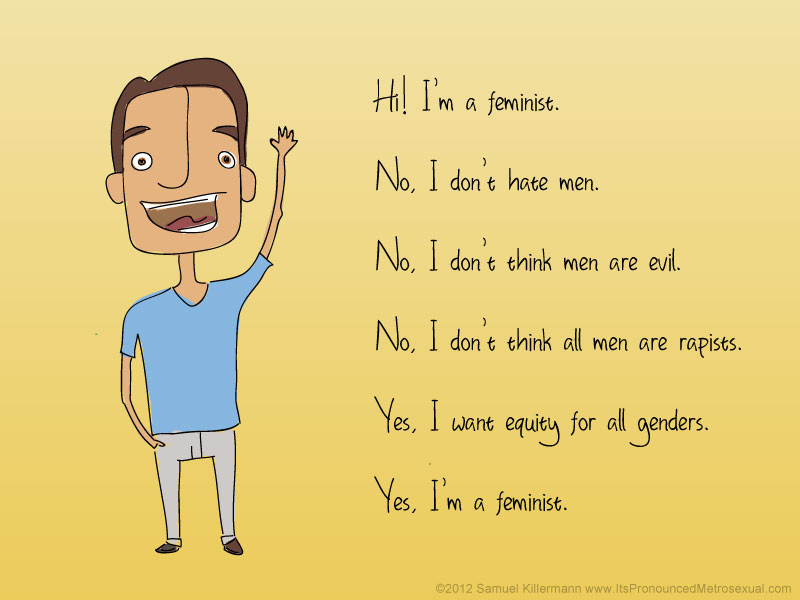
"Oh hai. I is Feminist. I can has Equality?"

This past week has been pretty interesting online: from discovering the dichotomy among feminists, to laughing my head off at Buzzfeed’s new list of funnies for internet feminists. Over the last week, I found a lot of women online insinuating that Karvachauth was anti-feminist. And that got me thinking. Are we becoming crazily antagonistic to men, ignoring the actual notion of equality that underlies true feminism?
Ayuh, dis sounds about right! 
My understanding of feminism – (this may or may not be substantiated by academic theory, and I claim no expertise on my part to assert that my idea of feminism is the absolute truth) - is that it is a promoter of equality.  Not absolute equality or the warped notion that a man = woman = man = woman. But rather, equality warts and all. Equality among equals, equality of respect and value, and equality of worth.
To my mind, feminism is about seeking the empowerment of women, and by extension, of men. To my mind, empowerment is truly attained when a human being is sovereign over their mind and body, and the attainment of the state of understanding and acceptance that every individual’s mind and body is theirs only, and not for another to pass judgment on or impose upon unreasonable restraints, encroachments and demands.
With that in place, it does not disturb me that there are women and girls who choose to veil themselves in different parts of the world of their own volition. With that in place, it does not disturb me that there are women who choose to fast for their husbands’ longevity from dawn until the moon appears in the night sky.
Why? Because each of these women makes the choices they actively believe in, and endorse. And in doing so, they are entirely free and liberated. She made the choice, and she must (and will) deal with the consequences. Why brand her a scion of all things anti-feminist, when she is simply doing something of her own volition, something no one compels her to do, something she does because she wants to?
The trouble creeps in when these things are imposed. Imposed veiling, imposed rituals, imposed obligations, imposed rules that a woman must be subservient to a man. For when there is an imposition, there is an encroachment of individuality. When there is an encroachment of individuality, there is an erosion of empowerment. When there is an erosion of empowerment, there is an absolute disregard for identity. And when identity is disregarded, as a natural corollary, dominance prevails.
Being a feminist is the one part of my identity that I am happiest about. But that does not mean I hate men, or
Oh hai. I is Feminist. 
that I do not believe in giving men the respect that is due to them. For me, feminism is not about denouncing everything by reading a sexist overtone into it when there is and should be none. For me, feminism is not about blindly parroting that “the woman is always right”. For me, feminism is not about taking down men and all things masculine.
For me, feminism is about celebrating the differences that men and women bring to the table. It is about not just recognising those differences, but complementing them with each of our own contributions. Men and women are both valuable to society: one can’t survive without the other, and the entire human race will crumble in seconds if one is wiped out while the other remains. There is something that intricately links the survival of society and the acceptance of this truth.

For me, feminism is about loving all the men as much as the women in my life for making it what it is. 

Telling you that I am a feminist feels great. It feels like a mug of steaming coffee early in the morning. Warm, fuzzy and home-like.
Yep. Totally.

Thursday, 26 September 2013

4 reasons to fall in love with Frida Kahlo.

Do you ever wonder why do we love her? I do, almost every time that I watch a picture of her and notice something particular and mysterious about her face, her beautiful hair and all the cultural legacy that she carried in her back. 

To explain my love I could enumerate one hundred millions of reasons, but one of the biggest is the fact that she was a passionate woman, and that is the way we all should live our lives.

Magdalena Carmen Frida Kahlo Calderón was a Mexican artist from the early 20th century. Her legacy comes to us through her portraits, her paintings and her beautiful ideas throughout her years. Yes, she had a hard life, but also she had an extraordinary way to live the love, one of the most inspiring emotions in her life.

Do you want to know 4 reasons to love her even more?

1. She was intense: Her feelings were the main source of inspiration (just as we should inspire our lives too right?). Her first portrait in the 1926, was also her first “serious” step into the painting as a tool to express her emotions, then she became unstoppable. Her first marriage with Diego Rivera was the top and the also the heart of the new Frida, a woman much more confident but unfortunately (as many of us) with a big sorrow that she always reflected in her art, she couldn’t gave birth any children.

2) She exposed her emotions with no shame: She claimed “I paint self-portraits because I am so often alone, because I am the person I know best” and is easy to understand her emotions through her words, as clear as we can see her colored flowers over her hair. Further she said about her art “They thought I was a Surrealist, but I wasn’t. I never painted dreams. I painted my own reality”. Analyzing this, we can see how she showed her real feelings, no caring how openly exposed she would be to the world’s eyes.

3) A woman with an opinion: She was constantly involved with the political scene of her country. Mexico was living serious changes, and she decided to join the process as an activist. Besides that, she also had some famous friends like the Chilean poet Pablo Neruda, the Spanish painter Pablo Picasso among many others that obviously were the coolest people of her period.

4) Her legacy: Nowadays thanks to Frida and her devises, Mexican women and also people from all over the world can be delighted with all the treasures that she left us, treasures that were more than only colored painting. For example if you go to México you can find “La casa azul” located in Ciudad de México, the house where she lived all her life and later became a museum.

Today we can found her in almost everywhere, and of course we are all blessed to have a part of her inspiration inside of us. She is such the icon that personally I want to recreate everyday, and maybe someday to cooperate with our cultural world as much as she did too. I like to think that we all can have a little bit of  the vivacious Frida inside of us.

By Carla Deppler

Tuesday, 6 August 2013

Gender Equality: An Uphill Battle

I’ve lived in New York City for nearly seven months and I’m already familiar with the complexities of taking the 8:20 “4” train into uptown Manhattan every weekday morning. Not only are the subway cars filled with grumpy workaholics yet to have their first cup of coffee—the incoming trains are often already packed by the time they arrive at the station, breeding an “every man for himself” mentality.
Elbows fly as soon as the familiar ding indicates the doors are opening, and we all jockey to be the first on the train. But hundreds of short-tempered New Yorkers forced to crowd together before 9 a.m. creates a palpable tension in the air. Like an electrical current awaiting that initial spark.
I had just slipped between a tall gentleman in a suit and an older woman shouldering a gym bag, and grabbed the overhead bar for stability, when I heard a woman’s voice coming from the door I had just dashed through.
“Excuse me,” she said, in an annoyed tone to the man behind her.
It’s a reccurring theme: Person A wants to exit the train, person B wants to quickly enter.
The result: a head-on collision.
The commuters lucky enough to have already staked out their positions observed the scene with weary interest, yet we couldn’t have predicted the seriousness of the situation.
“You need to stop! Just don’t push me, okay?” the woman exiting the train said, now raising her voice.
She had turned around with palms facing out to look up at the guy who had tried to forcefully steer her out of the car. Without hesitation he spun back around to face her, leaned in close, and proceeded to tell her off in language that was so aggressive and uncalled for that I couldn’t believe it was coming from the mouth of a full-grown adult.
“Don’t start with me, b@!$%,” he yelled, causing everyone in the train to jump.
“I was just say—,” the woman started to protest, but he quickly cut her off.
“Oh, you want to keep going?” he asked.
The six-foot-something man abruptly switched from name calling to actual threats, repeating several variations of “I will knock you the f$@# out.”
He demonstrated his seriousness by stepping closer and closer with each taunt, puffing out his chest and using his height to loom over her with a truly terrifying look in his eyes. I honestly thought she was going to get hit, and I’m assuming she thought so too from the way she cringed.
The entire scene was witnessed by dozens of people who, like me, had all stopped what they were doing to stare at the man in horror. The woman slipped into the crowd at the first opportunity, disappearing into the congested platform.
I clutched the overhead bar and tried to comprehend what I had just seen. As the train lurched forward, I wondered whether the strides we have made for gender equality are still falling short of the mark when women can’t stand their ground without being labeled “shrill,” a “b@#!$%,” or worse—threatened physically.
Unfortunately, there is still this tendency in our society to think of women as “prepackaged.” When there should be acceptance no matter how a woman chooses to think/behave/live her life—you know, because we are all human beings—some of us are met with backlash as we realize that we don’t want to fit anyone’s preconceived stereotype (i.e. meek, nurturing, and soft...  etc.) Witnessing this chaotic scene forced me to acknowledge that the world continues to reinforce the belief, for many women, that we shouldn’t talk back, be assertive, or insist that a man not physically assault us and expect to not pay for it in some form or another.
It is time that we pay more attention to the implications of the implicit assumptions that men and women have about gender. As children, we are inundated with messaging that eventually shapes how we come to view our place in society, and how accepting we are of people who don’t fit into those traditional stereotypes. If she is continually exposed to similar situations, will the little girl who was sitting next to her mother on that train come to think it is okay if she is treated like that by men? Conversely, will the little boy watching the chaotic scene from the station platform (if exposed to similar situations at home) grow up to think that women should be submissive, or else? The World Health Organization seems to think so. According to the United Nations’ premier authority on health, men worldwide are three to four times more likely to become an abuser if they grew up in a household with domestic violence.
Recent think pieces like Lean In, by Sheryl Sandburg, suggest that more and more people are getting on the bandwagon about female empowerment (at least, from a workplace equality standpoint). However, in other countries, this woman on the subway might have just been lucky she wasn’t backhanded without a second thought. To some degree, the global community of women share in this uphill battle against gender stereotypes that push us to conform to how we “should” or “should not” behave. Despite the advances we have made collectively over the last century, these implications continue to affect the way we are treated at work, at home and, yes, even on the subway.
If you are interested in learning about your own implicit associations, I encourage trying a few of the social attitudes quizzes developed by Harvard University’s Implicit Project.

Written by Sabrina Willard

Tuesday, 7 May 2013

Her Vagina is not Angry


On Sunday April 27th I went to see a fantastic rendition of Eve Ensler’s The Vagina Monologues here in Busan, Korea. I decided to ask one of the participants about her role in the show. She has chosen to stay anonymous because of some backlash she might face about her sexual orientation. She asked to be called ‘Ryn’ (cute, right).

1) First things first, why the Vagina Monologues?
I chose to do the Vagina Monologues because I really believe in the cause. The whole V-Day campaign focuses on globally ending violence against women. I have been so fortunate in my life to have the support network that I do, and I want to make sure that I do everything I can to make sure other women have that network.

2) What was your favorite thing about doing the show?
My favorite thing about the show was the rehearsals. Everyone would roll in and we would have just sharing moments or snuggle moments or just time to get to know one another. The community of women involved in the show is truly phenomenal.

3) You managed to raise a good chunk of money for a few charities. What can you tell me about the women's shelters?
One of the shelters is for women and children who have escaped domestic violence. I have found that, oftentimes, Korea tolerates domestic violence much more than in the west, at least in my hometown. There are no times in which beating your partner or child is acceptable. And so, I wish to raise money for women and children to help them free themselves that lifestyle.

The other shelter is for women who have exited the sex trade. So many women are propositioned to work as “factory women” or “seamstresses,” etc, but instead are sold into sex slavery. This shelter provides a safe space in which these women can heal, learn, and reintegrate into society.

4) What's your take on “One Billion Rising”?
I think that it absolutely breaks my heart that over 1 billion women on this planet have suffered. Personally, I really struggle with the idea of rising individually. I question how much impact my solo voice has. I stand on my soap box advocating women’s rights, gender equity, and human dignity, But,really, I am not doing anything but shouting. I think 1 Billion Rising gives me an outlet—a place to do something. And, I am always down for a dance party.

5) Why did you choose “The Flood”?
I didn’t choose it, actually. The director chose it for me. I did have some specific monologues I did not want to do because they hit a bit too closely to home, and I think I would have had a difficult time separating “Ryn” from my character.

I had problems developing my character for The Flood. The basic premise of my monologue is an old woman who is very nervous to talk about her "down theres." She likens it to a cellar, and struggles to see the beauty of the vagina. She also discusses her first kiss that caught her off guard, and "there was a flood--down there." The boy who kissed her was not impressed and made fun of her, which led to "the idea of flooding [making her] too nervous, [so she] never even got close again." This part of the monologue broke my heart. It isn't forceful sexual violence or abuse, but offhanded and emotional. A boy made a young girl feel embarrassed about something natural and uncontrollable (and, frankly, awesome). It made her self-conscious and unable to have a happy, healthy sexual identity.

As a woman who has an open and fluid sexual identity, I forget that there are so many women who do not have that luxury. So many women of my mother's, grandmother's generation never had the opportunity to become sexual beings--as opposed to the societally appropriate child-bearing vessels. It is our responsibility as educated and/or progressive women to reclaim our sexuality and make it something we want it to be, rather than something someone else expects.


6) Korea can be extremely anti-homosexual at times. What has your experience as a lesbian been like?
My experience as a lesbian in the ex-patriot community is pretty rad. I don’t ever hide that part of me, and I have found that the ex-pat community is much more open-minded about sexuality. They may not agree with it, but they also are not holding onto the last straw of hope that I will fall in love with a man.

In the Korean community, it is so much more difficult. It isn’t even recognized. There are so many men and women who are closeted for fear of never getting a job, disownment from their families, etc.

What is more interesting is the lesbian culture within Koreans. Personally, I hate the terms “butch” and “femme,” so I will use “Pants” and “Pumps” instead, okay? Within the Korean lesbian community, generally you can only be Pants or only be Pumps. Pants very often will only date Pumps. They try so hard to still fit into the male/female stigma of this country. One partner very clearly being the “man” in the relationship, one clearly being the “woman.”  There is no room for the versatility we have in the western culture. Of course, the west definitely has a Pants and Pumps dichotomy, however, there is a lot more flexibility. Personally, I am in the middle. There are many days when I rock converse, skinnys, button down, and a lady vest, but I also love wearing dresses and skirts and scarves. When I was talking to a Korean lesbian about this, she was astounded that I would even consider wearing both types of clothing. I explained that in the States, we do not have to pretend to be one man and one woman for society to be okay with us. Sometimes, society isn’t okay with us as two women, but that isn’t something for which I am willing to change myself.

7) Any extra fun stories from when you ladies were preparing for the show?
There was one Sunday when EVERYONE but me was a bit fragile from the previous night. We had a plan to do a run through and small group practices, but it just ended up turning into a giant cuddlefest/chat session. This really brought us together and cemented some pretty stellar friendships.

8) The most powerful performance for me was about the Korean comfort women. What can you say about that piece?

You mean, I didn't knock your socks off, Matt? What a shame.

I can say a lot of things about this piece. I know that men have been using rape as a tactic of war for hundreds of thousands of years. We don't learn about that in history class, or if we do, it is introduced glossed over as, "Oh, this happened" and we move onto the "real" parts of war. However, this monologue brings to light the repercussions of using women for sexual needs. It discusses the living conditions, desire for death, and necessity for recognition. I was able to keep my emotions in check when the actors said horrific things like, "Sometimes they didn't even take off their clothes...just took out their penis" or "do it even when we bleed" or "Things we could not do...keep my baby." What I could not handle was the last minutes of the performance when the women, in unison, shout, "Say it...Sorry...outside the Japanese embassy every Wednesday...Say it...To me...Sorry...To me...Sorry".

In discussing the monologue with the performers, one of the women said that Korea's culture is so much a communal culture that the Comfort Women were everyone's mother, every one's grandmother. And, so it touches on a part of their history that is still so raw and bleeding. Every time I watched that piece, I felt like an intruder looking in on a piece of history that was so private and holy--something I would never understand.

9) What's your favorite color?
My favorite color is cerulean. It is the only crayon I refuse to lend out. I have only seen in once in real live nature, and it blew my mind.

10) How do you think the Vagina Monologues has helped female sexual liberty/ sexuality?
I think that the Vagina Monologues brings awareness to necessary discussions about vaginas. It is very true that many women get squicky talking about their vaginas, as if we are ashamed of them. It also sparks a lot of conversations between partners about their sexual organs. I think that showing over 300 men and women in our community that Vaginas are not scary and that we need to love and respect them is important. Vagina Monologues also highlights the importance of rising against sexual slavery.

11If you could only listen to one of the monologues for the rest of your life, which one would you choose?
CUNT!!! I think that it is a brilliant deconstruction of a very pejorative word. I think that words for Vagina (pussy, twat, etc) should never be used to bully. Equally, I think that dick should be taken out of the vernacular as a pejorative, but then again, I would have to completely modify my own vocabulary. I do love a good dick joke.

12) Famous last words?
I refuse to stand by and watch as billions of women suffer violence because of their gender. Strike. Dance. Rise.

By Matthew Ariss

Saturday, 16 February 2013

WOMEN BLAMING WOMEN


Sexual harassment as defined by The U.S. Equal Employment Opportunity Commission (EEOC) in its guidelines is:
‘’Unwelcome sexual advances, requests for sexual favours, and other verbal or physical conduct of a sexual nature when:
·         Submission to such conduct is made either explicitly or implicitly a term or condition of an individual's employment, or
·         Submission to or rejection of such conduct by an individual is used as a basis for employment decisions affecting such individual, or
·         Such conduct has the purpose or effect of unreasonably interfering with an individual's work performance or creating an intimidating, hostile, or offensive working environment.’’

Unwelcome Behaviour is the critical word. Unwelcome does not mean "involuntary".
A victim may consent or agree to certain conduct and actively participate in it even though it is offensive and objectionable. Therefore, sexual conduct is unwelcome whenever the person subjected to it considers it unwelcome. Whether the person in fact welcomed a request for a date, sex-oriented comment, or joke depends on all the circumstances.


Here are some examples of what constitute sexual harassment:
·  Actual or attempted rape or sexual assault.
·  Unwanted pressure for sexual favours.
·  Unwanted deliberate touching, leaning over, cornering, or pinching.
·  Unwanted sexual looks or gestures.
·  Unwanted letters, telephone calls, or materials of a sexual nature.
·  Unwanted pressure for dates.
·  Unwanted sexual teasing, jokes, remarks, or questions.
·  Referring to an adult as a girl, hunk, doll, babe, or honey.
·  Whistling at someone.
·  Cat calls.
·  Sexual comments.
·  Turning work discussions to sexual topics.
·  Sexual innuendos or stories.
·  Asking about sexual fantasies, preferences, or history.
·  Personal questions about social or sexual life.
·  Sexual comments about a person's clothing, anatomy, or looks.
·  Kissing sounds, howling, and smacking lips.
·  Telling lies or spreading rumours about a person's personal sex life.
·  Neck massage.
·  Touching an employee's clothing, hair, or body.
·  Giving personal gifts.
·  Hanging around a person.
·  Hugging, kissing, patting, or stroking.
·  Touching or rubbing oneself sexually around another person.
·  Standing close or brushing up against a person.
·  Looking a person up and down (elevator eyes).
·  Sexually suggestive signals.
·  Facial expressions, winking, throwing kisses, or licking lips.
·  Making sexual gestures with hands or through body movements.

While a significant number of women in Africa are in the workforce, little is known about the extent to which sexual harassment persists in the workplace, the kinds of actions that are taken when it occurs and whether working women are even aware of possible actions they can take. The small amount of available evidence suggests that sexual harassment in the workplace continues to be a common occurrence, typically perpetrated by a person in a position of authority; the majority of women do not take action or lodge an official complaint for fear of being dismissed, losing their reputation or facing hostility or social stigma in the workplace.
By and large, the topic of sexual harassment is initially met with discomfort, denial and fear of reprisals and some judgmental attitudes about women provoking the incident. At the same time, further probing suggested that women perceived sexual harassment as normal behaviour, an occupational hazard, and even harmless.

Sexual harassment as “normal” and “harmless
Many women view sexual harassment to be a normal and harmless practice, a natural part of a working woman’s life and rarely an issue requiring complaint or action.
These are some responses from a study done amongst 137 healthcare personnel in Kolkata, India.

“Women will study and enter various professions. And then men will behave in this manner [smiling]. We have accepted this is how things will continue.”
                                                                 (Doctor, age 30, government hospital)
“Only a few do this [unwanted touching] so it does not matter”.
                                                                (Doctor, age 25, government hospital)
“This is harmless fun that they have… it will stop with time”.
                                                                (Doctor, age 35, private hospital)

Discomfort, denial and fear
Exploring the topic of sexual harassment in the workplace was a challenging task. A vast majority of women don’t want to discuss the issue. Their discomfort in addressing the topic is evident from the fact that most women who have been harassed in one way or the other refer to it as “that thing”.

Many of them are initially reluctant to discuss the issue of sexual harassment and many denied that incidents of harassment occurred at their current workplace.
Also, some women have fears about discussing sexual harassment for fear of losing their jobs. For example, women employed on daily wages or on contract are particularly reluctant to engage on this issue. They say that sexual harassment was not a priority (compared to obtaining permanent employment).


Women blaming women
By far the most puzzling is the fact that some women have suggested that while sexual harassment at work is provoked by the woman herself, with statements like “if a woman says there is sexual harassment, then I will find out about her behaviour or her dressing”.

Despite the number of women are being sexually harassed at work, few women ever take and complain to their supervisors or to management. Actions taken in these cases were, by and large, indirect and rarely involved confronting the perpetrator or taking action to dismiss the perpetuator.
A variety of reasons appeared to endorse a culture of silence and denial. Most women were not aware of the guidelines and complaints mechanisms/formal institutions of redress. Many feared attitudes that would blame them for provoking an incident or feared the loss of their reputation as a result of complaining. They also recognised their relatively powerless positions and feared job-related discrimination, including dismissal, and withholding of promotions and income.

There is no excuse or rationalisation for sexual harassment in the workplace. It is wrong and women all around must wake up to the fact that it is an infringement on their human rights. They need to understand what constitutes harassment and adopt a no-tolerance approach to it, and seek redress, and above all, they should never blame themselves or other women for any acts of sexual harassment.

BY CHARLES AKHIMIEN