Showing posts with label Equality. Show all posts

Monday, 18 November 2013

"Oh hai. I is Feminist. I can has Equality?"

This past week has been pretty interesting online: from discovering the dichotomy among feminists, to laughing my head off at Buzzfeed’s new list of funnies for internet feminists. Over the last week, I found a lot of women online insinuating that Karvachauth was anti-feminist. And that got me thinking. Are we becoming crazily antagonistic to men, ignoring the actual notion of equality that underlies true feminism?
Ayuh, dis sounds about right! 
My understanding of feminism – (this may or may not be substantiated by academic theory, and I claim no expertise on my part to assert that my idea of feminism is the absolute truth) - is that it is a promoter of equality.  Not absolute equality or the warped notion that a man = woman = man = woman. But rather, equality warts and all. Equality among equals, equality of respect and value, and equality of worth.
To my mind, feminism is about seeking the empowerment of women, and by extension, of men. To my mind, empowerment is truly attained when a human being is sovereign over their mind and body, and the attainment of the state of understanding and acceptance that every individual’s mind and body is theirs only, and not for another to pass judgment on or impose upon unreasonable restraints, encroachments and demands.
With that in place, it does not disturb me that there are women and girls who choose to veil themselves in different parts of the world of their own volition. With that in place, it does not disturb me that there are women who choose to fast for their husbands’ longevity from dawn until the moon appears in the night sky.
Why? Because each of these women makes the choices they actively believe in, and endorse. And in doing so, they are entirely free and liberated. She made the choice, and she must (and will) deal with the consequences. Why brand her a scion of all things anti-feminist, when she is simply doing something of her own volition, something no one compels her to do, something she does because she wants to?
The trouble creeps in when these things are imposed. Imposed veiling, imposed rituals, imposed obligations, imposed rules that a woman must be subservient to a man. For when there is an imposition, there is an encroachment of individuality. When there is an encroachment of individuality, there is an erosion of empowerment. When there is an erosion of empowerment, there is an absolute disregard for identity. And when identity is disregarded, as a natural corollary, dominance prevails.
Being a feminist is the one part of my identity that I am happiest about. But that does not mean I hate men, or
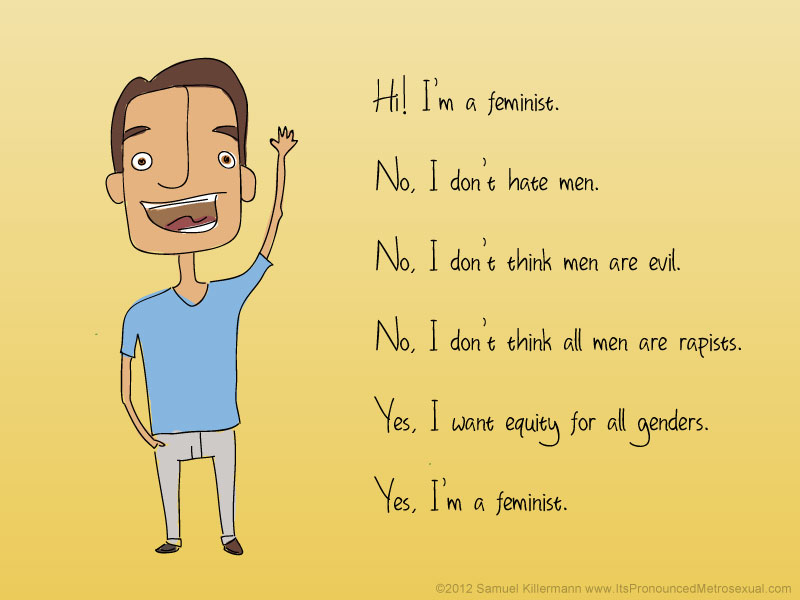
Oh hai. I is Feminist. 
that I do not believe in giving men the respect that is due to them. For me, feminism is not about denouncing everything by reading a sexist overtone into it when there is and should be none. For me, feminism is not about blindly parroting that “the woman is always right”. For me, feminism is not about taking down men and all things masculine.
For me, feminism is about celebrating the differences that men and women bring to the table. It is about not just recognising those differences, but complementing them with each of our own contributions. Men and women are both valuable to society: one can’t survive without the other, and the entire human race will crumble in seconds if one is wiped out while the other remains. There is something that intricately links the survival of society and the acceptance of this truth.

For me, feminism is about loving all the men as much as the women in my life for making it what it is. 

Telling you that I am a feminist feels great. It feels like a mug of steaming coffee early in the morning. Warm, fuzzy and home-like.
Yep. Totally.

Tuesday, 6 August 2013

Gender Equality: An Uphill Battle

I’ve lived in New York City for nearly seven months and I’m already familiar with the complexities of taking the 8:20 “4” train into uptown Manhattan every weekday morning. Not only are the subway cars filled with grumpy workaholics yet to have their first cup of coffee—the incoming trains are often already packed by the time they arrive at the station, breeding an “every man for himself” mentality.
Elbows fly as soon as the familiar ding indicates the doors are opening, and we all jockey to be the first on the train. But hundreds of short-tempered New Yorkers forced to crowd together before 9 a.m. creates a palpable tension in the air. Like an electrical current awaiting that initial spark.
I had just slipped between a tall gentleman in a suit and an older woman shouldering a gym bag, and grabbed the overhead bar for stability, when I heard a woman’s voice coming from the door I had just dashed through.
“Excuse me,” she said, in an annoyed tone to the man behind her.
It’s a reccurring theme: Person A wants to exit the train, person B wants to quickly enter.
The result: a head-on collision.
The commuters lucky enough to have already staked out their positions observed the scene with weary interest, yet we couldn’t have predicted the seriousness of the situation.
“You need to stop! Just don’t push me, okay?” the woman exiting the train said, now raising her voice.
She had turned around with palms facing out to look up at the guy who had tried to forcefully steer her out of the car. Without hesitation he spun back around to face her, leaned in close, and proceeded to tell her off in language that was so aggressive and uncalled for that I couldn’t believe it was coming from the mouth of a full-grown adult.
“Don’t start with me, b@!$%,” he yelled, causing everyone in the train to jump.
“I was just say—,” the woman started to protest, but he quickly cut her off.
“Oh, you want to keep going?” he asked.
The six-foot-something man abruptly switched from name calling to actual threats, repeating several variations of “I will knock you the f$@# out.”
He demonstrated his seriousness by stepping closer and closer with each taunt, puffing out his chest and using his height to loom over her with a truly terrifying look in his eyes. I honestly thought she was going to get hit, and I’m assuming she thought so too from the way she cringed.
The entire scene was witnessed by dozens of people who, like me, had all stopped what they were doing to stare at the man in horror. The woman slipped into the crowd at the first opportunity, disappearing into the congested platform.
I clutched the overhead bar and tried to comprehend what I had just seen. As the train lurched forward, I wondered whether the strides we have made for gender equality are still falling short of the mark when women can’t stand their ground without being labeled “shrill,” a “b@#!$%,” or worse—threatened physically.
Unfortunately, there is still this tendency in our society to think of women as “prepackaged.” When there should be acceptance no matter how a woman chooses to think/behave/live her life—you know, because we are all human beings—some of us are met with backlash as we realize that we don’t want to fit anyone’s preconceived stereotype (i.e. meek, nurturing, and soft...  etc.) Witnessing this chaotic scene forced me to acknowledge that the world continues to reinforce the belief, for many women, that we shouldn’t talk back, be assertive, or insist that a man not physically assault us and expect to not pay for it in some form or another.
It is time that we pay more attention to the implications of the implicit assumptions that men and women have about gender. As children, we are inundated with messaging that eventually shapes how we come to view our place in society, and how accepting we are of people who don’t fit into those traditional stereotypes. If she is continually exposed to similar situations, will the little girl who was sitting next to her mother on that train come to think it is okay if she is treated like that by men? Conversely, will the little boy watching the chaotic scene from the station platform (if exposed to similar situations at home) grow up to think that women should be submissive, or else? The World Health Organization seems to think so. According to the United Nations’ premier authority on health, men worldwide are three to four times more likely to become an abuser if they grew up in a household with domestic violence.
Recent think pieces like Lean In, by Sheryl Sandburg, suggest that more and more people are getting on the bandwagon about female empowerment (at least, from a workplace equality standpoint). However, in other countries, this woman on the subway might have just been lucky she wasn’t backhanded without a second thought. To some degree, the global community of women share in this uphill battle against gender stereotypes that push us to conform to how we “should” or “should not” behave. Despite the advances we have made collectively over the last century, these implications continue to affect the way we are treated at work, at home and, yes, even on the subway.
If you are interested in learning about your own implicit associations, I encourage trying a few of the social attitudes quizzes developed by Harvard University’s Implicit Project.

Written by Sabrina Willard

Tuesday, 23 July 2013

THE MASK WE WEAR


Daily we acquaint ourselves with people of different  colors , sizes and cultures . Out of many , whom we  come across ,only few are able to retain themselves in our mind and then eventually in our hearts .

‘Masking‘.  The act of concealing or disguising.  Amongst the many evolutionary /revolutionary changes man has undergone, nothing more than the simple act of disguise has ,been honed . It is perhaps our chanting mechanism. The face we present to the world is rarely our real face .

Coded by the masks people put on , we often associate ourselves with the wrong people and thus for the rest of our lives we keep seeking  for “that particular person  “ who inspired us . With whom the world seemed a joyous celebration.
.
So the question is. How do we know who is  worth entrusting our emotions in ? Who actually respects us and who is sabotaging our emotional availability?

There are many situations where  the act of masking is dropped off .  It is often in the presence of non persons . “ Non person “ according to the book “ Body language “ by Julius Fast are “ people not worth concerning ourselves about “ . In other words people such as our parents , siblings , children and especially the help around the house ( maids, drivers , cook , washing lady etc ).

 “If you want to know what a man's like, take a good look at how he treats his inferiors, not his equals.”
― J.K. Rowling, Harry Potter and the Goblet of Fire

A clever  yet simple  quote from the famous Harry Potter  aptly illustrates the  phenomena of judging people for who they truly  are .
Masking is somewhat necessary , and is decreed by the society  we reside in . Nevertheless , at proper times the mask should be dropped  , it is obligatory to do so if one wants to develop healthy , functional relationships .
Paradoxically, the big problem is that after wearing a mask for almost a life time ,some of us are unable to easily drop it which ultimately not only harms ourselves but the people around us as well .

Despite our utmost attempts to conceal our true selves , our  body language transmits enough signals to scream out to people , who we really are and what to expect  us . In my opinion people hardly change, the things we become oblivious to about a person  initially , eventually become apparent over the passage of time .

                                                                                                     By : Mariam Samuel


Saturday, 19 January 2013

TV – You’re Doing it Right


Television is arguably the single most influential artistic means of the 20th century. It is all encompassing, bordering on invasive, but it almost uniformly loved. There are two televisions for every three people in America, and even where this excess does not exist televisions are generally accessible. Television has helped take down dictators, revealed corruption, amused children and captivated audiences; people can be found for hours on end lost in the meditative trance that TV promotes, or screaming at their televisions when their football team loses an important game, something they would have no way of seeing otherwise. It is hard to calculate how much effect television has on us, but the effect, even for those who are rare viewers, is undeniable.
TV acts as a double edged sword in our society; it is both a mirror of our current values and a subtle teacher, slowly influencing our thoughts and opinions in all aspects of life. Equality is one of the more traceable aspects and TV has unintentionally chronicled the evolution of women’s place in society, the workplace and the family. Each generation of producers, actors and writers has pushed the envelope farther and shown more risqué things, just like women have done in daily life. Once upon a wonder it was unimaginable for a pregnant women to be shown on TV, but Lucille Ball eventually helped us move past that taboo. The Flinstones showed the first images of a man and wife in bed, and once that was finished another taboo popped up. Each one was dashed away with a few episodes of controversy as women went through being able to then hold jobs on TV, being main roles and finally becoming leaders and role models. This, as all things do, has come at a price, with modern television women almost always either living in the extreme of positive role models or over-sexualized weaklings and uptight dominatrixes. We will discuss a few of the former women in this article, the women who have fought against small-mindedness and have been people that we can admire. We will discuss a few of the women that helped topple the taboos, and a few who are still showing their stuff, ones that you should be watching now.

One of the first notable shows, “I Love Lucy”, was created by and starred the immortal Lucille Ball. The show allowed Ball to both continue her acting career, while simultaneously have a family, as her husband played one of the male roles. “I Love Lucy” was one of the first shows to center its story around a woman, a hard working house wife. Lucille Ball also made history by helping to create an innovative 3 camera technique, which is still commonly used in modern shows. Ball is one of the first of the great TV actresses and her legacy continues today.
Murphy Brown is a show that held great influence in my own youth. While I didn’t understand the importance of what was happening in the show, nor did I know anything of the political controversy that the show inspired, I did notice the powerful presence which was portrayed by the character the show is named after. Murphy Brown was witty, smart, and hardworking. She was shown as a character with a heart-wrenching flaw, she was a recovering alcoholic, but who had overcome her demons and became stronger for it. Murphy Brown’s main controversy was her desire to be a single working mother. This choice even spurred comment for the current vice-presidential candidate Dan Quayle, who commented that the show ignored the importance of fathers. The show powered on, and helped make the argument that women are not needy creatures.

These are just two of the multitude of shows that have helped form and been influenced by women’s rights in the past 70 years, but let’s discuss a few shows that you should be watching now. Like right now. Instead of reading this. even.

30 Rock is one of my favorites. The show stars (and was created by) Tina Fey as the strange and sad at love, but cool in all of the right ways, Liz Lemon. As the Head Writer of TGS (The Girlie Show) Lemon shows, time and again, that women have the stuff to lead. She works hard, she’s passionate and caring, she’s a good friend and, best of all, the woman will can cause spleen rupturing laughter. She looks for love, but is never desperate to find it, she is ambitious, but not ruthless, and did I mention that she’s hilarious?

Miranda is the quintessential British show (according to my limited Canadian perspective) starred by the quintessential British comedian. Miranda Hart is fully aware of what society would call her faults, and she isn’t afraid to make fun of them in her self-titled comedy. She is clumsy and large and socially awkard, but what shines through more than these alleged flaws is her enchanting quirkiness and luminescent wit. In the show Miranda opens a joke shop, despite the risks, and represents the value of doing what you love, rather than what you’re told.   

Parks and Recreation is my favorite show on TV right now. It is filled to the brim with quality characters, and their zany leader, Leslie Knope, continuously proves her unending wonderfulness. The mockumentary chronicles her progress through the world of small town American politics, from departmental worker, to mayor, and mayhaps someday to female president. She is a powerful woman, passionate and unstoppable, who does what is right even at the risk of her own happiness. She works hard to fix her town’s obesity problem, deals with her lackluster boss and makes me laugh even more than our good friend Liz Lemon.

Role-models can be found everywhere; television is a fantastic place to both relax and be inspired. If you gain nothing else from this post go and watch Parks and Recreation. Not the first season, you can google right past that, start with season 2. Make sure you’re loaded up on snacks, find a comfy spot and prepare not to leave the couch for the rest of the day.

By Matthew Ariss