Showing posts with label Child Marriage. Show all posts

Thursday, 12 September 2013

Child marriage: The degradation of humankind


Recently a very traumatizing news about child marriage was published: an eight year old girl died after suffering internal injuries due to sexual trauma in Yemen. The girl was only one of the many victims of such a cruel law that perpetrates sexual slavery and underdevelopment.
The many other consequences of child marriage are not so visible, but are extremely hurtful for girls who have the right, just as everybody else, to grow in a happy and stable environment. Child marriage is an aberration of society and must be stopped!
Education comes as a solution, but we must act now! Governments must do educational campaigns and impose laws that stop child marriage and treat it, not as a cultural custom, but as an act of moral lacking and a crime because its own purpose is to satisfy a party which takes everything away from a person who is in a vulnerable condition.
A child must have special rights due its unique estate. Apart from the position of vulnerability, a girl lacks the total development of her psycho-social status and needs to feel safe and respected. Society must demand that Human Rights come before economic power! How can such disgusting creatures live with themselves after perpetrating such barbarian acts?
Moreover, these acts tell us that humankind is enormously lacking of fraternity and understanding. To harm a child, symbol of innocence and love, is the worst thing a parent or anybody else can do. Cruelty, unfortunately teaches us to know more about some degrading practices in our species.
When defending moral, one cannot avoid feeling old-fashioned and dated, but in a world where everything is relative and humankind has no more shame or sense of value for the suffering of others, feeling old-fashioned is a complement.
In life, the path of tranquility and fulfillment is field with respect and caring for other individuals. When the path is corrupted by manifestations of such disgraceful acts, evil perpetrates. Yesterday an innocent victim died. How many more will we allow to suffer in order to change the way things are done?

Gabriela Isa Rosendo Vieira Campos
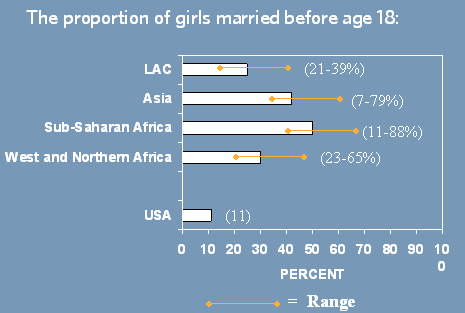
From:  http://www.unfpa.org/swp/2005/presskit/factsheets/facts_child_marriage.htm
By Gabriela Campos

Monday, 10 December 2012

Mysore “Marriage”: Curse of Muslim Women in Kerala


‘Mysore kalyanam’(Mysore Marriage), where Pathan Muslim men from Mysore marry brides from Kerala,a State of India thrives in the city despite bitter experiences for over a decade.

Local unemployed men — some of them anti-social elements, criminals, thieves and drug addicts, — marry girls from Wayanad, Malappuram and Kannur districts of Kerala only to get financial benefits. They divorce their wives later  for various reasons and leave them to fend for themselves. Some of the hapless women are left with three or four children to feed.
Often, the reason cited by men for divorce are trivial issues such as ‘wife has not learnt Kannada, she is not good at making candles or rolling beedis, not fit for Mysore culture or that her cooking skills are bad’.
For some of these men, marriage has become a habit. They go on marrying one girl after other and take dowry from parents of all helpless brides. They organise even fake establishments — parents, house, relatives, etc — in collusion with brokers, who get 15 to 20 per cent of the dowry amount.
Most of the women return to their parents voluntarily, while some are sent back to their native place by local leaders or police. However, a few of them stay back — most of them in Shantinagar, Ghousianagar, Nehrunagar and Kesare, where a majority of Muslims live — and lead a difficult life, because they do not want to be a burden on their parents.
K T Mathews Thomas, inspector, Udayagiri police station, said even on last Tuesday he came across such a case. But unfortunately, most of the cases go to Masjid committees in the area.
Thomas said, “Earlier this month a case was registered, wherein we sent the victim, Sareena, 24, wife of Aleem, an auto driver in Ghousianagar, to her home in Wayanad.”
Abdul Khadir Haji, secretary, Noorul Islam Sabha Committee, Ghousianagar, who has dealt with hundreds of such cases said 95 per cent of relationship in such marriages break within a few months — soon after the groom spends the dowry amount. Some relationships last for a few years. But the couple would have two or more children by then, which compounds the problem.
Most of the men involved in such marriages do not have a permanent address so that they can move from place to place marrying one woman after the other.
Women victims usually do not take legal action due to ignorance about their rights or language problem. Not many approach the police even though there is a women help desk at the CCB office on Ashoka Road. There is a Muslim special court to deal with such cases, but not many know about it.
Moulvi Umar Ali Shihab, Kerala Masjid, Ghousianagar, said the Masjid committee always discouraged such marriages, whenever an enquiry came from Kerala. “But most of the cases come here only after the couple get divorced,” he said.
Nizamudheen Noorani, administrator, Al-Noor English medium school, which caters to the needs of the children from slum areas in the locality, said about 125 students were victims of ‘Mysore kalyanam’.
He said even though the rate of such marriages was decreasing nowadays, brokers from Mysore and Kerala are still arranging quite a few of them. 
Parents in Kerala, who may have four or five daughters to be married off, are fooled by the brokers.

These women,mostly from poor background,married at an early age,usually at or before 18 years of age are married to men only because their parents think atleast they will be escaped from the poverty in the house and will have a good life.But in actual,these women only have a happy life lasting for about a month,and after that the dowry given by the girl's parents is spend by the husband and the problem starts.The first problem is of language as the grooms of Mysore knows only Kannada and the brides know only Malayalam.The first few days of marriage do not have this problem only because of the dowry.The next problem starts when the family relocates from the current house to a single room house in the slum.After relocation,usually these men leave their wives and would be back once in a month  or like that only for abusing,harassment on the basis of dowry.By the time these women would be pregnant and most of these women give birth to three or four children within five years of marriage and after that husband leaves them for ever.

As the condition of their families in Kerala is worse,most of them prefer to live in Mysore on the slums.The main source of money for these women is making Agarbathis(Incense Sandal Sticks) which earns them Rs.50 a day with which they have to live and look after their children.Most of these children do not go to school as their life does not permit them to study.This marriage was prevalent some 20 to 30 years back in Kerala and was predominant at that time.But because of Governmental and Police actions ,by the end of 90's it was somewhat eradicated.But recently some 3 to 4 years,the problem has started again.As the police of Karnataka state fears enter these slums,where some 10000 women are living in worse conditions which we cannot think of, some urgent action is needed from the part of Government or other Organisations for saving the life of these poor woman and to help another thousands who will be in the same trap in the future. Those who read this, at least pray for them and lend a hand for helping these poor sisters of ours.

By Sreejesh K

Monday, 29 October 2012

Child Brides: Stolen Lives of Nigeria’s Girls


Nigeria has some of the highest rates of child marriages in the world. In some areas, particularly the Northwest region, nearly half of the girls in the country are married by the age of 15, often to much older men.


The government has tried to ban marriage under the age of 18 by passing the Child Rights Act in 2003. Federal law, however, can be implemented differently at the state level. To date, only a few of the country’s 36 states have developed provisions to execute the law. Furthermore, Nigeria has three different legal systems operating simultaneously-civil, customary, and Islamic-and state and federal governments only have control over marriages that take place within the civil system. This type of governance makes it difficult to curtail child marriages across the country1


The consequences of child marriages are devastating for girls:
“When I was 10 my parents arranged for me to marry in the forest. They pretended it was just a party. But it was a wedding and they sent me away. My mother never told me I was going to be married. They came and took me by force. I cried but it didn't make any difference,” Child Bride, 10 years old2.


Married girls receive basically no education. Only 2 percent of 15-19 year old married girls attend school, compared to 69 percent of unmarried girls1. Lack of education limits girls only to the reproductive roles-submissive wives and mothers. A lack of education also means that young girls lack knowledge about sexual relations, thus denying girls the ability to make informed decisions about sexual relations, planning and family, and most importantly, her health2.


Having children at such a young age is also a serious health hazard. Mothers whose bodies are physically incapable of going through childbirth suffer horrible injuries that leave them physically and emotionally scarred for life. One of the most severe consequences of child pregnancy is fistulas. The Ministry of Health estimates between 200,000-400,000 girls and women are living with fistulas1. Fistula is a condition that leaves girls leaking urine and/or feces and often results in abandonment by partners, family and friends. These girls therefore become stigmatized by their communities and often resort to working in the sex industry as result of being shunned by society.   


Fistula is not the only medical condition that young brides are susceptible to. Young girls are much more likely than unmarried girls to contract HIV from their usually older, polygamous husbands. Married girls have less knowledge about HIV and are less likely to negotiate condom use. They are also unaware that HIV can be passed on from mother to child1.


Despite all these devastating consequences, child marriage still continues to prevail and there is considerable opposition to the law banning child marriage, particularly in Northern Nigeria. This is partly due to families living in poverty who cannot afford to care for their daughters; having notions of morality and honour with a high value placed on a girl’s virginity, and religion. One cleric states that it is difficult to accept banning of child marriages because it is permissible according to religion3.


The way forward is a difficult and challenging path, but a necessary one. A lot can be done to promote later, chosen and legal marriage. Some suggestions include raising awareness of the extent of early marriage and human rights abuse it constitutes; engaging communities through public campaigns, pledges or incentive schemes; and raising awareness for parents, community leaders, and policymakers about the importance and necessity of enrolling girls in schools and completing education.


1“Child Marriage Briefing Nigeria”: Population Council, August 2004. http://www.populationcouncil.org/pdfs/briefingsheets/NIGERIA.pdf
2 “Child Marriage:” Forward: Safeguarding Rights and Dignity. 2012
3 Navai, Ramita. Unreported World: Nigeria Child Brides.2008.


By May el Habachi

Friday, 31 August 2012

DIMINISHING CHILDHOOD DESIRES UNDER CURSE OF CHILD MARRIAGES


Child betrothal or child marriage is among the most unfortunate customs that is being practiced across the globe even today. Childhood comprises cherishable days, when tension only means tomorrow’s exam, the only liability should be homework and the only boundary was instruction sets from parents and teachers. At such a tender and innocent age, a child is made to experience responsibilities and abuses of early marriage.
Child marriages may depend upon the socio-economic status of the family. The aristocracy of some cultures, as in the European feudal era tended to use child marriage as a method to secure political ties. Families were able to cement political and/or financial ties by having their children marry. It’s like a contract and breaking of a betrothal can have serious consequences both for the families and for the betrothed individuals themselves.
In Arab and Altaic societies, arranged marriages were and are common. Children are often married to create a period for the spouses to know each other before consummating marriage. Feelings of closeness and loyalty were encouraged during these early years or months. Elsewhere, daughters are considered a liability on to the shoulders of the family.
In Niger and Chad, over 70% of girls are married before the age of 18 as per ICRW (2010).
Percentage of women aged 20-24 who were married/in union before the age of 18 were 74.5% in Niger by ICRW (2010).
All across the world, if present trends continue, 100 million girls will be forced to marry as children over the next decade. That’s 25,000 girls married every day for the next 10 years. Isn’t it a huge number of girls sacrificing their aspirations?
Child marriage is a fundamental violation of human rights. Many girls and of course few boys too, are married without their free and full consent. Ideally, 18 years has been established as the legal age of consent to marriage. Child marriage is directly related with no or low levels of schooling for girls. In West and Central Africa, girls with three or fewer years of schooling are five times more likely than girls with eight or more years of schooling to marry before age 18. Poverty leads many families to withdraw their daughters from school and arrange marriage for them at a young age. These girls are denied the proven benefits of education, which include improved health, lower fertility, and increased economic productivity.
Child marriage, in many instances, marks an abrupt transition into sexual relations with a husband who is considerably older and undesired. The younger a bride is, the larger the age difference between her and her spouse. In some settings it appears that the younger a girl is when she gets married, the less say she has in the choice of her husband.
Then comes, intense pressure by husband’s family to become pregnant. First births carry special risks for both mother and child. The vast majority of births to adolescent girls are first births that occur within marriage. The foremost risk first births carry is prolonged or obstructed labor, which can be hazardous to health of mother. First births also have elevated risks of infant mortality. Globally, adolescent mothers tend to be poorer, less educated, and less adequately nourished than older mothers; they also face greater social disadvantage. Child marriage may put girls at increased risk of HIV infection compared to unmarried sexually active girls. Married girls have sex more often, have more unprotected sex, and have partners who are more likely to be HIV-positive because of their older age.
In this custom laden society, what did a woman or a girl child fetch?   Neither freedom of movement nor freedom of speech. Everyone who has taken birth on this earth inherits certain fundamental rights then why are these rights being violated ruthlessly in case of girls.


Written by Aakshi Kalra

Thursday, 10 May 2012

Early Marriage: A Real Social Evil.......


Early marriage affects women's health status adversely. A vast number of girls are married at the teenage. It leads to teenage pregnancy and various physiological problems. In rural India almost 60 per cent of girls are married before they are 18. Nearly 60 per cent of married girls bear children before they are 19. Almost one third of all babies are born with low birth weight. Thus, young girls are introduced to the sexual life and to the reproduction processes at the teenage.Because of malnutrition, over burden of work illiteracy, ignorance of the sex-behavior these pregnant girls take high risk of life. Around 10 to 15% of the annual births are from these adolescent mothers. However, most of their babies suffer from malnutrition, under weight and risk of mortality. In India, women have on an average 8-9 pregnancy and they spend around 80% of their reproductive years in pregnancy and lactation. Study shows that in the low income group pregnant women have deficiency of 1,100 calories and lactating women 1,000 calories.
Women of the lower socio-economic groups gain only around 3-5 kgs during pregnancy, which is far less than the required weight. Anemia in pregnancy accounts directly 15 to 20% of all material deaths in India. The maternal-mortality according to official report, is 400 to 500 per 1, 00,000 births. However, this figure is as high as 1,000 to 1,200 to 1,200 in some rural areas. Again, more than 71% and 29% of the deliveries in the rural and urban areas took place without trained personnel (NPPW, 1988). In most of the rural areas, Medical Termination of pregnancy services is not available. Besides, women are not aware about the Medical Termination of Pregnancy Act, 1971 that has made abortion legal. Hence, illegal abortions by incompetent persons continue, resulting in abortion-related mortality and morbidity as serious problems.
Harmful effects of early marriage:
Early marriage can cause severe problems like the following:

  • Psychological and emotional stress like forced sexual relations, denial of freedom and personal development as household chores now become a priority.
  • Denial of personal development and education.
  • Maturity levels become an issue as the little girl is now expected to play the role of a mother.
  • Girl children undergo severe health problems like pregnancy and childbirth.
  • Girl brides are also involved in early childhood care.
  • Threat to contracting sexually transmitted diseases increases when girl children are exposed to such an environment.
  • As girl children are still vulnerable and submissive, they can be subject to the atrocities of domestic violence and abandonment.
  • Mental and emotional stress in girl brides is high because they are not old enough to cope with maternal, marital or in law issues.
Early marriage of girls and boys impairs the realization and enjoyment of virtually every one of their rights. The imposition of a marriage partner on children or adolescents who are in no way ready for married life, and whose marriage will deprive them of freedom, opportunity for personal development, and other rights including health and well-being, education, and participation in civic life, nullifies the meaning of the CRC’s core protections for those concerned. Unless measures are taken to address early marriage, it will continue to be a major stumbling block to the achievement of human rights. This Digest is intended merely as a starting-point, drawing attention to a practice that has been neglected by both women’s and children’s rights campaigners in recent decades. It is hoped that it will provide an incentive for a campaign to prevent early marriage and end the silent misery of millions of girls in  many countries around the world, to open up new horizons for them, and contribute to the development of policies, programmes and advocacy to bring this about.

By Sreejesh K

Monday, 26 December 2011

No More Child Brides: Fire with Fire

At the end of the class, I can recognize a very shy girl. By teaching for more than five years, I now easily identify girls with Intrapersonal IQs and this girl is definitely one of them. She can write better than any other English classmate of her and she can definitely make up stories to excuse her lateness. I ask her to wait for me outside so that I can talk to her. 
"I want to be a math teacher," says the 17-year-old, her printed green scarf falling on to her lap. "I tell my parents, ‘Do whatever you want, but educate me. Let me go to school.’"


In northern India, where one in two girls is wed before the age of 18, the rate of child marriage is dropping.
Welcome to the front lines of the fight to stop child marriage in a country where nearly half of all girls wed before age 18. The weapon of choice: cash.

Our Daughters, Our Wealth, launched in 1994 by the northern state of Haryana, gives poor families $11 when a daughter is born, and also deposits money into a savings account. If the girl turns 18 unwed, she is eligible to redeem the bond, worth 25,000 rupees (roughly $500, or one third of an average yearly income). The earliest of the program’s approximately 150,000 enrollees turn 18 next year, offering a rare chance to study whether the program offers a solution other states—and countries—can use.

Young brides become young mothers with fatal consequences: pregnancy and childbirth complications top the causes of death among teenage girls, and babies born to mothers younger than 18 face a 60 percent greater risk of dying in their first year than babies born to older mothers. Girls who marry are forced to leave school, a costly loss: World Bank data show that for each year of secondary education, a girl’s future wages climb 10 percent to 20 percent.

The $500 payment is hardly a game-changing sum in India but the program’s designers say the state is sending a message about the worth of girls, traditionally seen as burdens to be fed until they move to their husband’s home, where in-laws benefit from their work.

While economic theory says scarcity increases value, Haryana’s low number of girls is endangering girls—and leading some families to seek earlier marriage for their daughters’ protection.

“Educated people are respected in society,” says 17-year-old Natasha, who is now in the 11th grade and says she wants to study accounting and work in a bank. “It is good to go outside the home and earn something.”

Natasha’s mother is one of many women who never had the chance to study because their families made them wives when they were only girls—an injustice they vow to fight. “I will use the money for her education,” says Natasha’s mother, whose parents arranged her engagement before she had turned 14. “I fought with my parents to stay in school. I don’t want her to have to do the same thing; I want her to have a better life.”


By Elaheh  Zohrevandi

Tuesday, 13 December 2011

CHILD BRIDE SLAVERY in INDIA

(Picture via SUE LLOYD-ROBERTS, Daily Mail)
Allowing people to marry under the age of 18 is against the UN convention and the practice is outlawed in most countries.

In India, child marriage was made illegal under the Child Marriage Restraint Act passed during British rule in 1929. The Indian government also signed the United Nations Convention on the Rights of the Child, emphasising the right to education and freedom from abuse which the Convention entails.  Despite these laws, mass child marriages continue to take place even today--openly defying the law.

A father from India who married off his 6-year old daughter to a 20-year old boy justified his action by saying, "It's the tradition. Girls are married at a very young age, regardless of the age of their husbands, and they're expected to adjust to the situation." (http://www.dailymail.co.uk/femail/article-389469/The-illegal-child-brides-India.html#ixzz1gQLWA6dB)  

The practice of child marriage is also common in Niger, Chad, Mali, Bangladesh, Guinea, Burkina Faso, Central African Republic, Mozambique, Nepal, Uganda and Cameroon, where over 50% of girls are married by the age of 18. More than 30% of girls are married by the age of 18 in another eighteen countries, mostly in Asia and Africa (UNICEF, Early Marriage, a Harmful Traditional Practice. Statistical exploration, 2005). (UNICEF, Early Marriage: Child Spouses, 2001). (source:  excerpt from an article by Diana Brown submitted to the UN Human Rights Councilon behalf of IHEU and the World Population Foundation on 27 February 2006).

Major Causes of Child Marriages: Poverty and culture

Statistics show that child marriage is most common among the poorest groups in society. Extreme poverty is often highlighted as a major cause for child marriages, especially in Asian and African regions where poor families regard their daughters as a burden. This obvious gender inequality existing in most countries where women are treated as ‘second-class citizens’diminishes the true value of the female gender.  As bride slaves, young girls are treated as chattel, bartered and sold, turning them into literal sex slaves.  Some are even sold into marriage to pay off the family debt.

Culture and tradition also play strong roles in the continuation of such practices. This brings about unwillingness from the authorities to put a stop to the practice continuing to expose young girls into forced child marriages with not even the authorities wanting to help them. These girls end up having no one to turn to for help.  

Consequences of Child Marriage: Health Risks and more

The risk that a girl of 15 or younger will die in childbirth is five times more than a woman in her 20s. Pregnancy is the leading cause of death worldwide for women between the age group of 15-19. Child brides face a higher risk of contracting HIV because they often marry an older man with more sexual experience. Girls ages 15 – 19 are 2 to 6 times more likely to contract HIV than boys of the same age in sub-Saharan Africa. (http://unaskedadvice.wordpress.com/2011/09/14/being-married-as-a-child-causes-mental-illness/ )

Of the 10 million children under 5 who die each year worldwide, two million are in India.
The rate of women dying in childbirth in India is 490 per 100,000 live births, compared with single digits in Europe and the United States. 

Also, many of these child brides become victims of domestic violence. They are also deprived of the education they very much need, to be independent and seek better opportunities to improve their lives. And when the child marriage crosses borders, this can lead to human or child trafficking where the child is forced into a life of being a child bride and slave labourer at the same time. Their situation not only keeps them trapped in their life of poverty but also creates health issues and even death.

However, a June 2011 article on child brides pointed out that child brides exist even in developed countries (Tracy McVeigh, social affairs editor of guardian.co.uk):

  •       Rates of early and forced marriage are also high in Europe, with the highest percentages in Central and Eastern Europe where 2.2 million girls have married before their 18th birthday.
  •       The highest rates are in Georgia (17%) and Turkey (14%). At least 10% of adolescents marry before the age of 18 in Britain and France.
Clearly, the problem is of global concern and should be addressed.

Taking Action


Jengri from India, a child bride at age 11 and now a widow, transformed herself to being an advocate and voice for children who are bride slaves.

She said, "I thought my life was over but now I have a cause and I have a new life." Her husband,  an alcoholic truck driver and more than 20 years older than her died from an accident  3 days after the wedding. (http://www.dailymail.co.uk/femail/article-389469/The-illegal-child-brides-India.html#ixzz1eYCvqi4e)

Jengri may be one of the few who didn’t have to suffer years of brutality from her husband as a bride slave. For an 11-year old widow, she went through a rude awakening. But this didn’t stop her from overcoming her harrowing experience. Instead of dragging herself into depression and hopelessness, she changed her view from being a victim to being an activist to champion the cause against child bride slavery. 

Several non-government organizations (NGO) have been established over the years advocating for women’s rights and empowerment to address global concerns including child marriages. In India alone, over 47 women’s organizations exist to address women and child issues. (list of women NGOs can be viewed through: http://www.jagriti-international.org/organizations.asp) 


There is a need to call for global action not only to strictly enact, standardise and enforce national laws on child marriages, but also to address the causes of child marriages and other global problems.

With people like Jengri giving a voice to those who cannot speak, and a global awareness resounded on the issue, girl children across the world may finally look forward to a life that their well-to-do counterparts enjoy.


Contributed By: Lylin Aguas

The Woman Is A Girl (Story of Child Brides) Part 2

Not every marriage lasts forever, but early marriage has lifelong consequences for girls.

Every day, teenage girls are forced into marriage with older men without their consent. And if the marriage goes wrong and they run away from their marital home to seek help from their mother and father, they are frequently rejected.

Once, there was a girl with small dreams. And later on there was a woman who had big dreams but life was short and hopes were shattered, punches were strong and bones easily scattered.
There are several things about marriage that a girl should feel before knowing. Things like that need for being held, that urge to call the guys name or even that white dress; yes that requires its own time. But many girls don't get the chance to feel any of those. Sayeh was only six when she was forced to marry her 54-year-old husband for a small amount of money offered to her parents; a man twice her father's age. For him it was like he had bought the wife and the daughter in one. She had her first abortion before even knowing what pregnancy was. "A living thing inside me?" was what she first told her neighbor when she explained it to her. She forgot about the pain and cried of shock instead. "World is such a cruel place, I'm goanna change this hell!"
Karim had a heart attack before even getting to see his child. Experiencing death of the one whom you've spend half of your short life with can be damaging but having dead bodies in yours is even worse. Long story short, Sayeh committed suicide on her 12th birthday. Not a big surprise to me.

The narrated piece is not fictional and I'm not proud to be the one telling you this but there are more than many girls all around us who are sentenced to marriage which in my point of view is as scary as being sentenced to death. There are even more than many men in their 50s who choose their last wives as girls. I'm going to tell you why some men marry children.

Married men, who pursue young girls, are not after love, they are after conquests. They may be successful or have powerful positions but they are in some ways insecure. They are out to prove they are still attractive and there is no better way to do that than to win the adoration of unsuspecting young girls. Young girls may be encouraged to marry older men, due to the perception that an older husband will be able to act as a guardian against behavior deemed immoral and inappropriate.

Some believe that older men feel rejuvenated when they marry younger women. On the other hand, it could be a test that a man is still attractive to younger, beautiful women.

Dominant notions of morality and honor are important factors encouraging the practice of child marriage. These are influenced great by the importance placed on maintaining 'family honor' and the high value placed on a girl's virginity. It is considered that shame would be cast on a family if a girl was not a virgin when she marries. Therefore, in order to ensure that a girl's virtue remains intact, girls may be married earlier, in order to ensure their virginity.


From years of dealing with victims of marriage as children, despite the fact that I am not married, I consider myself a married child. I deeply believe that as long as girls are forced to get married before reaching puberty and against their will, and as long as men rule the world of marriage and living with a person as grown up partners, we are all victims of discrimination and uncivilization. In fact, we are all married to the shame of living on a planet that bares such dishonest bond between two human beings.

Saturday, 19 November 2011

The Woman Is A Girl (Story of Child Brides) Part 1

"As study after study has taught us, there is no tool for development more effective than the empowerment of women." Kofi Annan, Secretary-General of the United Nations

Among all the issues and Problems related to women, from domestic abuse and social misbehaves, poverty and economic disorders in the society, child marriage shines like a single star in the darkness of life's night.
In the last ten years, about 60 million young women have been married before the age of 18. In developing countries, one in every three girl is forced to get married against their will and in violation of international laws and women's rights. These women –I rather call them Child Brides- grow up with limited education and life opportunities. They often have a life made of poverty, isolation and helplessness.
Child marriage, marriage before age 18, is not limited to one country or continent. It affects almost every country in the world including The United States in which ten percent of the married women are under the age of 18 and it's not surprising to hear that Niger, a West African country, is the country with the highest rate of child marriage.
Poor families have almost no way to support healthy alternatives for girls, such as education, or even to feed and clothe them.

There are social and cultural norms that put pressure on families to marry daughters at young ages. For instance, in Islamic countries like Iran, Afghanistan and Saudi Arabia parents may believe that marriage will ensure their daughters’ safety by preventing premarital sex and out-of-wedlock pregnancy. In traditional societies, older men marry young, virginal girls to prove their masculinity and this culture continues to drive this behavior. In Islamic based cultures, according to the holly book of Quran, The minimum age of marriage for girls is 9 while its 15 for boys. There are no limitations for puberty and self-willingness and this leaves us here with unanswered questions about the right to marry a girl in her childhood whether she wants it or not.

Premature pregnancy and motherhood are inevitable consequences of child marriage. Girls under 15 are five times more likely to die during pregnancy and childbirth than women in their twenties. Even if the child survives, he or she is more likely to suffer from low birthweight, undernutrition and late physical and cognitive development.

It's terribly unsurprising that 55% of the widows are women who married before reaching the age of 18. Dealing with the death of someone three times your age, someone who has played the role of a partner in your life isn't something easy. Unfortunately, 60% of the child widows in developing countries are left alone without having a proper education or a source for supporting their own children because they are no longer virgin and even when they are chosen for marriage, they are not the first choices. Most of them accept being married men's second or third wives just to support themselves and their children financially.
The story doesn't end in the east side of the globe. In African countries the statistics are rarely reliable but yet staggering:  In Africa, 42% of girls were married before turning 18.

These are just facts and numbers while the major act can only be done by the NGOs. To support this idea I point at my own country in which stopping forced marriage and child labor is not a math problem. In these countries, p doesn't equal q.
Changing a society's culture is not something one can do under the law's shadow alone. What I suggest through longtime dealing with labor children and women is handing the issue to Non-Governmental Organizations since the governments in many Asian and African countries can't forget about their unjustified laws and help children who lose a sweet childhood before even getting to feel the real life.

The picture taken by Effat Allahyari, Iranian Photographer, depicts the poverty and acceptance of this phenomenon in a developing country.


This Afghan boy is married and has a daughter. He collects wastes and sells them to feed his family.