Showing posts with label women in the Arab Spring. Show all posts

Tuesday, 22 January 2013

More harm than good?

Two years have passed since the revolution took the Arab World by storm. Although many regimes have plunged into a state of chaos, much must to be said about the resilience of the people behind the movements. Rebellious movements channelized several years of existential angst of the people in the Middle East. For women in the Middle East, who heretofore were oppressed in most countries, the revolutions had a promise of equality within them – they bore the promise of equality, of a new regime where they would not just be respected, but would also be put on par with the men in their society.

These women fought – they fought with bravery in their stride. Be it the girl who was molested, stripped and beaten in public, or be it the brave blogger that spent time bravely telling the world of her story in the midst of an upheaval. Women were an integral part in every revolution. They participated in every riot that helped topple decades-old draconian regimes in Tunisia, Egypt, Libya and Yemen. They still do, in Syria.
But the hopes that ran high with the beginnings of the Arab Spring have begun to dwindle – there are increasing signs that prove that women are being left out of the political process. Women in these countries have faced a life bereft of some core fundamental rights that included the freedom of dressing and movement, and participation in the socio-political life of their country. Today, after their past dictators have been overthrown, fear runs rife in these women for their fundamental rights – because conservative forces are slowly gaining ground after the overthrow. In Tunisia and Egypt, and slowly now, Libya, Islamist-led governments have taken shape. The balance between secularism and conservatism is becoming increasingly difficult to maintain with the persistence of conservative traditionalism. There is the looming fear of a possible continuation of the Sharia Law, which when manifests in hardliner interpretation and enforcement, can be jeopardizing to the overarching umbrella of women’s rights.
In Tunisia, the new Constitution has been drafted without so much as a sensitization or a care for women’s rights. Defining them as being “complementary to men” under Article 28 of its draft version, the Constitution has actually gone on print to render women second-class citizens. Egypt’s first democratically elected president had made a promise in his campaign to ensure that women will be given access to all their rights – but not without the added caveat that these rights have to be “consistent with the values of Islamic Law”, and “maintaining the balance between their duties and rights.” The gender gap is easily evident. In the pre-revolution election in 2010, 12% of the candidates returned in Egyptian Elections were women. In the first elections in post-revolution Egypt, only 2% of the successful candidates were women. In Libya, though electoral laws have been passed in a bid to welcome the participation of women in political life, the new cabinet shows a glaring disparity between rhetoric and practice: there are only two women in the new government.

This is evidence of a continued undercurrent of relegating women to social roles. It is not “Islamic culture” that is doing this – for Islam is a religion and not a “culture” – as some people are likely to construe it. It is the hardliner notion that women are simply not equal to men.

And yet, though, it is still a little too early to determine whether this will be the plight of women for good, in the region. That is the thing about transitions: nothing is set in stone. This is doubly the case for these countries, because the transition from decades-long dictatorships to the dawn of democracy was almost overnight. But this interim can be useful: it can be a window of opportunity for those that were marginalized to be inducted into an included setting. By themselves, those that were once marginalized have begun taking initiative to put all hands on board: with attempts to discuss the possible ways of preparing the new constitutions, the rule of law and the role of religion in legislation and in society.

These countries are on the threshold of a new future. But caution rings strong: they can either go right ahead and claim their bright future, or, slide right back into the past.

Monday, 16 January 2012

From inside the Palm of a Revolution: Part III: Interview with Atiaf Alwazir


When Atiaf Alwazir began blogging in 2008, she had no idea it would one day be amongst the voices of her people in Yemen, telling the world about her country at a time when it would be at the brink of an uprising. Being a citizen journalist and blogger, Atiaf is amongst the section of her country that is perhaps amongst the sole sources of information on the events in Yemen. She is sincerely devoted to the cause of being the voice of her people, just as they are on the precipice of an uprising, as the winds of change have blown over the country since early last year. In the course of an exchange of emails, DeltaWomen had the privilege of interviewing Atiaf on the changes in her country and on her blogging endeavours. Atiaf tweets as @womanfromyemen and blogs here.

Atiaf's Blogger Profile carries this picture. 
Your country is on the brink of change. Why did it take a revolution in Tunisia and Egypt to inspire the people of Yemen?
It is important to note however, that today’s Peaceful calls for change are not a new phenomenon in Yemen. In 1962, two months before the military coup, the first peaceful demonstration was held in Sana'a.  I am happy to say that my father was part of that movement. In 2007, the Southern Movement led many peaceful demonstrations calling for reforms which later escalated to calls for separation from the north. In 2008, numerous strikes by port workers, teachers, laborers and professors took place in many cities throughout Yemen.  Activists, journalists and lawyers held continuous demonstrations for the release of political prisoners and detained journalists. Today’s peaceful revolutions are a continuation to these past efforts. What makes this current movement unique is that it is not an elite movement, and it is a youth-led peaceful initiative with mass participation nationwide. It is not just people who are politically oppressed but mainly those who are economically deprived. Previous demands called for reforms, but today’s protests called for an end to the regime. I remember my feeling the first time I chanted: “the people want the end of the regime.” As soon as I uttered these words, I turned around to check who is watching us, but I quickly realized there were hundreds of people shouting the same thing.  It was a liberating feeling to know that fear is now finally broken by all. Like the various coloured tents, the inhabitants of these tents come from very different backgrounds and share one space.

As a girl, and as a blogger based in Yemen, what are some of your biggest challenges? Do you feel threatened by anything?
One main challenge is of being arrested, kidnapped or killed like it happens to our male activists. But the other challenges particular to women are the challenges many women in the country face, the region and the world. Of course the struggle to get our voices heard, to get respect for what we say and do regardless of our gender. Of course as a woman the challenges include social pressure that what we do is not appropriate. Smear campaigns can be held against women for speaking out targeting their reputation, in a society where women’s reputation is sacred.

Sourced from www.elpais.com.
The Egyptian, Libyan and Tunisian revolutions have been described as very much a "youth"-led  revolt and dependent on social media technologies like Facebook and Twitter for its success. Is that quite the same in Yemen? As a young person in Yemen, do you feel there is a difference in the Yemeni situation?
In Yemen, less than 2% of the population are “online”. With that in mind, of course Facebook and twitter were not the cause of the revolution. In my opinion social sites and the internet is never the cause of the revolution, but rather something that helps. People are the true agents of change. This however does not mean that internet has no role. It has a very important role even in a country with low internet penetration. In Yemen social media has been a great help and great tool in spreading awareness to the outside world via twitter especially in light of the fact that mainstream media is not focused on Yemen. Twitter and other social sites have also enabled activists to connect and spread more “independent” news, given that independent media is lacking. Blogger and social media activists have become valuable sources of independent news. Facebook has also helped activists organize through the various Facebook groups, some are secret and some are not.

What do you feel about the West's stance on Yemen? Do you think there is a need for military intervention?
I am strongly against military intervention. There is no one response for how the “west” has responded, as different countries have had different reactions to the revolution in Yemen.  Some European countries such as France have been more supportive and have publicly condemned the violence, while other countries such as the US continue to make confusing remarks and in addition continue to support financially the military dictatorship through military aid.

Seeing how events are panning out in Egypt, do you think Democracy will be fitting for Yemen? Is the walk up to democracy difficult?
Of course it will be fitting for Yemen, as we have a history of pluralism and various political parties.  We have a vibrant civil society, and now a strong mass movement.  What is going to be important is to strengthen the government institutions, which are the keys to a democratic state.  In Yemen, these institutions are very corrupt, and lack the independence they need. In addition, without rule of law, nothing can be implemented.  Strengthening the justice sector is of utmost importance. Of course we will face a very difficult time, and some groups from the opposition who are as corrupt and as undemocratic as the current regime, will most likely lead the country, and hence the revolution will continue for years to come.


By Kirthi Jayakumar

Thursday, 12 January 2012

From inside the Palm of a Revolution: Part II: An Interview with Zainab Alkhawaja


Sourced from axisoflogic.com

Coming from a family with four daughters, Zainab Abdulhadi Alkhawaja is a pro-democracy activist from Bahrain. When the winds of change blew life into the Arab Spring last year, Bahrain was not left behind as activists in the country took up cudgels for their cause of being subjected to gross oppression. Zainab was born in exile, but came back to Bahrain when she and her sisters were young adults. To her, Bahrain was the right place to be, the very place she believed she was always meant to be. Over the past year, Zainab has been the voice of her people, as she tweeted and blogged for the world to see and learn of the situation prevailing in Bahrain. (Follow Zainab on Twitter as @angryarabiya)

Calling herself "the Angry Arabiya", Zainab tells the world of all the horrors that have unfolded under the aegis of the draconian leadership in Bahrain, truly showing the world the precise reason for her anger. In her trajectory as a human rights activist, Zainab has seen horrible situations- right from her own arrest to being beaten and subjected to rudeness, to seeing her father and husband being arrested. Over a short Skype conversation, Zainab spoke to Delta Women on the situation in Bahrain and on her role as a pro-democracy activist.

Bahrain is on the cusp of a revolution, an uprising that is soon set to turn a year old. Do you think it took a revolution in Tunisia and Egypt to inspire the people of Syria?
Uprisings are not new to Bahrain. There have been plenty of revolutionary uprisings, in the 1980s, in the 1990s, where people have shown their antagonism to the harsh rule of the longstanding dictatorship that has lasted right up until now. So technically, this isn’t the first time that Bahrain is rising against the despotic rule. After events in Egypt and Tunisia, people began reinforcing their faith in the power and efforts of people coming together. For a very long time, Arabs in general, have been living under dictatorships. Governments in most Arab countries have been completely different from governments elsewhere. What happened in Egypt and Tunisia reinforced the courage and the faith of the people in mass efforts. It is not that the people of Bahrain have just realized that they were living under tough rulers, but just that the success of the revolutions in their neighbouring countries effectively encouraged them to take to the bull by the horns.

Sourced from www.peaceisthenewblack.blogspot.com
As a woman based in Bahrain who is also a blogger and tweeter, you have faced a lot. What threatens you most about the journey of pro-democratic activism that you have embarked upon?
The very fact that one is being an activist against an oppressive regime is sufficient to warrant that there are going to be threats. When it is your loved ones that are targeted, though, it hurts you so much more. My father is a prominent human rights activist, and he has been targeted by the regime plenty of times. I went on a hunger strike when my father was in prison, and I am so proud of my father. Sometimes, my family is targeted for my activism. It is a lot more personal when your own loved ones are subjected to harsh treatment. My husband Wafi was arrested too, he stuck with my father though he knew they were after him for it. He was arrested and kept in prison, subjected him to so much torture- at one point he had to crawl about because his legs were swollen from relentless whipping. When the government in Bahrain wants to punish someone, they bring that person’s family into it, knowing it hurts more. I fear for my little daughter, Jude, and it does affect me when my family is targeted because of the things I do. But, seeing the way my family was targeted, I have come to realize that that was a sample of what happens to several people who have been subjected to such treatment. It doesn’t stop with just my family, and though it gives me a lot of pain, I use it to spur myself on, and to make myself much stronger.

What do you think of the West’s stance on Bahrain? Do you think they should take on a military intervention for Bahrain?
We don’t want military intervention. From the very beginning, our message has always been the same- we don’t want troops sent here, we don’t want anyone to fight our battles for us. It is our revolution, and we are capable of seeing it through. We want just one thing- that the West should stop supporting dictators in this part of the world. Many dictatorial governments, Bahrain’s regime included, have been supported by the west- be it financially or with weapons. When tear-gas was used against peaceful protesters here, what smacked us in the face was the fact that each of those canisters was marked with the phrase that read “Made in Pennsylvania, USA”. That’s the message we’re getting. It is no use saying that they support the crusade for self-determination that we are in, while on the other hand, covertly supplying our oppressive government with everything they need to crush us. Today, everyone in Bahrain has stood up to the oppression of the government, and is fighting strong for the freedom that is eluding us. It is unfair to allow the government and the dictatorial regime to continually receive support from the West.

Sourced from www.shiapost.com
Do you think Bahrain is ready for Democracy? Is it something that would suit the country?
Democracy is essentially a state of affairs where people are guaranteed their rights and live lives with dignity. Self-determination is a basic right, a right of the people to choose who rules them, and how. These are basic human rights- for every human being, irrespective of whether they may be in Bahrain or wherever. That being a given, I don’t see why a democratic set up and a regime steeped in democratic values wouldn’t fit Bahrain or any other country for that matter. People from Bahrain go abroad to study, they see what democracy appears to be and how it functions, and they realize that things are a lot better with such a political and social setting. When they come back, the glaring differences strike them, and that is why this uprising is what it is.

There were aspersions cast on the uprising, surmising that the entire revolution was a “Shiite Conspiracy”. What are your thoughts on that?
Shias and Sunnis have been living side-by-side for years in Bahrain. It is not true to say that this is a Shiite conspiracy- Sunnis have also borne the brunt of oppression and face the same harsh treatment that the government metes out. There are also poor Sunnis, as there are poor Shias. Bahrain is a very peaceful country, and there are almost next to no crimes- and most certainly no sectarian crimes. It appears that the aspersion cast is just a case of dividing and ruling. The claims that Shias were receiving support from Iran, and that they were just trying to convert Bahrain into a Shiite country has no basis, it’s completely absurd. The Al Bandar report explains this. There were reports when the Bahraini government laid claim that the Iranian media had mentioned the revolution in Bahrain, and that was the basis for the claim that Iran backed the revolution in Bahrain, but that’s absolutely absurd- the media simply reports exactly what happens, and merely reporting something does not mean that a country has a hand in the event reported! Shias and Sunnis have fought side-by-side for the revolution, they have prayed together and they both want to see a bright future for Bahrain. There is a lot of love, a lot of unity between the people, irrespective of whether they are Shia or Sunni. The baseless allegations of a Shiite conspiracy are just cases of hate speech, scare tactics that are used to scare off the West.

As people of the world who pursue a common cause, what would you like those who support your cause to do about the situation in Bahrain?
Today, in Bahrain, people of all ages, including children aged between twelve and fifteen are being arrested, tortured and subjected to a lot of ill-treatment. There have been martyrs and mothers of martyrs who lie mourning, crying in despair as the children they would call out to would no longer respond, no matter how many times they are called. We just need people out there to be echoes of our voices. Tell the world our story. Tell the world to let us be heard. Don’t let our voices be lost in the annals of history. I had a recent twitter campaign, where so many people all over the world have written with a wonderfully kind statement, saying that they care. We need more people to just hold up our voices, and to make sure that we are heard.

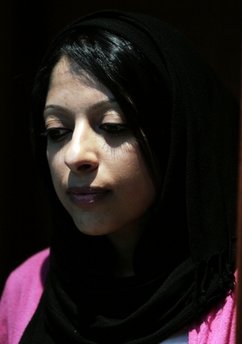
Zainab's Twitter Display Picture: The Angry Arabiya


By Kirthi Jayakumar