Showing posts with label Culture of Rape. Show all posts

Friday, 26 April 2013

Change the undercurrents!


On December 16, 2012, a 23-year-old girl met a terrible fate on board a bus. After the six men raped her in their absolutely brutish fashion, the girl was thrown on the side of the road with her friend, left to die. Passers-by went without taking any of it into consideration, and eventually when she did get to hospital, the girl fought back bravely, but succumbed to her injuries.

To say India was angry in the aftermath is saying nothing. Protest waves flowed from all quarters, and the national capital was held siege by angry people, demanding legislative reform. The first step to that effect came when a committee was appointed to examine the changes that were to be made to the incumbent legal system. A second phase came in when some of those suggested changes were approved, and India had a tougher legal system, applying the death penalty to the offender in a rape case.

And yet, even as that was going on in the foreground, rape cases piled up across the country. Tribal women, foreign women, little girls, teenage girls and young mothers: the list only had addenda from every quarter. Why?

The flaw lies in many sides. The first flaw falls in the larger ethos of the prevailing mental attitude. A society that is disposed towards treating women as chattel, considering women as nothing more than just property that would bring money when sold under the guise of marriage, or trafficked, or even beaten up brutally within the confines of a home, cannot change just with a dose of legal reform. The undercurrents of a prevailing mindset that is so dead-set against the equality and emancipation of women needs tackling, not through legal reform, but through education. The second flaw falls in the approach to rape as a crime. Rape is not only about sex, or about lustful intentions. Rape is about the fact that a man, or a few men, believes or believe that they can have sex with any woman they want to by asserting dominance. Rape is about their faulty perception that a woman’s conduct can be “regulated” by threatening rape, or actually carrying out rape. Rape is about their ridiculous perceptions that the way a woman dresses determines if she should be raped or not – and rape is also about the continued agenda that the media and mainstream entertainment outlets continue to reiterate: that a woman is only about her body, and that she is all about being at a man’s disposal, to such an extent that the few films that are made with a woman-centric theme are considered an exception to the norm. If there needs to be a positive trend in the reduction of the instances of rape, there should necessarily be a shift in attitudes. The third major flaw falls in the lack of sufficient strength in the security sector. A robust security sector are the teeth to the paper tigers that legislations otherwise are. What use is a law if there is no implementation, and what use is there in rhetoric that professes a need for implementation if it does not establish an institution with sufficient capacity to bring the law into action.

If the incident in Delhi in December was a call for action, the recent incident in Delhi concerning the five year old is a grim reminder of how much is left to be done, and how little has already been done. It’s time to wake up, really. 

By Kirthi Gita Jayakumar

Monday, 22 April 2013

Wake up!


On December 16, 2012, a 23-year-old girl met a terrible fate on board a bus. After the six men raped her in their absolutely brutish fashion, the girl was thrown on the side of the road with her friend, left to die. Passers-by went without taking any of it into consideration, and eventually when she did get to hospital, the girl fought back bravely, but succumbed to her injuries.

To say India was angry in the aftermath is saying nothing. Protest waves flowed from all quarters, and the national capital was held siege by angry people, demanding legislative reform. The first step to that effect came when a committee was appointed to examine the changes that were to be made to the incumbent legal system. A second phase came in when some of those suggested changes were approved, and India had a tougher legal system, applying the death penalty to the offender in a rape case.

And yet, even as that was going on in the foreground, rape cases piled up across the country. Tribal women, foreign women, little girls, teenage girls and young mothers: the list only had addenda from every quarter. 
Why?

The flaw lies in many sides. The first flaw falls in the larger ethos of the prevailing mental attitude. A society that is disposed towards treating women as chattel, considering women as nothing more than just property that would bring money when sold under the guise of marriage, or trafficked, or even beaten up brutally within the confines of a home, cannot change just with a dose of legal reform. The undercurrents of a prevailing mindset that is so dead-set against the equality and emancipation of women needs tackling, not through legal reform, but through education. The second flaw falls in the approach to rape as a crime. Rape is not only about sex, or about lustful intentions. Rape is about the fact that a man, or a few men, believes or believe that they can have sex with any woman they want to by asserting dominance. 

Rape is about their faulty perception that a woman’s conduct can be “regulated” by threatening rape, or actually carrying out rape. Rape is about their ridiculous perceptions that the way a woman dresses determines if she should be raped or not – and rape is also about the continued agenda that the media and mainstream entertainment outlets continue to reiterate: that a woman is only about her body, and that she is all about being at a man’s disposal, to such an extent that the few films that are made with a woman-centric theme are considered an exception to the norm. If there needs to be a positive trend in the reduction of the instances of rape, there should necessarily be a shift in attitudes. The third major flaw falls in the lack of sufficient strength in the security sector. A robust security sector are the teeth to the paper tigers that legislations otherwise are. What use is a law if there is no implementation, and what use is there in rhetoric that professes a need for implementation if it does not establish an institution with sufficient capacity to bring the law into action.

If the incident in Delhi in December was a call for action, the recent incident in Delhi concerning the five year old is a grim reminder of how much is left to be done, and how little has already been done. It’s time to wake up, really. 

By Kirthi Gita Jayakumar

Friday, 12 April 2013

Women hit back at India's Rape Culture


Source
The male tormentor of the young women of the Madiyav slum did not spot the danger until it was too late. One moment he was taunting them with sexual suggestions and provocations; the next they had hold of his arms and legs and had hoisted him into the air.

Then the beating began. Some of the young women lightly used their fists, others took off their shoes and hit him with those. When it was over, they let him limp away to nurse his wounds, certain that he had learned an important lesson: don't push your luck with the Red Brigade.

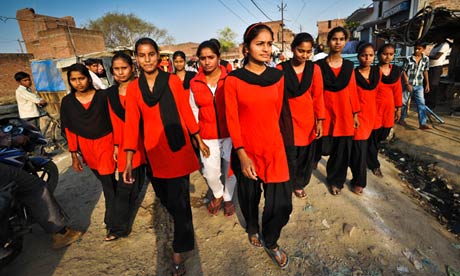
Named for their bright red outfits, the Red Brigade was formed in November 2011 as a self-defence group for young women suffering sexual abuse in the northern Indian city of Lucknow, 300 miles south-east of Delhi. Galvanised by the gang rape and murder of a 23-year-old medical student in Delhi last December and the nationwide protests that followed against a rising tide of rapes, they are now gaining in confidence.
From a core membership of 15, ranging in age from 11 to 25, they now have more than 100 members, intelligent and sassy and with a simple message for the men who have made their lives a misery: they will no longer tolerate being groped, gawped at and worse. Their activities are a lesson in empowerment.

Men who fall foul of the Red Brigade can first expect a visit and a warning. Sometimes the Red Brigade will ask the police to get involved, but if all else fails they take matters into their own hands. Their leader, 25-year-old teacher Usha Vishwakarma, has her own experience of the daily danger faced by many young women in the country. She was just 18 when a fellow teacher tried to rape her. "He grabbed me and put his hands round me and tried to open my belt and trousers," says Usha, sitting in the bare-brick front room of her small house. "But I was saved by my jeans because they were too tight for him to open, and that gave me a chance to fight, so I kicked him in the sensitive place and pushed him down and ran out of the door."
No one at the school took her accusations seriously, telling her to forget it and stop causing trouble. The experience left her traumatised and for two years she did nothing. But little by little her confidence came back. In 2009 she set up her own small school for local girls in an outbuilding next to her family home. Yet all around her, she says, she saw more and more young women suffering the same abuse she had faced. And it was threatening to wreck the chances of her young female students.

"Parents were telling girls to stay in their homes so there would be no incidents. They said, 'if you go to school, boys will be troubling you, so stay home and there will be no sexual violence'," says Vishwakarma. "But we said no, and we decided to form a group to fight for ourselves. We decided we would not just complain; we would take a lead and fight for ourselves." They bought red kameez (shirts) and black salwar (trousers) and began to plan the fightback. "We chose red because it means danger and black for protest," says Vishwakarma.

There is much to fight back against. "It is in the minds of men that girls are objects and it has been like that always," says Vishwakarma. "Religion shows women as very powerless and that whoever is strong can do anything."

Other members of the group drift in and join her, sitting on the bed along one wall of the front room. At the other end of the room is a table laden with the placards they carry with them when they go out to protest on the 29th day of every month. The demonstrations mark the date of the Delhi bus rape and murder on 29 December. Their slogans read: "Stop rape now" and "We want safety".

"In the electronic era there are pictures everywhere of women and girls being treated like objects. It is now very simple to see pornography and it is feeding the hunger for sex. The men think that if you are looking sexy, then you want sex," says Vishwakarma.

They have started martial arts training so that the men do not have a physical advantage over them. Pooja, Vishwakarma's 18-year-old sister, laughs as she recalls the reaction of the boy they grabbed in the street when his taunts became too much. "We all stopped and turned round and we surrounded him and grabbed his arms and legs and he thought it was a joke, but we were not kidding and four of us lifted him in the air and the others started to hit him with their shoes and fists," she says.

The rough justice the Red Brigade metes out might seem extreme to western sensibilities, but many Indian women are making it clear that they are no longer prepared to put up with endemic abuse. That much is clear from the crime figures: reports of molestation in Delhi are up 590% year on year and rape reports by 147%. The rape cases have hit tourist numbers, which were down 25% in the first three months of the year – 35% fewer women are travelling to India.

The Red Brigade say sexual abuse is a part of daily life for young women like them. They all have stories of abuse, attempted rapes and daily harassment. "This is what happens in India," says 16-year-old Laxmi, one of Vishwakarma's lieutenants. "These things happen all the time. All of us know this, so don't let anyone say otherwise. This is why we have formed the Red Brigade."

Seventeen-year-old Preeti Verma nods in agreement. Her family are too poor to have a toilet in the house, so she has to go out into the fields, she says. Every time she went out, the man in the neighbouring house threw stones at her to try to scare her into jumping up. "He wanted to see my body," she says. "I told him: 'What are you doing? You are shameless, don't you have a mother and sister in your house?' But he replied that his mother is for his father, his sister is for her husband and that I was for him." She told Vishwakarma, and the man received a visit from the Red Brigade and another from the police. She has had no trouble from him since.
"We've caught a lot of men recently," says 17-year-old Sufia Hashmi. "I joined up because men always used to pass comments on me and touch my body, but now we beat them the men cannot do anything and they run away. You feel powerful and you feel good."

The next day, they gather on the roof of a gym across the city to run through their moves, a mixture of kicks, punches and throws. An instructor shows Pooja how to use a wooden stick to keep a boy at bay. She holds it against his assistant's throat and the boy looks terrified. The others gasp and giggle.

Yet it is not just the young men of the neighbourhood that the Red Brigade must overcome. Many of the members are very young and, although some of their parents are supportive, others are convinced they are wasting their lives. "The attitude of my parents is very demoralising," says 16-year-old Simpi Diwari, a tiny young woman who a few moments ago was kicking away the legs of one of her colleagues. "I want to be like Usha, fighting against the cruel things, I want to be a teacher and a motivator too, but I am fighting with my parents just to be allowed out of the house."

On the way back to the slum, the rickshaws pass a public park and for a moment these tough young women show themselves for what they really are – children forced to grow up fast. They beg and plead to stop. "Please, please," they say, their eyes gleaming in excitement. Shrieking gleefully, they race off towards the swings, slides and roundabouts. Later they stroll back through the market, eating ice-creams, heading for their homes. The sun is low in the sky, the shadows long. The men watch sullenly as they pass, like wolves who have just discovered the sheep are armed. No one risks a word.

Thursday, 28 March 2013

Every 22 minutes a woman is raped in India


Rape is a pandemic phenomenon in India. The victims were largely Indian girls, and even foreign tourists. The phenomenon ultimately triggered a wave of anger in the streets. Of these events is the most prominent incident of gang-rape of a woman on a bus, in New Delhi, India. The victim died last December. This was followed by the case of rape of a Swiss tourist, in India, who was abducted while she shared with her husband.

Government statistics show that rape occurs every 22 minutes in India. So that encouraged the parliament to approve legislation to aggravate punishment for perpetrators of rape and criminalizing anything done to harass women. It is currently awaiting approval from the President of India, Pranab Mukherjee, to begin implementation of the new legislation.

Women's rights activists of India, Rotchera Gupta said that "courage girl who was raped on December 16 has affected the community. So the dozens of men and women in India rose to demand an immediate end to all forms of attacks on women. And Parliament had responded to their demands." The girl in Delhi has become a symbol of the everyday suffering of women in India, and is a symbol of catastrophic magnitude faced by rape victims in India.

A student demonstration of one of the participants said that "today's protest in the context of specific daily life of Indian women. Because the father had contacted me through the phone more than six times a day to ensure my safety, that I will get home safely. " Although now a lot of rape cases are reported every day in the Indian media, but it is not yet clear whether it is evidence of an increasing number of the same crime in general. However, there is no doubt that it has increased awareness, because in fact that is not a few Indian women who have had the courage to express their experiences.


By Bella Nabilla
Source : http://hizbut-tahrir.or.id/2013/03/26/setiap-22-menit-wanita-diperkosa-di-india/

Saturday, 29 September 2012

Legitimate? What on EARTH is legitimate about rape?


In the same world where there exists a Justice Arijit Pasayat who said “While a murderer destroys the physical frame of the victim, a rapist degrades and defiles the soul of a helpless victim.", there also exists a complete blockheaded Todd Akin, who said “If it’s a legitimate rape, the female body has ways to try to shut that whole thing down.”

I never agreed with the Republicans’ parochialism, but my disagreement never went anything beyond an ideology. I am neither an American citizen nor one to have a say in American affairs, and consequently my denouncement of the Republicans’ ideas don’t really count for action. But this past week, Missouri Congressman, an absolutely ridiculous thinker at that, Todd Akin, belted out a Magnum Opus of the Republican brand of thought. Running against Democrat candidate Claire McCaskill for Senate, he was asked whether he supported abortion in the case of women who have been raped. And his brilliant response was, “If it’s a legitimate rape, the female body has ways to try to shut that whole thing down.”
Ridiculous, Right?

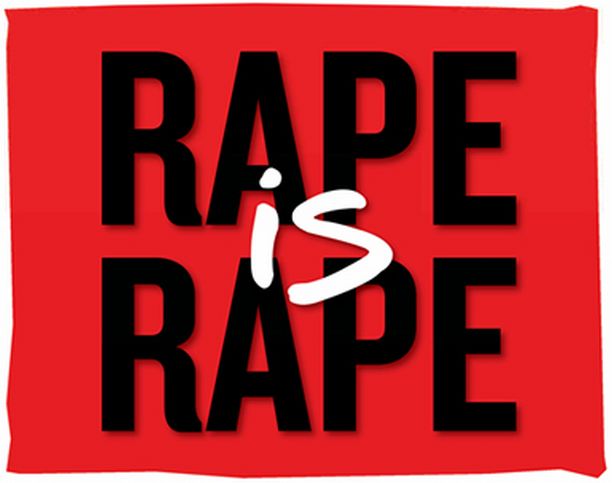
What in the world is Legitimate Rape? Is there anything legitimate at all, about Rape? Rape is Rape, and nothing in the world can legitimize it. It is a heinous crime, and is easily the product of the most depraved mentalities ever. It is a filthy weapon in war, a horrible tactic in peace, and a disgusting thing to indulge in whatsoever. How can there ever be such an epithet as legitimate, to something that is so terribly wrong? Between actually committing rape, to supporting it in rhetoric like Akin did, there is no difference. What kind of insensibility propels his thinking, to let him say that a woman’s body has ways to shut an “illegitimate” rape down? What kind of a stupid, inept understanding of something as basic as science colours this immature head of his into saying such rot?

Rape is easily the most nefarious of all possible crimes. To top the fact that a woman has to suffer under the brunt of the crime and its violation of her very sanctity and modesty, she has to bear the stigma that society attributes to HER, and not to the man who did it to her; she has to bear the consequent pregnancy, the upbringing of the child who she invariably comes to love if not already, but has so much anger for the manner of his conception; she has to bear the brunt of idiotic ideas like Akin’s. And as long as attitudes like this prevail, more like her will come and go, suffering in silence. Rape is rarely treated as the felony it ought to be construed as, and until it is, women will always suffer in the hands of a vile social attitude.

And it doesn’t stop with the woman. For children of today to make a niche in life as people tomorrow, their mother must be literate, and treated well. If women are subjected to sexual violence, the institution of the family is broken, and society is crippled and forced on its knees. That the entire institution that “society” is comes to a grinding halt when women are targeted is not a baseless contention because women are the adhesive for the cohesive subsistence of a family or a society to exist. And until this realization dawns on the world, it will always be at war against women.

Why is it so easy to wage war against a woman? Why is it so easily the weapon of choice? Where is the beginning, where is the end? Or is there an end, at all?

By Kirthi Gita Jayakumar

Saturday, 22 September 2012

Rape is never legitimate


The big buzz on women’s rights in the United States has lately focused on the comments of one congressman, Todd Akin of Missouri representing the Republican or GOP party. When asked if women who become pregnant due to rape should have the choice of abortion, he stated that: 


“Well you know, people always want to try to make that as one of those things, well how do you, how do you slice this particularly tough sort of ethical question. First of all, from what I understand from doctors, that’s really rare. If it’s a legitimate rape, the female body has ways to try to shut that whole thing down. But let’s assume that maybe that didn’t work or something. I think there should be some punishment, but the punishment ought to be on the rapist and not attacking the child.” –Todd Akin 


Basically, Akin is saying that there are two kinds of rape—“legitimate” and “illegitimate.” How can rape be “legitimate”? As a student graduating with a bachelor’s degree in biology, I have never encountered any evidence that a woman’s body is able to somehow magically reject sperm entering their bodies with or without force. There are studies to support that rape-related pregnancy occurs with significant frequency and the chance of pregnancy is ultimately the same as with rape and consensual sex. Is the body supposed to also magically recognize that the women is being raped legitimately and let the sperm enter? Rape is never legitimate. There is only one kind of rape—illegitimate, cruel, and torturous. How is this even a discussion in one of the most powerful and supposedly civilized countries in the world? This also portrays the thoughts of the GOP party in the US, which is one of the largest parties to lead the US politically forming policies in regards to its citizens. After Akin made this statement, leaders of the GOP party and several others called for him to drop out of the senate race in Missouri. Despite this, Akin did not drop out and stays in the race.  
President Obama released a statement in response to Akin’s disturbing thoughts:
Rape is rape. And the idea that we should be parsing and qualifying and slicing what types of rape we are talking about doesn't make sense to the American people and certainly doesn't make sense to me. So what I think these comments do underscore is why we shouldn't have a bunch of politicians, a majority of whom are men, making health care decisions on behalf of women." –President Barack Obama 


I could not agree more. How can Akin, a 65 year old white male, who has never experienced the hardships of women make a statement such as this? He is not one of the hundreds of women in the Democratic Republic of Congo where rape is a constant threat by armed gangs. He is not a woman whose body will be used and disposed of because of a war for minerals. He is not one of the hundred thousands of women that will sometime in their lives experience rape.
A great article written by Eve Ensler can be found here: http://www.huffingtonpost.com/eve-ensler/todd-akin-rape_b_1812930.html
-Surya Singh

Saturday, 24 December 2011

No More Rape Culture!


Around this time, last year, the world slowly awoke to the prospect of Self-Determination in the Middle East. The skin of Dictatorships was throbbing as the veins of protest under simmered with the drive to overthrow despotism and replace the defective governmental system with Democracy. The world watched as the first domino collapsed, with Tunisia’s Jasmine Revolution. The second domino shook precariously and finally fell, as Egypt sent Hosni Mubarak out of his post. The third domino took much longer to rock- as a dictator’s iron fist clamped down on his people, eventually ending with his bloody end. Even as I write, so many more dominoes are shaking.
The confluence of a culture of silence and a culture of rape is a lethal mix.
Sourced from www.sparksummit.com

In another part of Africa, a hunger crisis sparked by geographical vagaries and fuelled through relentless efforts of a faulty governmental policy has left Somalia broken. The world is focussed, sending aid, supplies and food in all the proportions it can afford. South Sudan entered its much sought after status as a “state”, and is handling its own brand of crisis, with world attention that empathizes with the cause. But even as women in Africa take beating after beating no one seems to hear their cries.

Be it DR Congo or Delta State, women suffer under the brunt of rape. A recent news article speaks of nuns being raped. The article explained that an innocent attempt by some Catholic reverend sisters to render spiritual cover to some depraved communities in the Delta State has actually landed them in trouble. The Catholic nuns were, according to the news item, ambushed and raped by men who had guns in tow, just as they were approaching the community at nightfall to evangelise and pray for the sick in the area. The reverend sisters were allegedly too scared to report the issue to the police. However, it was said that the police had begun a manhunt for the rapists. Although the incident is being discussed in low tones, neither the church nor the victims are willing to take action against the suspected rapists. This culture of silence coupled with a relentless pursuit of a culture of rape is a lethal combination to the preservation of the rights of women and the accordance of respect that they rightfully deserve to enjoy. No law, no rhetoric will ever make a difference in the backdrop of a society that is so terribly embedded in murky waters such as this.

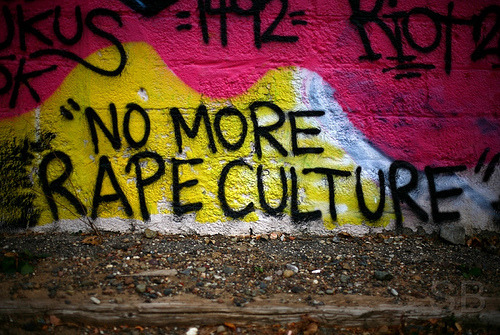
The situation needs to be resolved from all angles- the issue of rape needs to be targeted by addressing the condition civil society. Thanks to the mistreatment meted out to the women, what with so many of them raped and traumatised with sexual assault in a manner so terribly bereft of compunction, today, many of these women suffer under the brunt of a stigma that puts a permanent pockmark on them. Seriously- when will this culture of rape stop? Will it ever stop? Is it asking for too much that a woman’s modesty be respected and honoured? Is it too much to hope that a woman is given the freedom to enjoy her dignity?