Showing posts with label women in war. Show all posts

Monday, 10 September 2012

Sexual Violence...The New Weapon of War


It was called Slavery during the civil war, Comfort Women in World War II, and today they are considered the modern day sex slaves. During the civil war, the women were discriminated upon and abused because of their race. In World War II, the Comfort Women who were victims of the Japanese military sexual violence were abducted, lured with promises of work and brought in “comfort stations” to be raped, abused, or punished for whatever reason. It is said that approximately three quarters of comfort women died, and most survivors were left infertile due to sexual trauma or sexually transmitted disease.  

In the Bosnian war in the 1990s, sexualized violence was also rampant. There were “rape camps” where women were repeatedly tortured and violated, some by as many as 20 men a day – an “ethnic cleansing” of children and adults through sexual violence because of their religion. In other nations like the Democratic Republic of Congo, Sudan, Sierra Leone, Myanmar, Bangladesh, Libya or Egypt, the males and females suffer the same fate under what is now called the new weapon of war – sexual violence.
Though historically the majority of the victims were female, sexual violence during conflicts of war does not discriminate on gender or age. By using sexual violence as a form of weapon to humiliate and strip them of their dignity, the victims to a large extent lose their spirit and will to fight, shaming and bringing dishonor to their families.

For some who were able to escape their abusers, there was a glimmer of hope to start a new life, but the tragic and violent experience will always remain a deep scar in their memories. Some never really recovered from the trauma. Many continue to suffer in silence for fear of further humiliation and being ostracized by their own families and the society they live in. Others never survived the torture and abuses inflicted on them. They perished from the systematic acts of sexual violence... the nameless and faceless John and Jane Does, forever buried into obscurity and never to be found again.

To this day, the debate continues on the number of actual victims. The difficulty in coming out with an accurate statistical data is largely due to the fact that such violence is kept by the victims and their families, many resorting to honor killing to protect the family’s reputation. Some simply disappeared. Others were too emotionally and psychologically distraught to report and recount the horrors of their experience.

And to add to what is already an acknowledged concern by the international community, there were people expected to be protectors of the victims - the “peacekeepers,” who also turned out to be involved in abuses or exploitation. The victims were left to fend for themselves the best they can under the circumstances where such “peacekeepers” were involved in sexual abuses. Such was the case recently reported in the Democratic Republic of Congo where the sexual violations committed by UN peacekeepers were termed a grave betrayal of trust. UN Peacekeepers reported as sexually and violently violating young girls were not really questioned  “so long as they wear that iconic blue beret or blue helmet.” How such criminal acts can be tolerated is deplorable and should be punishable and never tolerated.   

Developments:
Though there have been developments in addressing the growing concern on the use of sexual violence as a tool or weapon during conflicts of war, the pace is still going way too slow.

In Sierra Leone, former Liberian President Charles Taylor became the first head of state since World War II to be convicted by an international war crimes court on 11 counts of war crimes and crimes against humanity. He was convicted of kidnapping children and turning them into child soldiers and sex slaves aside from the notoriety of hacking off the limbs of their enemies and carving their groups' initials into opponents.
The Dayton Accords signed after the Bosnia-Herzegovina war provided for restitution for survivors of sexualized violence. Victims were supposed to be allowed to return to their former homes as long as the return would be “safe and dignified.” But “no rules have been put in place to provide alternatives for the many women whose former homes are the site of extreme trauma and sometimes months of repeated rape.”   Though the Accord was enacted, it failed in the sense that some victims ended up returning to communities only to be vulnerable to the very people who committed abuses against them and their families.  

The victims of war through sexual slavery should not be viewed as dishonour to the family. Nor should they be treated as mere victims of sexual violence or another number added to the growing statistics of such violence. Rather they should be provided with the means to recover from their trauma to be able to start a new life again. Family support and professional therapy to help them cope are critical to their recovery. Some may never be able to cope and live through the degrading and inhuman experience they went through. The road to recovery won’t be easy for these victims but with the support from their families, government and Non-Government Organizations, they have a chance...

Sources and Readings:


By Lylin Aguas

Sunday, 22 July 2012

Protection of Women in Armed Conflict


It is estimated that one hundred million people have died in armed conflicts over the last century[1]. During such conflicts, civilians make up the largest number of casualties and experience serious forms of abuse. While women and girls suffer the same consequences during war like the rest of the civilians, they also suffer specific forms of violence and abuse like sexual abuse. They become victims of war.  In many instances the violence is predominantly ruthless. Although men and boys may also be victims of gender based violence, women and girls remain the primary target. Sexual and gender-based violence have progressively become weapons of warfare. According to Koffi Annan, All too often, conflict happens in societies that can least afford it, takes its toll on those who least deserve it and hits hardest those least equipped to defend themselves. Civilians have become the main targets of warfare. From rape and displacement to the denial of the right to food and medicines, women bear more than their fair share of the burden.[2] Sexual abuse and violence has serious implications on women and girls including unwanted pregnancies, transmission of sexually transmitted diseases and psychological trauma. In the words of Major General Patrick Cammaert, former Deputy Force Commander, MONUC[3] “It is now more dangerous to be a woman than a soldier in modern wars.”

The protection of women during armed conflict is enshrined in both international humanitarian law applicable in times of armed conflict and international human rights law. Generally, International humanitarian law aims to humanize war by restricting means of warfare and offering protection to civilians or persons not taking part in hostilities. Civilians are therefore illegitimate targets.  Recognizing that civilians in many armed conflicts account for the majority of casualties of armed conflict, international law seeks to ameliorate their conditions by granting them protection. Such protection should be accorded without discrimination on various grounds including sex. It covers areas such as inter alia;
      Protection against the effects of hostilities
      Protection against arbitrary treatment
Apart from the general protection of all civilians, the four Geneva Conventions and the Additional Protocols contains specific provisions on the protection of women during armed conflict;
1.       Protection of women as civilians
Article 27 of the fourth Geneva Convention relating to the Protection of Civilians in Armed Conflict specifically provides that “Women shall be especially protected against any attack on their honour, in particular against rape, enforced prostitution, or any form of indecent assault.” The same protection is reiterated in Additional protocol I of 1977 which subjects women to special respect. Similarly, Article 4(2) (e) of Additional Protocol II of 1977 prohibits: “Outrages upon personal dignity, in particular humiliating and degrading treatment, rape, enforced prostitution and any form of indecent assault”. Women are also protected under the Rome Statute establishing the International Criminal Court. Under the Statute rape and other acts of sexual violence constitute crimes against humanity. In addition to rape and other acts of sexual violence any act that ‘outrages upon personal dignity, in particular humiliating and degrading treatment, are war crimes in both international and non-international armed conflicts’. 
2.       Protection of women as combatants and prisoners of war
Not all women are victims of war, some are actors and play a major role armed conflicts as combatants. Women who take part in hostilities are protected under international humanitarian law when they fall into the hands of the enemy. When captured by the enemy, the third Geneva Convention Relative to the Protection of Prisoners of War calls for favourable treatment to be given to women as that granted to men. All prisoners of war are entitled to humane treatment and protection from violence. It adds in Article 3 that "Women shall be treated with all consideration due to their sex” and that "Differences of treatment between prisoners are permissible only if such differences are based on the military rank, the state of physical or mental health, the professional abilities, or the sex of those who benefit from them"[4]. Combatants who are captured in non-international armed conflict are not granted the status of prisoner of war but are offered protection under Article 3 common to the four Geneva Conventions. While in detention, special protection extends to their treatment in detention.  Men and women are to be detained in separate institutions. Where the institution receives men and women, such institution should ensure that different premises are allocated to men and women. This protection is however specific to international armed conflicts.
3.       Special Protection
Special protection is also granted to specific types of women. Pregnant women and mothers having dependent infants in the event of an international armed conflict for example are granted special protection. Protocol I[5] requires that "maternity cases and pregnant women, who refrain from any act of hostility, shall enjoy the same general protection as that accorded to the sick and wounded". They should be given special care including adequate medical care and treatment. In cases of arrest, detention or internment for example they should have their cases considered with utmost priority.
Protection of women in times of armed conflict is very important. Article 38 of The Vienna Declaration and Programme of Action, 1993 emphasizes this importance. It states that “Violations of the human rights of women in situations of armed conflict are violations of the fundamental principles of international human rights and humanitarian law. All violations of this kind, including in particular murder, systematic rape, sexual slavery, and forced pregnancy, require a particularly effective response."


[1] Rehn, and Johnson Sirleaf, E. (2002) “Introduction” in Women, War and Peace: the Independent Experts‟ Assessment on the Impact of Armed Conflict on Women and Women’s role in Peace building, UNIFEM, pp.1
[2] Former Secretary General, Kofi Annan, United Nations Day for Women’s Rights and International Peace, 6 March, 2000, Press Release, SG/SM/7325, WOM/1190. Extract from Special Report of Amnesty International on the International Criminal Court. Fact sheet 7.
[3] See  2008 Parliamentary Hearing at the United Nations New York, 20-21 November. Available at http://www.ipu.org/splz-e/unga08/s2.pdf (accessed on 6/07/2012)
[4] Article 4
[5] Article 8

Wednesday, 18 July 2012

The Invisible War


Watching American shows on television here in India, despite the delayed relays, tell you much more than How Ted Mosby met his Children’s Mother, or how Sheldon Cooper, Howard Wolowicz, Rajesh Koothrapalli and Leonard Hofstadter make the world of nerds a much more charming propensity than the world otherwise believes. It also tells you much more than the NYPD’s top lady cop and her writer-partner catching murderers, and much more than the FBI’s White Collar Crimes division forging a bond with an ex-Con to catch High Profile criminals. You’re probably wondering what the circumlocution is all about. Let me cut to the chase. I once watched an episode of Lie to Me, whose premise was similar to a documentary film that is quite the rage now –The Invisible War. Built around the sordid reality of military rape, both of these motion-picture depictions exposed the United States of America’s dark underbelly.

“Support Our Troops” has been a big phrase in US politics. But really, should anyone support troops that indulge in rape and then disgusting cover-ups to keep things under wraps? The Department of Defence estimates that over 19,000 women and men were assaulted in 2010 alone. Around 500,000 women and men have been raped or sexually assaulted since World War II, in the military ranks of the United States of America. Nearly 80 per cent of survivors never report for fear of retaliation and intimidation. Though there is a zero-tolerance policy in place on paper, there is absolutely no explanation for why there are sexual predators and offenders in the military. Why does this happen? It turns out that unit commanders have the full and unfettered discretion to refuse to move forward with a case.

The easiest trick in the playbook is to blame the victim and let the rapist walk. The inspiration behind the Invisible War was Helen Benedict, who reported on women soldiers on Salon.com. She put in extensive research on why soldiers take to rape. Several factors are involved – a military culture of misogyny and patriarchy to illegal occupations and soldiers who have been abused as children. Until there is a cut in the chain of command from the process of prosecution, and prosecutions culminate in penalties, rape will remain an integral part of military service.

In its reckless pursuit of war-mongering on the global front, the United States is forgetting the Invisible War that is reality to its many women in its army.

Written by Kirthi Gita Jayakumar

Saturday, 23 June 2012

Convenient!


Gender based violence underlines every war. Last week Human Rights Watch reported that members of the Syrian government forces have been using sexual violence to facilitate torture of both men and women detainees. In addition, civilians have also suffered violence of a sexual nature in their own homes.
Be it Rwanda, DR Congo, Darfur, Afghanistan, Libya or Syria, war has proved to be a thriving hotbed of gender-based violence and impunity. Rape is a weapon of war, and that is a fact. Why is rape such a quintessential weapon of war?

What makes sexual violence so common on every war front, and women the easiest targets is the fact that rape is cheap, easy and extremely effective.  Armed groups, combatants and non-combatants alike use rape as a means to terrorize and control women and communities. Subjecting women to sexual violence earns the woman the indelible mark of stigmatization that society throws on them. Shrouded with humiliation, families then wind up turning these women out of their homes, and when women are spurned the backbone of a societal structure is broken. Men don’t want to marry women subject to sexual violence. Families do not want to have them around anymore- either the stigma is too much to bear, or the fact that these women burden them since they can’t be married off (especially true in societies where marriages bring in bride prices). Sexual violence is calculated, brutal and absolutely bereft of humanity. Using sexual violence as a modus operandi in warfare is intricately woven with the hegemonic desire for power. Soldiers thirst to drive fear and strive to humiliate and punish women and their communities, in the hope that by doing so, they would invariably break down society entirely. Sexual violence in conflict and post-conflict situations is a preferred method that is used to reinforce gendered and political hierarchies.

The process of dehumanizing another human being conquers the enemy, because the subjects that are victimised are not seen as anything more than targets that should just be destroyed.


Monday, 18 June 2012

Breastfeeding in the Uniform


Just a few weeks ago I wrote a post about women in the military and today another related article caught my attention.
The debate over public breastfeeding got a new wrinkle when two servicewomen with the United States Air Force released a series of professional photos taken of the young mothers breastfeeding in uniform. Terran Echegoyen-McCabe and Christina Luna are pictured nursing their babies on an Air Force base in an image that they said was intended to raise awareness of the right to breastfeed in public. The striking image has seen a flurry of comments, from supporters who say breastfeeding is a 'fundamental right' to another who compared it to 'defecating in uniform'.
The photos were taken for the Mom2Mom Breastfeeding Support Group, set up by a military wife and mother-of-three to raise awareness of all women's rights to breastfeed in public. Mrs Echegoyen-McCabe is pictured breastfeeding her 10-month-old twin girls on her lunch break during a drill weekend as a member of the Air National Guard. By her side is friend Mrs Luna who feeds her toddler.
“A lot of people are saying it’s a disgrace to the uniform,” said military Spouse and Mom2Mom founder Crystal Scott. “They’re comparing it to urinating and defecating.”
No one can agree on everything and everyone is 100 per cent entitled to their opinion. But to compare breastfeeding to other bodily functions like defecating and urinating? It's disheartening and saddening.'
As the members of the Air National Guard, these women do their best to fulfill their commitment to their country without sacrificing their commitment to their children. There is nothing wrong about these strong beautiful women fighting not just for the freedoms of this country but for themselves and their children. Breastfeeding is a fundamental right in or out of an uniform. Like one of the supporters said: they are still moms, no matter what.

“I have breast fed in our lobby, in my car, in the park… I pump, usually in the locker room,” says Echegoyen-McCabe. “I’m proud to be wearing a uniform while breastfeeding. I’m proud of the photo and I hope it encourages other women to know they can breast feed whether they’re active duty, guard or civilian“.
Robyn Roche-Paull, a lactation consultant and a U.S. Navy Veteran wrote a book and has a blog called Breastfeeding in Combat Boots (http://breastfeedingincombatboots.com/military-policies/) which aims to make women's position clearer while breastfeeding and serving their country.  As she writes: „There are NO polices or regulations in any of the military branches that either approve OR disapprove of breastfeeding in uniform”.  She said that arguments against were based on the fact that it shows a woman to be nurturing and therefore 'unprofessional'.
U.S. law states that a woman may breastfeed her child at any location in a Federal building or on Federal property.


Sources: http://www.dailymail.co.uk/news/article-2153821/Military-slams-breastfeeding-moms-posed-uniform-nursing-babies-controversial-photoshoot.html
http://www.opposingviews.com/i/health/parenting/new-moms/breast-feeding/whats-wrong-military-moms-breast-feeding-uniform?page=2
by Natalia Alekseyeva

Thursday, 12 January 2012

From inside the Palm of a Revolution: Part II: An Interview with Zainab Alkhawaja


Sourced from axisoflogic.com

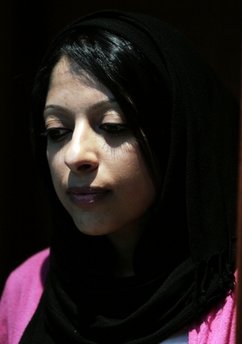
Coming from a family with four daughters, Zainab Abdulhadi Alkhawaja is a pro-democracy activist from Bahrain. When the winds of change blew life into the Arab Spring last year, Bahrain was not left behind as activists in the country took up cudgels for their cause of being subjected to gross oppression. Zainab was born in exile, but came back to Bahrain when she and her sisters were young adults. To her, Bahrain was the right place to be, the very place she believed she was always meant to be. Over the past year, Zainab has been the voice of her people, as she tweeted and blogged for the world to see and learn of the situation prevailing in Bahrain. (Follow Zainab on Twitter as @angryarabiya)

Calling herself "the Angry Arabiya", Zainab tells the world of all the horrors that have unfolded under the aegis of the draconian leadership in Bahrain, truly showing the world the precise reason for her anger. In her trajectory as a human rights activist, Zainab has seen horrible situations- right from her own arrest to being beaten and subjected to rudeness, to seeing her father and husband being arrested. Over a short Skype conversation, Zainab spoke to Delta Women on the situation in Bahrain and on her role as a pro-democracy activist.

Bahrain is on the cusp of a revolution, an uprising that is soon set to turn a year old. Do you think it took a revolution in Tunisia and Egypt to inspire the people of Syria?
Uprisings are not new to Bahrain. There have been plenty of revolutionary uprisings, in the 1980s, in the 1990s, where people have shown their antagonism to the harsh rule of the longstanding dictatorship that has lasted right up until now. So technically, this isn’t the first time that Bahrain is rising against the despotic rule. After events in Egypt and Tunisia, people began reinforcing their faith in the power and efforts of people coming together. For a very long time, Arabs in general, have been living under dictatorships. Governments in most Arab countries have been completely different from governments elsewhere. What happened in Egypt and Tunisia reinforced the courage and the faith of the people in mass efforts. It is not that the people of Bahrain have just realized that they were living under tough rulers, but just that the success of the revolutions in their neighbouring countries effectively encouraged them to take to the bull by the horns.

Sourced from www.peaceisthenewblack.blogspot.com
As a woman based in Bahrain who is also a blogger and tweeter, you have faced a lot. What threatens you most about the journey of pro-democratic activism that you have embarked upon?
The very fact that one is being an activist against an oppressive regime is sufficient to warrant that there are going to be threats. When it is your loved ones that are targeted, though, it hurts you so much more. My father is a prominent human rights activist, and he has been targeted by the regime plenty of times. I went on a hunger strike when my father was in prison, and I am so proud of my father. Sometimes, my family is targeted for my activism. It is a lot more personal when your own loved ones are subjected to harsh treatment. My husband Wafi was arrested too, he stuck with my father though he knew they were after him for it. He was arrested and kept in prison, subjected him to so much torture- at one point he had to crawl about because his legs were swollen from relentless whipping. When the government in Bahrain wants to punish someone, they bring that person’s family into it, knowing it hurts more. I fear for my little daughter, Jude, and it does affect me when my family is targeted because of the things I do. But, seeing the way my family was targeted, I have come to realize that that was a sample of what happens to several people who have been subjected to such treatment. It doesn’t stop with just my family, and though it gives me a lot of pain, I use it to spur myself on, and to make myself much stronger.

What do you think of the West’s stance on Bahrain? Do you think they should take on a military intervention for Bahrain?
We don’t want military intervention. From the very beginning, our message has always been the same- we don’t want troops sent here, we don’t want anyone to fight our battles for us. It is our revolution, and we are capable of seeing it through. We want just one thing- that the West should stop supporting dictators in this part of the world. Many dictatorial governments, Bahrain’s regime included, have been supported by the west- be it financially or with weapons. When tear-gas was used against peaceful protesters here, what smacked us in the face was the fact that each of those canisters was marked with the phrase that read “Made in Pennsylvania, USA”. That’s the message we’re getting. It is no use saying that they support the crusade for self-determination that we are in, while on the other hand, covertly supplying our oppressive government with everything they need to crush us. Today, everyone in Bahrain has stood up to the oppression of the government, and is fighting strong for the freedom that is eluding us. It is unfair to allow the government and the dictatorial regime to continually receive support from the West.

Sourced from www.shiapost.com
Do you think Bahrain is ready for Democracy? Is it something that would suit the country?
Democracy is essentially a state of affairs where people are guaranteed their rights and live lives with dignity. Self-determination is a basic right, a right of the people to choose who rules them, and how. These are basic human rights- for every human being, irrespective of whether they may be in Bahrain or wherever. That being a given, I don’t see why a democratic set up and a regime steeped in democratic values wouldn’t fit Bahrain or any other country for that matter. People from Bahrain go abroad to study, they see what democracy appears to be and how it functions, and they realize that things are a lot better with such a political and social setting. When they come back, the glaring differences strike them, and that is why this uprising is what it is.

There were aspersions cast on the uprising, surmising that the entire revolution was a “Shiite Conspiracy”. What are your thoughts on that?
Shias and Sunnis have been living side-by-side for years in Bahrain. It is not true to say that this is a Shiite conspiracy- Sunnis have also borne the brunt of oppression and face the same harsh treatment that the government metes out. There are also poor Sunnis, as there are poor Shias. Bahrain is a very peaceful country, and there are almost next to no crimes- and most certainly no sectarian crimes. It appears that the aspersion cast is just a case of dividing and ruling. The claims that Shias were receiving support from Iran, and that they were just trying to convert Bahrain into a Shiite country has no basis, it’s completely absurd. The Al Bandar report explains this. There were reports when the Bahraini government laid claim that the Iranian media had mentioned the revolution in Bahrain, and that was the basis for the claim that Iran backed the revolution in Bahrain, but that’s absolutely absurd- the media simply reports exactly what happens, and merely reporting something does not mean that a country has a hand in the event reported! Shias and Sunnis have fought side-by-side for the revolution, they have prayed together and they both want to see a bright future for Bahrain. There is a lot of love, a lot of unity between the people, irrespective of whether they are Shia or Sunni. The baseless allegations of a Shiite conspiracy are just cases of hate speech, scare tactics that are used to scare off the West.

As people of the world who pursue a common cause, what would you like those who support your cause to do about the situation in Bahrain?
Today, in Bahrain, people of all ages, including children aged between twelve and fifteen are being arrested, tortured and subjected to a lot of ill-treatment. There have been martyrs and mothers of martyrs who lie mourning, crying in despair as the children they would call out to would no longer respond, no matter how many times they are called. We just need people out there to be echoes of our voices. Tell the world our story. Tell the world to let us be heard. Don’t let our voices be lost in the annals of history. I had a recent twitter campaign, where so many people all over the world have written with a wonderfully kind statement, saying that they care. We need more people to just hold up our voices, and to make sure that we are heard.

Zainab's Twitter Display Picture: The Angry Arabiya


By Kirthi Jayakumar

Tuesday, 10 January 2012

The Pen is Mightier than the Sword: Part I: Interview with Jean Sasson


Author Jean Sasson has opened up to the world the lives of women in the Middle East, and more recently, even been the voice for Osama bin Laden’s son and wife, Omar bin Laden and Najwa Bin Laden, all through the fabulous repertoire of books she has written. Writing not just as a narrative that tells the tale of brave women, Jean speaks from the heart and offers a sight of the best enumeration of history and politics through the eyes of people who experienced it firsthand. In an exchange via email with DeltaWomen, Jean takes us through her journey so far.

Jean's repertoire of Novels


Writing is a talent. Unearthing stories of people who inspire people is an even bigger talent. Was this something that you always wanted to pursue?
Well, I never really considered the difficulty of interviewing subjects and bringing such inspiring stories to life -- Instead I thought of how I would one day write. But, life threw me a curve and after living in Saudi Arabia and discovering so many worthwhile stories, I was thrust into a situation where I had to learn how to get into the minds and hearts of subjects and tell their stories in a way that would bring the reader to identify with them and feel that they are in the middle of a very important story. It is a very delicate situation, I will admit.

How do you pick out your subjects and decide the focus for your stories? Is there a specific yardstick you have, to evaluate a prospective story?
Well, the stories more or less came to me. I am asked to write many stories, mainly of women, but not entirely. All the stories are heartfelt and meaningful and deserve to be told and known by the world. However, I must "feel" that I connect with the person. So, out of 30 or 40 book possibilities each year, I can only pick ONE story to tell. However, thus far, I have just "known in my heart" the story that I should write. With Princess Sultana, (The Princess Trilogy) we were first friends, and she had discussed for years the fact that the world needed to know the truth of life for women in Saudi Arabia. Then I met Mayada (Mayada) in Iraq when I travelled there in 1998. I had not thought of writing her story, although it was fascinating. But once she was imprisoned, and managed to be freed, and had learned another side of Iraq, and the stories of women whose families were less influential than her own, I then spoke with her about telling her story. Joanna's story came to me from her brother, after he read Mayada's story. I met Joanna (Love in a Torn Country) in London and after getting to know her, and learning all the details of her life, felt very drawn to her. The Bin Ladens (Growing up Bin Laden) contacted me via email and I really liked them and felt they were extremely nice people with a valuable story to tell, a story that no one the world really knew. Maryam's story (For the Love of a Son) was brought to me by her friend in Jeddah, who contacted me through a friend in London. So, as you see, most of the stories happened nearly by chance of my finding out about these amazing people!

What inspires you? 
I am inspired by people of character. All of the books I have written have been about strong women (and in Omar's case, a strong man) who led challenging and difficult lives, but who never ever compromised their values and morals. They never gave up but fought hard for truth and right. Such people inspire me, and I admire them.

Your latest book, For the Love of a Son is a beautiful portrayal of motherhood set in the backdrop of Afghanistan. Can you tell us something about your journey in the course of writing this book?
Honestly from the first days of the Taliban torturing and murdering innocent women, I always wanted to do a book about an Afghan woman. So when Maryam's friend Alison accidentally met a friend of mine while on holiday in Spain, she managed to get in touch with me and tell me about Maryam's story. I felt something electric about Maryam, a woman who would Never, EVER stop searching for her son. Yet, an important part of the story was how a very strong woman like Maryam was manipulated by family into marrying a brutal man she did not want to marry. This opens up the very important issue of how it is so important for family to support women - and, this does not happen as it should in the Muslim culture. Maryam acknowledges this, as do my other heroines. The women's feelings are not important to the culture. When they are beaten and abused, even their mothers look at them and say, "What did you do to upset your husband?" It's always the woman's fault, no matter what happens. This is wrong, and I believe Maryam's story goes a long way to show people that it is up to the Muslim families to make a change and to support and care for the women who are brutally abused. My journey while writing this book was one of determination that this story be out, and that the world learn how helpless women can be when their families desert them.

Sometimes, the writer's abilities shadow the true narrative of the subject. How do you keep your assessment of things outside the ambit of the narrative that you pen in such authentic prose?
I try to get to know the subject so well that I can honestly feel their lives, so when I am writing, I feel I am them, and I am feeling their joys and pains as clearly as if it were me living it. After I write about an event, I have my heroines (or hero) read what I have written from our personal conversations, and then tell me if I got it right. Amazingly, they have always told me, "It is as if you were me. You captured my feelings perfectly." I think that is the goal of any writer who is telling another's life story. Also, even if I had a different experience in a similar situation, I am able to push those thoughts from my head. I become Princess Sultana who is furious with her brother, or a frightened Mayada who is in a prison room, or a fleeing Joanna on a mule, or a hysterical Maryam who has lost her son. That's why I often weep as I am actually writing because I truly feel that this wrong happened To Me and I can feel it. I believe that this ability comes from the fact that I have empathy for others; therefore, I truly can feel their pain and their joys.

As a writer on women in the eye of a storm at different times, do you ever feel threatened? Have you ever believed that you've taken too much of a risk?
Well, I've had some threats and I've had some harassment, but I never felt threatened, nor felt afraid. Although I'm afraid of spiders and of heights, I've never been afraid of another human being, so no one has been able to intimidate me. I can never recall feeling fearful or nervous of another person. Although I am not a violent person, I have always felt myself capable of defending myself, and would, without hesitation. Therefore, I've never felt that I've taken a risk of any kind.  

As a writer on women's issues, what do you think could be construed as the "status of women" in the world, today? Are women truly liberated?
I believe that the "status of women" is different in every region. Even in the USA, there are places where women have it better than in other places. It's the same all over the world- even in the Middle East. It is different in every country. In my opinion, women are not truly liberated anywhere, although they are coming close in Northern Europe. In the USA, women are still beaten and abused by men, although our laws will punish the abuser. But often it is too late and the woman ends up dead. There's a case every week or so. In some countries, men are applauded when they are abusers of women. Until the entire world realizes that until all women are free to live in dignity, our earth is not a great place for anyone -- men suffer too when women are not free.  

Your work focusses on the Middle East and Afghanistan. What about the rest of the world?  
Yes, I focus on the Middle East and have written about Afghanistan. Yet, there are many stories in many other countries. Since I can only write one book every two or three years, it is difficult to cover the world, although I am anxious to write a book about a woman from Pakistan and a woman from India and a woman from Thailand. Possibly that will happen one day. 

Do you think the assessment by Thomson Reuters was right in that it surmised that Afghanistan is the worst place for a woman to live in? Funnily enough the survey didn't include any country in the Middle East within the top five worst countries, despite the fact that women can be subject to lapidation as a punishment. What are your views on that?
I would say that Thomson Reuters has it right, although it is difficult when deciding these "lists" because there are so many countries where life for women is brutal.  From my personal travel and experiences, I would have submitted the following list had I be asked for the top five... 
 1) Afghanistan: America's presence in Afghanistan has done nothing to help women. For this, I am ashamed as an American that we have not made this an important part of our policy there. We have failed the women of Afghanistan. The present government of Afghanistan has totally failed their women.
2) Yemen
3) Pakistan: Mainly limited to small villages -- in the cities it tends to be much better for women. The government of Pakistan seems to scorn women. That's a pity because Pakistani women can really help their country and should be given the chance. There are many Pakistani women in prison today only because they were raped -- they were a victim, but they are blamed for a crime of which they were the helpless victim.
4) Saudi Arabia: Although women are educated in Saudi Arabia, there is no one to help them if the man of the family is an abuser, or even decides to murder them. No one will step in to help them, NO ONE. This does not mean that there are not good Saudi men who are kind to the females in their family. Sadly, there are just as many men who are not so inclined.
5) India: Once again, mainly limited to small villages - there are still places where young brides are burned to death only because the family is ready for another dowry. It's a shame for a great country for India to have such things occurring.
I have never been to Africa other than Egypt and Libya, so I can't speak on the Congo and Somalia, although from what I have read, those two countries are doing nothing to protect their most valuable asset - their women.  

In your opinion, is a woman truly an agent of social change? If so, do you think that it is restricted only to the educated and empowered segments?
Yes, I believe that a woman can be an agent of social change.  There are women today living in Afghanistan and Yemen and African nations who are standing up to the men and to the powers in control and making small gains.  But the truth of the matter is that due to the importance of education and other resources necessary to be heard, generally females bringing social change are very often limited to the educated and empowered.

A little something from your desk for the women of the world...
NEVER EVER stand by in silence if you see anyone being mistreated. Jump in, take a chance, help a human.  As I say so often to those who criticize me for writing books about women’s issues, "When anyone is being harmed, whether physically or emotionally, it is not only my right to intervene, it is an obligation." I truly believe this, whether it is about women, children, or animals - any live creature being harmed will get my 100% support.  For me, my life is worth nothing if I can't help others. I am willing to put my life on the line, and when I have done this, others have backed down.


By Kirthi Jayakumar