Showing posts with label Ziyanda Xaso. Show all posts

Tuesday, 3 July 2012

The Gender Pay Gap


The gender pay gap is the difference between the rates women and men are paid for doing the same job. It has been an issue that has been looked at by policy makers ever since women started entering the labour market in large numbers. An organization that has monitored this issue is the Organization for Economic Co-operation and Development (OECD). OECD countries have an average wage gap of 15% with the range of 3.9% to 40%. This means that women salaries range from 60 cents to 96.1 cents for every dollar earned by men with an average of 85 cents. These statistics are based on men and women with similar professional skills, history and education.
Another underlying factor that seems to worsen the situation is the fact that some life events have a direct influence on both men and women’s careers. Women seem to bear the brunt of the impact that marriage and having children has on a career. They get penalised whereas their male counterparts get incentivised up to 2% by employers for the same events.
The labour force has had a lot of change throughout the years. Now women make up almost 50% of the workforce and the majority of these women are the highest income earners in their families or the only breadwinners and others even support more than one family. Surely this more than anything else should prompt policy makers to remedy the situation. There are currently more single income female headed families now than ever before, and it does not look like the situation will improve. Women should therefore earn as much as their male counterparts for doing the same job.
It is recognised all over the world that once you educate a woman, you educate a nation. There has been a huge drive and focus on ensuring that the girl child receives an excellent education and opportunities for growth and success. This is crucial for women empowerment and towards the achievement of the Millennium Developmental Goals. Investing in women and girls will have a powerful impact on the any economy and will create a better world for both men and women. Governments need to take the next step in ensuring that the gender pay gap is eliminated through policies and legislation. Organizations that perpetuate the gender pay gap need to be penalised. And transparency is crucial; employers need to lift the veil of secrecy that surrounds employee salaries. Just as public sector salaries are publicised, the same should apply to the private sector. Governments need to realise that there will be an economic and social cost to allowing the gap to continue.
Life events should not be looked at by employers as just female issues. An overhaul of policies such as maternity and parental leave policies needs to occur. There is also a growing trend of women opting for part-time work or for working in smaller organizations due to them wanting to put their families first. Women should not be forced to make these sacrifices they should have the option of continuing on their career-path without having to cut back. Employers need to find a way of being supportive and accommodating as women often take this time off during their most productive years. This therefore becomes a loss both to the employer and the woman’s career. Therefore policymakers need to be more gender focused in favour of women their policies and legislation.


By Ziyanda Xaso

Sources

Thursday, 21 June 2012

MULTIPLE INTELLIGENCE


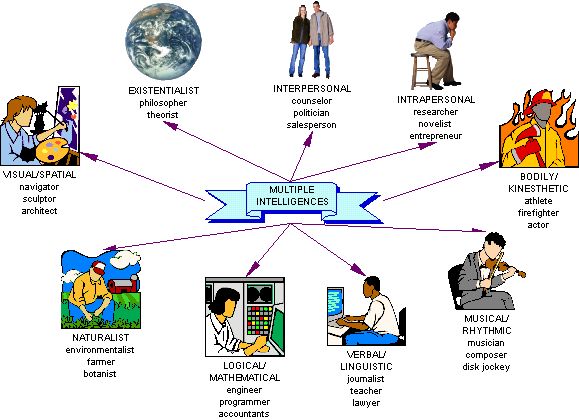
A lot of the times people think of intelligence in one way, the logical and linear form of intelligence that we are trained and taught to emulate in school and measured in IQ tests. But intelligence is a lot more complex than that as demonstrated by autistic geniuses as well as some dyslexic ones. One of the pioneers in multiple intelligences is Dr Howard Gardner, a professor of cognition and education at the Harvard Graduate School of Education. He has identified nine different types of intelligence than can assist in our better understanding of who we are and how we function.

His work is applied in education to ensure that children with the different types of intelligence are not excluded from the learning process and are allowed to grow within their cognitive path. Multiple Intelligence (MI) allows parents and teachers an opportunity to understand and teach their children in multiple ways. This increases the chances of success for a child. These intelligences are not mutually exclusive and an individual can possess any combination of them.

  • Linguistic intelligence (Word Smart) involves sensitivity to spoken and written language, the ability to learn languages, and the capacity to use language to accomplish certain goals. This intelligence includes the ability to effectively use language to express oneself rhetorically or poetically; and language as a means to remember information. People with linguistic intelligence have the ability to think in words and to use language to express and appreciate complex meanings.  It allows us to understand the order and meaning of words and to apply meta-linguistic skills to reflect on our use of language.  It is the most widely shared human competence and is evident in poets, novelists, journalists, lawyers, and effective public speakers.  Young adults with this kind of intelligence enjoy writing, reading, telling stories or doing crossword puzzles.

  • Logical-mathematical intelligence (Number / Reasoning Smart) consists of the capacity to analyse problems logically, carry out mathematical operations, and investigate issues scientifically. It entails the ability to detect patterns, reason deductively and think logically. This intelligence is most often associated with scientific and mathematical thinking. People with logical-mathematical intelligence have the ability to calculate, quantify, consider propositions and hypotheses, and carry out complete mathematical operations.  It enables them to perceive relationships and connections and to use abstract, symbolic thought; sequential reasoning skills; and inductive and deductive thinking patterns. This type of intelligence is usually well developed in mathematicians, scientists, and detectives.  Young adults with lots of logical intelligence are interested in patterns, categories, and relationships.  They are drawn to arithmetic problems, strategy games and experiments.

  • Musical intelligence (Musical Smart) involves skill in the performance, composition, and appreciation of musical patterns. It encompasses the capacity to recognize and compose musical pitches, tones, and rhythms. It runs in an almost structural parallel to linguistic intelligence. People with musical intelligence have the capacity to discern pitch, rhythm, timbre, and tone.  This intelligence enables us to recognize, create, reproduce, and reflect on music, as demonstrated by composers, conductors, musicians, vocalist, and sensitive listeners.  Interestingly, there is often an affective connection between music and the emotions; and mathematical and musical intelligences may share common thinking processes.  Young adults with this kind of intelligence are usually singing or drumming to themselves.  They are usually quite aware of sounds others may miss.

  • Bodily-kinaesthetic intelligence (Body Smart) entails the potential of using one's whole body or parts of the body to solve problems. It is the ability to use mental abilities to coordinate bodily movements. Here mental and physical activities are seen as related. People with bodily kinaesthetic intelligence have the capacity to manipulate objects and use a variety of physical skills.  This intelligence also involves a sense of timing and the perfection of skills through mind–body union.  Athletes, dancers, surgeons, and craftspeople exhibit well-developed bodily kinaesthetic intelligence.

  • Spatial intelligence (Picture Smart) involves the potential to recognize and use the patterns of wide space and more confined areas. It is the ability to think in three dimensions.  Core capacities include mental imagery, spatial reasoning, image manipulation, graphic and artistic skills, and an active imagination.  Sailors, pilots, sculptors, painters, and architects all exhibit spatial intelligence.  Young adults with this kind of intelligence may be fascinated with mazes or jigsaw puzzles, or spend free time drawing or daydreaming.

  • Interpersonal intelligence (People Smart) is concerned with the capacity to understand the intentions, motivations and desires of other people. It allows people to work effectively with others. Educators, salespeople, religious and political leaders and counsellors all need a well-developed interpersonal intelligence. People with interpersonal intelligence have the ability to understand and interact effectively with others.  It involves effective verbal and nonverbal communication, the ability to note distinctions among others, sensitivity to the moods and temperaments of others, and the ability to entertain multiple perspectives. Teachers, social workers, actors, and politicians all exhibit interpersonal intelligence.  Young adults with this kind of intelligence are leaders among their peers, are good at communicating, and seem to understand others’ feelings and motives.

  • Intrapersonal intelligence (Self Smart) entails the capacity to understand oneself, to appreciate one's feelings, fears and motivations. It involves having an effective working model of ourselves, and to be able to use such information to regulate our lives. People with intra-personal intelligence have the capacity to understand oneself and one’s thoughts and feelings, and to use such knowledge in planning and directing one’s life.  It involves not only an appreciation of the self, but also of the human condition.  It is evident in psychologist, spiritual leaders, and philosophers.  These young adults may be shy.  They are very aware of their own feelings and are self-motivated.

  • Naturalist intelligence (Nature Smart) enables human beings to recognize, categorize and draw upon certain features of the environment. It combines a description of the core ability with a characterization of the role that many cultures value. People with naturalist intelligence have the ability to discriminate among living things (plants, animals) as well as sensitivity to other features of the natural world (clouds, rock configurations). This ability was clearly of value in our evolutionary past as hunters, gatherers, and farmers; it continues to be central in such roles as botanist or chef.  It is also speculated that much of our consumer society exploits the naturalist intelligences, which can be mobilized in the discrimination among cars, sneakers, kinds of makeup, and the like.

  • Existential intelligence (Humanity Smart) is concerned with 'ultimate issues'. It is the sensitivity and capacity to tackle deep questions about human existence, such as the meaning of life, why do we die, and how did we get here.
For more information about Dr Gardner and his work, you can visit his site here.
If you are interested in finding out where your strengths lie, take a quick MI Assessment here.

Wednesday, 13 June 2012

HOW TO SUCCEED IN MALE DOMINATED INDUSTRIES


Since the eighties there has been a migration of women into positions previously dominated by males. Industries such as engineering, finance, construction, etc. have seen an influx of women that are succeeding in these industries. Success for women in these male dominated industries takes hard work. Research has shown that women have to work ten times harder than their male counterparts to get noticed in these jobs.  This invariably has an effect on the quality of life for the families of these women. Below are a few tips from Roxanne Rivera who succeeded in the male dominated construction industry. She served as CEO and president of this company for 22 years; therefore she really knows what she is talking about and has had first-hand experience. She has written a book called “There’s no crying in business” that deals with how to succeed as a woman in a male dominated industry.


Gone are the days when women were concentrated in lower paying service jobs like waitressing, retail workers and administrative assistants. Now more and more women are holding high level and high paying jobs in previously male dominated industries such as mining, agriculture, hunting, fishing & forestry as well as construction. Being a success in these industries for women requires a lot of joggling especially if the woman has children and a husband to look after. Our society is still skewed towards men in terms of career advancement. Women still suffer penalties in their jobs for absence due to child bearing and rearing that men don’t. Women doing the exact same job as men still get paid up to 40% less than their male counterparts. Men seem to be paid more for the mere fact that they have a child and or family to support. Below are a few tips that you can use as a woman to get ahead in the workplace, especially those that are dominated by men.

MAKE SURE THAT YOUR VALUE IS KNOWN
One of the challenges faced by women in previously male dominated industries is making their value known. The “old boys club” is still alive and kicking in the workplace and for a woman to stand out and make themselves known can seem daunting, if one plays by men’s rules. Women possess qualities that are sometimes lacking in men, which invariably menas that these might be lacking in the organization. Female attributes such as multi-tasking, empathy, listening, communication etc can help you stand out from the crowd. A lot of women think that they need to change who they are and act more manly when working in a male dominated environment; forgetting that what makes them unique is the fact that they are female. It’s okay to tap into these qualities especially if they are lacking in the organization. They can be the catalyst that propels you to being noticed as a person of value by your co-workers and bosses. It is important that you investigate and identify any resources that might be lacking in your organization. You then can do everything in your power to ensure that your bosses are aware that you are in possession of a critical and scarce skill in the organization. This is how you make yourself invaluable to your organization.

COMMUNICATION
Communication is one of the most important tools for getting ahead in a male dominated job. Understanding the different ways in which men and women communicate can provide female employees with leverage and make it easier for them to work with both male and female colleagues. Understanding both verbal and non-verbal communication is crucial in the workplace. For example, men tend to seek straightforward solutions to problems, whereas women are more likely to delay getting to the point by telling a story first to establish intimacy and empathy for a situation. Being able to understand and interpret these communication traits will put you at an advantage in any work situation. Body language is important and men do tend to be more direct with it. They are not afraid to check their watch and wrap things up in a meeting to leave for lunch. Or tap their feet when they don’t get the information they want quickly. Women on the other hand express their listening skills by nodding, which is usually perceived as a sign of attentiveness.

INDIRECT VS DIRECT COMMUNICATION
Men often value direct statements, where people “tell it like it is,” whereas women tend to be “polite,” which others can perceive as “beating around the bush.” Differences impact giving and receiving orders, constructive criticism, even compliments. Women can practice being more direct; determine “musts” and “mights.” On giving feedback or criticism, be specific. Stick to the facts, keep it brief, criticize the work, not the person, and put it in writing.
NONVERBAL MESSAGES
We send messages with our facial expressions, gestures, posture, rate, volume, and tone of our voice, door open vs. closed, style of dress, eye contact, etc. Mixed messages occur when our verbal and nonverbal acts don’t match. Learn to recognize and control your nonverbal signals; understand the nonverbal messages of others. Check out your perceptions when signals don’t match. Sit and stand up straight yet relaxed. Clarify if you nod in agreement or to signal that you are listening but may not agree. Bring signals up to clarify what’s going on.

ASSERTIVENESS
One of the biggest challenges that faces women in the workplace, as well as in their personal lives, is the ability to say no. Women tend to have a problem saying no when asked to do more and sometimes feel guilty when they do so. “One of the things you’ll learn when you start to say no is that you’ll earn the respect of your colleagues,” says Rivera. “They'll see that you know what you have on your plate and what you can capably take on.”

How does one learn to say no? It’s important to set priorities. “Identify what really matters in your life, and focus on how to achieve it,” Rivera says. Next, create boundaries based on those priorities, but also decide whether you’re willing to make exceptions in situations that can benefit you. And learn to delegate. “Women try to do everything themselves,” Rivera says. But delegating work to colleagues or subordinates doesn’t mean you’re trying to get out of work. It frees you up to do what you’re good at or what will help you achieve your goals. Explain why you’re delegating a task and what you expect out of it, then set a deadline and get out of the way. “Don’t look over the person’s shoulder, don't micromanage, and express thanks when the assignment is complete,” she says.

She also advises women not to try to be perfect. “I estimate that at least 50% of highly successful women in male-dominated professions are perfectionists," Rivera says. “That’s a good thing, because attention to detail is important in any job. But lavishing all your attention on tiny details can prevent you from taking risks, and taking risks is what gets you ahead.”

ASSERTIVENESS VS AGGRESSIVENESS
The very same communication behaviours can be perceived as assertive when performed by a man and as aggressive when performed by a woman. This is a tough issue, because it’s difficult to break stereotypic thinking by both genders. Asserting your needs, wants, ideas, and conflicts at work is usually better than letting everything go unnoticed. Back up your verbalized assertions by putting them in writing, if others don’t fully understand or take you seriously. Give it time to soak in when what you communicate may be difficult for others to accept. Avoid blowing up or restating your needs repeatedly in the same meeting. Remain calm, breathe, and take a break to keep things in perspective.

If you’re a woman working in a male-dominated environment, try the above strategies with your male co-workers and direct reports.

Below is a story of a woman who has worked in a male-dominated career for 20+ years. She shares tips on how she has been successful.
Dawn R, a senior designer, started her career as a mechanical drafter over 20 years ago, after completing a one-year technical school program. She was, and still is, in a non-traditional career. Working in the engineering department with mostly men has had its challenges over the years. Despite those challenges, Dawn is in a career which she finds very satisfying.

As a 20 year-old and the only woman in her department, Dawn endured many negative comments from her male counterparts. She acknowledges that women in a non-traditional career have to work harder than men. Over the years, Dawn has found that it’s important to be herself, but to try to fit into her surroundings. If she stands up for herself like the men do, she gains respect.  “Proving herself” was a key factor in being accepted by her male co-workers. Once they could see she was interested in doing a good job, and could do a good job, they slowly began to accept her. Dawn has found that being firm and in command, but not overbearing has worked well for her over the years.

Dawn has survived many rounds of layoffs which she attributes to keeping her head down and always working. When a challenge arises, she accepts it, but isn’t afraid to ask for help when she feels overwhelmed. Dawn believes that sexual harassment happens everywhere. She finds that married men are more apt to sexually harass. Bringing up the husband’s wife’s name into the conversation generally stops the harassment. If she can’t stop it on her own, Dawn goes to her manager. Dawn has found that professional dress is important. She notices that people will talk about and not respect those who wear skimpy outfits. However, the bottom line is the need to know her stuff. Through hard work and by building her skill level, Dawn has rose through the ranks to senior designer, which includes supervisory responsibilities. She was eventually offered a promotion to engineer, a position usually held by those with a four-year degree.

As women we need to always know and understand who we are, what we bring to table in an organization, to ensure that we are taken seriously by our bosses and colleagues. Gone are the days when women we expected to only do certain types of jobs. More and more women are working in male dominated fields. Women need to understand that they do not need to change who they are to fit in with the men. We need to act as ourselves so that our teams can accept us for who we are.

Another thing is, there is always a reason why a company chooses to appoint you as a woman in a job normally done by a man. Don’t take that vote of confidence from your employer lightly. Know that there is a reason why you were hired and make sure that you deliver because at the end of the day, the only way to shut your critics up is by being excellent at what you do.

By Ziyanda Xaso