Showing posts with label education of women. Show all posts

Sunday, 22 December 2013

The Changing Role of Women in Cambodian Society

Many years ago, it was usual in Cambodia to say: “All what women do is moving around the stoves.” Today, things are changing.

“Women belong to the kitchen stove” is an old Cambodian proverb. Nowadays, through intercultural dialogue and globalization, especially among the younger generation, things have changed.

Tradition says that women are responsible for looking after the house, for cooking and for bringing up the children. Apart from these, no other task was permitted. Sounds like a typical male chauvinistic society, right? However, it is interesting to note that for centuries that was the way that society operated.

In the past, schools was not for girls in Cambodia, Only men had a say and thought that schooling was not important for girls, for they would would anyhow get married and then become housewives. To learn something else would just be a waste of time, they thought. No girl could therefore study something, and even if she did occasionally, she was not able to apply her knowledge because her job after marriage was confined to the kitchen stove.

Since I was young my relatives said to my parent they are not agree with my parent to allow me to study English at night time, they said I’m a daughter why need to study a lot? I felt very upset when I heard this word from them, and I told my parent I will prove them they are wrong. In school I was study hard, I try to study and got a great score from school. Since I was study in primary school I’m a Mayor in the class, so who say the Women cannot be a leader? 

As I grow up and finish my high school I try to find a job, even salary cannot support my daily live but at least I gained experiences from it. A receptionist in Computer Center is my part time job as I need to continue study in university at night time so only work for half day, 50 bucks per month is cannot support for my daily live but even that I am happy with what I do, When I got my first pay check I feel very excited. My parents are also proud of me.

Day by day, year by year after I finished my Bachelor degree in Finance and Banking, nowadays I’m a Finance and Administration in the project of Ausaid, even I’m not very successful person but I can say I’m happy with what I have, I’m proud of who I am. Today a lot of Companies in Cambodia the percentage of female employee are increase more than a few years ago, even in Ministries and government.

Last but not least I can say that Women in the world including women in Cambodia have the right to do anything, they can do what they want, they can be a leader - they can be ANYTHING!

Written by Kimleang 

Sunday, 11 November 2012

Education: Key to Empowering Girls and Women of Nigeria


Education is the best investment in development. Not only is it a basic human right, but there is an undisputed positive correlation between the enrollment of girls in primary school and the gross national product and increase of life expectancy. Yet, 121 million children worldwide are out of school, 10.5 million being in Nigeria. This makes Nigeria the country with the largest number of out-of-school children in the world, with 80 percent being girls!

Barriers to girls’ education

There are various cultural and socioeconomic issues that prevent girls from going to school. One prominent cultural view is that it is better for the woman to stay home and learn to tend to her family instead of attending school. The Nigerian tradition attaches higher value to a man than a woman, whose place is believed to be the kitchen. Nigerian culture also holds the belief of male superiority and female subordination. These patriarchal practices give preference to educating boys rather than girls.  

Many families also often cannot afford to send their children to school. With almost 70 percent of the population living below the poverty, parents can only send one child to school. Although in theory school is free, in practice parents pay fees i.e. textbooks, crafts etc. And because daughters have assumed responsibilities in the home, they are less likely to be the one to attend school.

Another barrier to girls’ education is early marriage. Early/child marriage is a common practice in Nigeria, with 47 percent of women becoming mothers before they reach the age of 20. Young married girls and mothers are less likely to attend school. Only 2 per cent of 15-19 year old married girls attend school, compared to 69 per cent of unmarried girls.  Lack of education further limits girls only to their reproductive roles-submissive wives and mothers.

Schools also play an important role in girls’ education-or lack of it. Most schools have inadequate classroom space, furniture and equipment, and are often too remotely located. Water, health and sanitation facilities are usually inadequate. More disturbing, however, is gender inequity in classrooms. Some teachers are bias in their attitudes towards girls, further imposing a learning disadvantage and affecting their academic achievement.

Sexual harassment is commonly practiced in schools and universities, thus failing to provide a safe environment for adolescent girls. As one girl says:

When I was in school, male teachers used to want to sleep with female students…. The teachers will trouble you up to the extent that if you do not accept them, you will fail their subjects and at the end of the day you will want to leave the school.”

The situation for girls’ education in Nigeria is clearly in need of urgent reform. After all, educated girls are known to develop essential life skills, including: self-confidence, the ability to participate effectively in society, and protect themselves from HIV/AIDS and sexual exploitation. Educated girls also contribute to national wealth and improve general health of future generations.

Recommendations
Girls and women have the potential to transform Nigeria. Investing in girls will not only improve productivity and growth, but will also lead to a more healthy and skilled future generation.

In general, it is recommended to keep girls in schools by:

Creating incentives for all girls to attend school and complete their education
Encouraging Nigerian states to allocate more of their budges to schools and teacher trainings
Creating incentives for teachers to provide quality education and equal treatment among students
Establishing policies and mechanisms to protect girls from sexual harassment i.e. awareness programs, help lines, counselling, medical assistance for those who have been sexually abused, and punishment and full application of the law on any proven and established case of sexual harassment within any educational institution


What can you do?

Support organizations that support girls and women’s education, such as DeltaWomen
Donate to organizations that have a proven track record of helping integrate girls in the education system
Raise awareness on the subject through DeltaWomen’s facebook, twitter, and blog site.  
Online campaign: A great site for organizing online campaigns is http://www.avaaz.org/en/petition/start_a_petition/?vl

Sunday, 28 October 2012

Changing the world, one person at a time


Women born and brought up in rural areas are less educated and less aware of her rights. Women are forced to dedicate their lives only for the purpose of household chores. They are denied their basic access to her freedom and confined to four walls. 

Here’s a path breaking woman who knew her potential and possible ways to create her space in this male dominated society. I am writing about my short yet quite inspiring conversation with her. I am glad I could meet her in this journey of my life.


While I was waiting at the station, I saw an old woman carrying big bags which were certainly not easy to hold. She stood near a pole and sighed with relief and smiled. I wondered why she smiled. I heard that the train was delayed for 20 minutes and in those few minutes I decided to interact with her. I shared the same waiting bench with her and couldn’t stop myself from asking her, where she was going  with such heavy luggage.


Old lady replied, “My journey has no end. I am a voyager.”


Curiosity aroused in me to inquire further, I said, “Tell me, where, as I may help you out.”


She smiled and said, “I am from a distant village and I am carrying clothes and books in these bags for primary students. I have seen the condition of my villagers and especially young girls who couldn’t attend school. I am one of them. Since I have realized the need of the hour which is education, I believe I must spread the same for putting a concrete stone in the building up of society. Education makes us differentiate between justified and unjustified, correct and wrong and duties and rights. Girls in my village were made to work as unpaid slaves and maids. They were denied education and outdoor games. They were being sacrificed to the tradition of early marriage which led to widespread problems. I felt the need to bring about the change. I have recently opened up a small school in my village with the help of administration. The main reason behind my success is my family’s constant support.”


I became quite enthusiastic and asked further, “So what is your plan?”
She promptly answered, “Each one teach at least one. If I as an illiterate could understand this why can’t literates understand? ” 


I instantly replied,” Hats off to you Madam for your courage and thought provoking views.”
She said, “I am on my way to a village where a woman like me is running a school in a room. I wish to help her in her endeavor.”


What an inspiration, indeed!


By Dr. Aakshi Kalra

Thursday, 18 October 2012

The Importance of schooling in a girl’s life


A school is a temple of learning. Students learn the first strains of the notes in the practical world. Through schooling, a child starts her journey of education which transforms them to an adult, an intelligent mature person who knows what is right. In case of women, education is even more important.

As it is said, “An educated woman in the family means that the whole family is educated”

Education helps in alleviation from the curse of poverty. Schooling is the stepping stone of growth in terms of morality. A girl becomes aware of her surroundings, her basic rights and their judicial use. Unfortunately, in our so-called modern world not many girls have access to schools. In fact in rural areas there aren't enough schools for teaching girls. In some of the villages, a room has been allocated to facilitate schooling. Scant provisions and amenities make it difficult to continue education.

The financial condition of the family is a big constraint to schooling especially among girls. I spoke to a woman who works as a household help. She forced her daughter to learn how to sweep and cook. The reluctance in her daughter made me interfere. She said there is no point in educating her daughter. What is the use her studying, her mother asked. By learning household chores, she would be able to earn her livelihood, she argued. This is what we have been doing and seems to continue... After all, marriage is the end with children in hand, she said. 

Education is in the secondary list for them. It is not the fault of the woman that she was born in such a condition. But she doesn't understand that she can break the chain of events by educating her daughter.


- Written by Dr. Aakshi Kalra

Tuesday, 21 August 2012

Girlz can Science 2!


And soon they’ll realize they should ditch those trendy sunglasses for equally trendy safety goggles. And they get to work on make up, just like every girls dream! And really, they get to spend most of their time dancing with their friends while the one smart girl does all confusing mathy stuff.

At least that’s what the European Comission thought would get the attention of its girls in their recent advertisement “Science: It’s a Girl Thing”. The 30 second commercial is an effort by the EC to bolster the number of female students entering in the sciences. It hasn’t really been met with any hostility, but instead with a sly grin and a condescending pat on the head. I get what they’re trying to do, teenage girls DO care about make-up, and their friends, and having fun, but the commercial is way over the top, and pigeonholes the girls it is trying to convince to join the ranks of the science world.

While the commercial is 30 seconds of pure ridiculousness, the rest campaign seems to be pretty solid. The website, http://science-girl-thing.eu/, gives teenage girls a chance to explore their prospects in what is becoming a more and more lucrative field. There’s a photo contest where teenage girls can express what science is to them, there’s a quiz to help the girls figure out which aspects of science they might be interested in, there’s fun facts and dream job descriptions, and all of this is done on a slick and accessible website.

Thanks to efforts like this, the ratio of men to women is skewed, but it’s getting better. In 2007 three men received a science degree for every two women. The women that did get science degrees tended to lean towards more knowledge based sciences such as biology and psychology, and avoid more mathematical subjects such as engineering, physics and computer science. One of the main causes of this concentration is, of course, society’s misinformed belief that men are better at math, but a more poignant reason is that young women who join these science departments will likely be surrounded by males. The problem has become self-perpetuating. Women don’t want to join the physics department because they’ll be the only female, and because there are no women, the next set of potential female physicists don’t join either.

The “Science: It’s a Girl Thing” campaign is working hard to get young women to join, but they are faced with another significant problem commonly referred to as the leaky pipeline. Little girls love science, but as they move to high school less become interested (for whatever reasons). As they move into university even more drop off, and so on through masters and PHD degrees, with the smallest amount finally ending up working in academia. Every step of the way a significant amount more women move away from the sciences; to start working, to raise families, to join alternate fields; than men. If this trend is to stop, the campaign will need to evolve. It will need to find ways to keep women interested in the sciences that they join.

The campaigns intentions are good, even if the execution was a bit bumbling. An influx of women into a generally male dominated field will be advantageous and is a necessity if I am ever to get my chance to jump around in space.  

Check out the video here

And the “Science: It’s a Girl Thing” website here

Also, this one’s pretty interesting.


By Matthew Ariss

Saturday, 21 July 2012

Girls are Smarter than Boys


Yesterday my school (in South Korea) held an English reading-comprehension competition. 40 of the top English students were chosen, and then placed into rows throughout a small room. They had been given a short story one week earlier, and were now preparing to compete to see who had the best understanding. Each student was given a small white board with a dry erase marker and set with the task of writing the answers to questions I would ask them. As they sat waiting to begin, some chatting with their friends, others ferociously trying to absorb any last minute tidbits from their storybooks, I glanced over them and noticed something, once again, the obvious surplus of females in the room.

I began asking the questions, and the students began filling in their white board. If a student made a mistake; a misspelled word, a wrong answer, or a grammatical error; they would be disqualified. The first few questions were simple, and so no one was forced to leave. By the fifth question I was losing two or three students a round. We continued, slowly thinning out the numbers, until there were only seven students left. Still, the girls greatly outnumbered the boys, with only one boy left. He was knocked out that round, and so the top six places were taken by females.

This is a common occurrence at my school. All of my classes are divided into low, mid and high level English ability, and girls outnumber the boys in all of my high level classes. Some might argue that this is because girls are better than boys at language related tasks, but the boys are better than the girls at math and science related tasks. These people are, of course, stupid. Studies have conclusively shown that this only occurs when girls are TOLD that boys are better at math. It has nothing to do with ability, but instead with anxiety, with being told you cannot do something, and unfortunately believing it. But the girls in my school are not limited by such doubts either. We make the same level divisions for math class, and the same disproportion happens there, as well

This got me to wondering about the future of these ladies. Korea is a certainly a deeply patriarchal society. But, more significantly I think, it is a competitive society. Almost all of my students go to after school classes at private academies. Those who can afford the academies study privately for hours every night, and attend whatever free classes are offered. Korea has one of the highest levels of secondary education in the world. Most jobs require you to write a written test, as well as participate in multiple interviews. In a society that is so keen on being the best, women now have a significant lead. And as these women gain more power, become more educated, realize that they’re more accomplished than their male counterparts they are beginning to question why males are so often given the advantage.

In the end, it just seems to me that the girls try harder. The boys are being raised by men who have grown up reaping the benefits of a patriarchal society. They see their fathers watching TV while their mothers cook and clean. They are allowed to advance grades even when they fail classes. They are being trained to believe that their laziness is acceptable. But when my female students become adults, I don’t think they will tolerate such actions.

The students at my school have one advantage over many other students, their principal is a powerful woman. She is feared and respected by her employees, and she gets what she wants. The education board wanted her to retire this summer to make room for their excess of teachers, but she was having none of that. They wanted to get rid of the native English teacher (me) but she was having none of that. Under her direction the schools average grades have steadily risen. I think this is good for both the boy and girl students. The girls, they get to see a powerful woman at work, they can see that it is possible to rise to the top, even in this patriarchy. And the boys, they get to see what their competition is going to be.

Right now, Korea is a little behind in woman’s rights compared to some of the other first world countries. But they have been modernizing at a mind-boggling rate. They have momentum, and I will not be surprised if oppressed women of the world are soon looking on with envy.

By Matthew Ariss

Saturday, 16 June 2012

A return to the Primitive?


There was once an Afghanistan that thrived in development, where women were free to be human beings. There was a time when Afghanistan flourished under the aegis of an educational and business system, when its people were educated within the confines of the country. And then came war. The war(s) opened the floodgates for the advent of the Taliban, a radical segment of the Afghan population that decided to be the moral police.

And then came the dark underbelly of life that would grow to be reality for myriads of women in Afghanistan. The Taliban banned education for women, forced their confinement, mandated that a man of the house be the ones in charge of women within, removed every semblance to a life that would encourage modernity, and forced women to live a life that would be deeply embroiled in fear. Though the Karzai administration, post 9/11, has relaxed a lot of harsh policies concerning women, the prevalence of warlords and the looming fear of the rise of the Taliban keep women confined. Domestic violence is perpetrated liberally, where women find themselves leered at and harassed on the streets by miscreants, where the threat of rape looms large, where women must cow down to men in a tautly male-driven society. Despite the cumbersome burden comprising a heady mix of fear, threats and penury, women in Afghanistan are firm in their resolve, to rise above the thumb that pins them tight to the ground.

Adding to the already dismal state of affairs is a massive campaign launched by the Taliban – that education of girls is outlawed on all fronts. Arson and poison attacks are among the activity that targets those who teach girls. Young boys conduct searches of their fellow pupils and make notes in registers, doing everything in their capacity to avert a possible attack. These boys are forced to be on the frontline, stationed at the entrances of their schools, so that any possible attack would target them first before anything happens inside the school. A child is forced to be the keeper of his education. It is Hobson’s choice for many – either stay at home and struggle to find a menial job that pays pittance, or continue at school while braving the propensity for violence. A police checkpoint, student patrollers and vigilante teachers are their only defence against any prospect of violence in antagonism to the running of schools.

Afghanistan wears a cadaverous look. Schools have been burnt down across the country. Hundreds of children have been hospitalized after they drank contaminated water. Their teachers were attacked – two vicious actions targeting the running of a school. 1996 to 2001 was a dark patch of five years in Afghanistan under the yoke of the Taliban regime. Islamic instruction was the only permitted education – women and girls were to be excluded.

Has the country returned to those primitive times? In November 2008, a bunch of men threw acid on a group of 15 girls who walked to school in Kandahar. The Taliban insurgency was escalating, sending waves of fear across the country. Acid attacks are commonly being used as tools of choice targeting women in Afghanistan - from domestic violence to no-being-educated violence. Despite this, girls have been returning to school – among the only few gains in their crusade for civil liberties. The Taliban, for its part, seems to be pursuing a vociferous campaign in furtherance of shutting down schools before the American troop drawdown in 2014. In pursuit of this campaign of theirs, the Taliban has either carried out the attacks on their own, or, have gone to such low levels as to force children to poison their fellow pupils.

15 people were arrested for attacks in Takhar, in the north. They were mostly Taliban, but also included two girls in their fold – each of whom was given 50,000 Afghanis to smuggle toxic powder into the school and to slip it into water tanks that supply drinking water to the school. One of the girls was forced to spray poison in her classroom, by her own relative, who followed her to school repeatedly. The threat of abduction and death loomed over her head, though for her complicity in the crime, she is both ashamed and upset, per a video released in Afghanistan. However, the Taliban have denied involvement – claiming that these things were endeavours to pockmark their reputation. They laid claim to being antagonistic not to education itself, but to schools that propagate anti-Islamic teachings in violation of Afghanistan’s national sovereignty. Some contend that militia groups set up by the government have a hand in the spate of attacks, while some more contend that external forces are trying to be a spanner in the works as Afghanistan prepares to take responsibility for its security after nearly 11 years of international support.

The few girls that go to school huddle in bunches, seeking safety in numbers and crowds. Some brave the distances and hours without food or water, neither carrying nor eating anything on offer – lest they be poisoned.

Schools across the country have remained closed, though. 2,00,000 children are left without access to education and most of them are girls. This drives home one very poignant point, begging the asking, will Afghanistan sustain and foster respect for women’s and children’s rights once the international forces leave?


Tuesday, 12 June 2012

On the educated woman.


I have often thought of it as one of the most barbarous customs in the world, considering us as a civilized and a Christian country, that we deny the advantages of learning to women. We reproach the sex every day with folly and impertinence; while I am confident, had they the advantages of education equal to us, they would be guilty of less than ourselves.


These words were written by Daniel Defoe, in 1719. While maybe ahead of his time, it is alarming to see that in some places in the world, very little advancement has been made in over three centuries.

In the developed world, the education of women has become almost a non-issue, with girls overtaking boys both in achievement and number as education progresses. In fact, there are numerous articles discussing potential ways to redress the imbalance between the two. This has led to a sense of false complacency, as gender discrimination no longer really impacts a woman’s access to education.

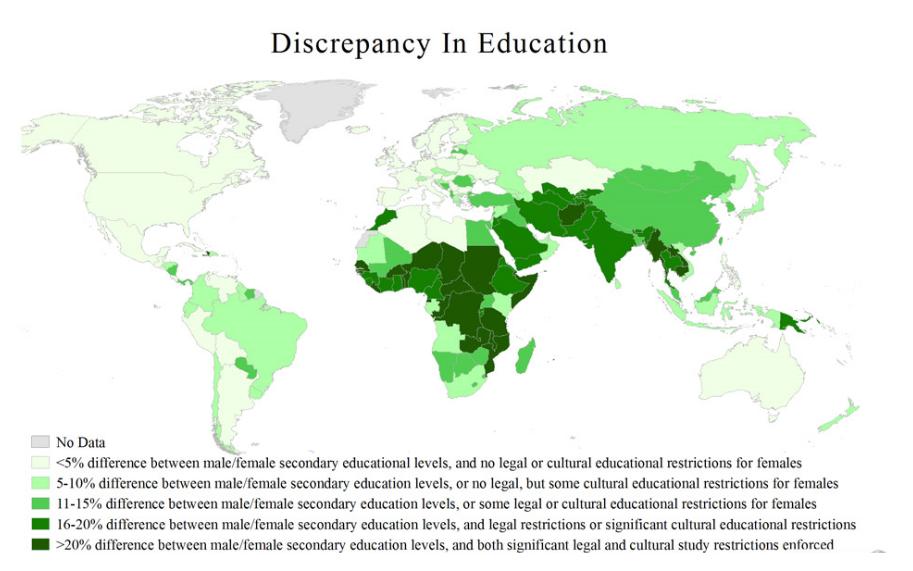
In many parts of the world, however, the quality of a life can still be made or broken by the presence of absence of an X chromosome. According to a study done by Valerie Hudson, in the Middle East, parts of central and southern Africa and parts of southern Asia still see significant gender-based discrepancies in education and legal or cultural restrictions which propagate them:

(source: http://www.foreignpolicy.com/articles/2012/04/24/the_worst_places_to_be_a_woman#0)


The education of women is not important solely on the principle of equality (though that is ample enough reason), as it has been shown that the effect of an educated female population has a ripple effect throughout the communities in which they live. Mothers have smaller, healthier families, are able to make better economic and personal choices. Such is the effect of the simple implantation of education that closing the gender gap in education was one of the Millennium Development Goals established by the UNFPA.

In a global community which is facing health and population crisis, it seems that empowering the central figure within families – still, centrally, the women – would not only greatly improve individual qualities of life but aid in the alleviation of larger issues. One only has to realize the untapped potential of the educated woman. In terms of sexual health, enforced usage of condoms would slow the HIV/AIDS epidemic. Economically, women could learn to support themselves and their families through simple trade. Family planning, a higher-skilled workforce, a population able to make discerning political choices – it is fair to say that by changing the status of women worldwide, the state of the world itself would alter dramatically.

Defoe’s essay does not entirely fulfil his ideological potential; while starting promisingly enough, it falls short in that it nonetheless concludes by relegating women to the household sphere and as less important than men. However, it would indeed be heartening if we, as an international community, could prove to Mr. Defoe that we have taken a step further and realized not only the moral importance of educating women, but the obvious benefits. Thus we would accurately be able to claim we have advanced somewhat since the sixteenth century.


By Farahnaz Mohammed